Federal Lawyer Annual Indian Law Edition 2019

Here:

Tribes and Cannabis: Reaching New Highs in the Burgeoning Cannabis Marketplace
U.S. Sales of Legal cannabis reached $9.2 billion in 2017 – a 33 percent increase over 2016 – and are on track to reach $24.5 billion by 2021. 

Features

Pipleline to Tribal Soveignty: Celebrating the Pre-Law Summer Institute’s 50th Class
If you ask Native American attorneys how they prepared for law school, chances are they’ll tell you they attended the American Indian Law Center Inc.’s Pre-Law Summer Institute (PLSI).
The Violence Against Women Act of 2018: A Step in the Right Direction for Indian Children and Federal Indian Law
It is well-settled law that if a person who violates the laws of the United States is a resident of another country, that person falls within the criminal jurisdiction of the United States. Similarly, if a person crosses state lines and commits child abuse in another state, he or she falls under the jurisdiction of the state where the crime was committed.
Rethinking Administrative Advocacy: A Step-by-Step Approach from Former Government Insiders
In today’s political climate, with frequent changes in leadership positions and new policy agendas, there has never been a better time to develop or brush up your administration advocacy skills to better achieve success for your client.

UPDATE — Suquamish is the first tribe with a compact with a state… here.

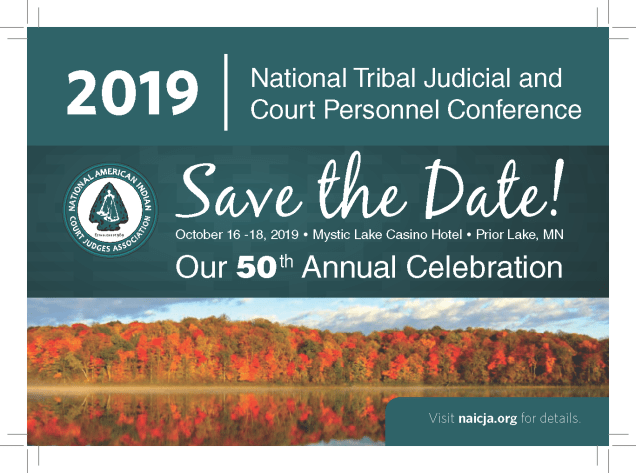
2019 National Tribal Judicial and Court Personnel Conference

2019 NAICJA Save the Date Conference Postcard_Page_1

The National American Indian Court Judges Association (NAICJA) invites presentation proposals for the 50th Annual National Tribal Judicial and Court Personnel Conference which will be held October 16-18, 2019, at Mystic Lake Casino Hotel in Prior, MN. Click here for the request for presentation proposals.


Hopi Tribe Effort to Stop Shutdown of Navajo Generating Station Fails

Here are the materials in Hopi Tribe v. Central Arizona Water Conservation District (D. Ariz.):

1 Complaint

22 Motion to Dismiss

23 Motion for Judicial Notice

36 Gila River Indian Tribe MTD

40 Hopi Response to 23

41 Hope Response to 22

46 Reply in Support of 22

46 Reply in Support of 23

47 Gila River Reply in Support of 36

49 DCT Order

National Indian Law Library Bulletin (4/3/2019)

Here:

The National Indian Law Library added new content to the Indian Law Bulletins on 4/3/19.

U.S. Supreme Court Bulletin 
http://www.narf.org/nill/bulletins/sct/2018-2019update.html
Petitions for certiorari were filed in these cases: 
Buchwald Capital Advisors LLC v. Sault Ste. Marie Tribe of Chippewa (Bankruptcy; Tribal Sovereign Immunity) 
Oglala Sioux Tribe, et al. v. Fleming (Indian Child Welfare Act) 

Federal Courts Bulletin
https://www.narf.org/nill/bulletins/federal/2019.html
Chemehuevi Indian Tribe v. Newsom  (Indian Gaming Regulatory Act – Duration Provision)
United States v. Cooley  (Fourth Amendment; Indian Civil Rights Act)
Seminole Tribe of Florida v. Azar  (Indian Self-Determination and Education Assistance Act – Health Services)
LaBatte v. United States (Class Action Settlement Agreement)
Peggy Fontenot v. Mike Hunter  (Oklahoma’s American Indian Arts and Crafts Sales Act)
City of Council Bluffs, Iowa v. United States Department of Interior (Gaming – Tribal Service Area)
Gibbs v. Haynes Investments, LLC  (Lending Operations)
United States of America v. State of Washington  (Fishing Rights – Usual and Customary Areas)
Bay Mills Indian Community v. Snyder  (Jurisdiction, Land Title)

Tribal Courts Bulletin
http://www.narf.org/nill/bulletins/tribal/2019.html
John & Jean Letarte v. Mashantucket Pequot Gaming Enterprise  (Personal Injuries; Negligence) 
Wilding v. Mashantucket Pequot Gaming Enterprise  
(Employment Termination)

Law Review & Bar Journal Bulletin (contact us if you need help finding a copy of an article) 
https://www.narf.org/nill/bulletins/lawreviews/2019.html

  • Alaska Native perspectives on the Alaska constitution. 
  • Banishment of non-Natives by Alaska Native tribes: A response to alcoholism and drug addiction. 
  • Traditional jurisprudence and protection of our society: A jurisgenerative tail. 
  • Trust lands for the Native Hawaiian Nation: Lessons from federal Indian law precedents.
  • Indigenous peoples, the international trend toward legal personhood for nature, and the United States.
  • Foundations of Sand: Justice Thomas’s critique of the Indian Plenary Power Doctrine.
  • Agua Caliente Band of Cahuilla Indians v. Coachella Valley Water District: A tribe’s successful fight for federally reserved water rights.
  • Extending tribal criminal jurisdiction outside of Indian Country: Kelsey v. Pope. 
  • “Dramatically altered the legal landscape?” City of Sherrill v. Oneida Indian Nation in the lower courts.
  • A watershed moment in the education of American Indians: A judicial strategy to mandate the state of New Mexico to meet the unique cultural and linguistic needs of American Indians in New Mexico public schools.
  • Democratizing treaty fishing rights: Denying fossil-fuel exports in the Pacific Northwest.
  • Roe on the Rez: The case for expanding abortion access on tribal land. 
  • Tribal lending under CFPB enforcement: Tribal sovereign immunity and the “true lender” distinction.
  • Na Mo’o O Ko’olau: The water guardians of Ko’olau weaving and welding collective memory in the war for East Maui water. 
  • The wild west re-lived: Oil pipelines threaten Native American tribal lands. 
  • A presidential power of monumental proportions: Does the Antiquities Act permit the review and revision of national monuments or can the president steal your land? 

News Bulletin
https://www.narf.org/nill/bulletins/news/currentnews.html
In the Health and Welfare section, we feature articles about a new book and current legal action relating to adoption and the Indian Child Welfare Act.

U.S. Legislation Bulletin 
https://www.narf.org/nill/bulletins/legislation/116_uslegislation.html
The following bills were added: 

  • H.R.1937: To amend the Native American Business Development, Trade Promotion, and Tourism Act of 2000, the Buy Indian Act, and the Native American Programs Act of 1974 to provide industry and economic development opportunities to Indian communities. 
  • H.R.2017: To amend the Internal Revenue Code of 1986 to make permanent the Indian employment credit. 
  • S.954: A bill to provide grants to State, local, territorial, and Tribal law enforcement agencies to purchase chemical screening devices and train personnel to use chemical screening devices in order to enhance law enforcement efficiency and protect law enforcement officers. 
  • H.Res.278: Expressing the sense of the House of Representatives to recognize the crisis of violence against Native women. 
  • H.R.1964: To provide for the recognition of the Lumbee Tribe of North Carolina, and for other purposes. 

Regulatory Bulletin
http://www.narf.org/nill/bulletins/regulatory/2019.html
A notice of the Bureau of Indian Affairs, under the HEARTH Act, announces approval of a tribal ordinance authorizing the Fond du Lac Band to enter into leases for agricultural, residential, business, wind and solar, wind energy evaluation, and other authorized purposes without further BIA approval.

New Article on the Fight to Defend ICWA in The Washington Post Magazine

Although ICWA’s opponents argue that the law is harmful to Native children, not following ICWA harms both Native children and tribal communities. When state courts follow ICWA from the outset of a child welfare case, the outcomes of the case are vastly improved. Most of the ICWA cases that reach appellate courts involve cases where state agencies and courts failed to apply ICWA at the outset of the case. Simply stated, ICWA works when state agencies and courts properly apply the law.

For more, please read the article here.

Native American Pipeline to Law Workshop at UC Berkeley: Still Accepting Applications

Pipeline

This is a great opportunity for students to learn about law school, admissions criteria, LSAT prep, and more. Registration is free, food and lodging is provided, and a limited number of LSAT Prep courses will be available for participating students. It does not matter which school the student wishes to attend: these sessions are geared to help all students.

Date: June 26-30, 2019
Location: UC Berkeley School of Law
Boalt Hall, 225 Bancroft Way, Berkeley, CA 94720 (map)
For more information, visit: law.asu.edu/pipelinetolaw
Deadline: May 1, 2019
Questions? Contact Kate Rosier at 480-965-6204

Current law students who completed one of the Pipeline to Law Workshops highly encourage others to register and participate. Read their stories.

Oglala Sioux Tribe v. Fleming Cert Petition

Here:

cert petition

Questions presented:

1. Whether the Eighth Circuit erred in holding, in conflict with decisions of this Court and three other courts of appeals, that the possibility of filing a separate mandamus action was in and of itself “sufficient” to provide an “adequate opportunity” requiring Younger abstention, where plaintiffs had no opportunity to challenge the constitutionality of the preliminary hearing procedure in the course of the state’s abuse and neglect proceedings?
2. Whether the court of appeals erred in holding, in conflict with three courts of appeals, that the “extraordinary circumstances” exception to Younger abstention applies only to flagrantly and patently unconstitutional statutes, but not to flagrantly and patently unconstitutional policies, and in concluding that separating children from their parents for sixty days with no notice or opportunity to be heard inflicted no irreparable harm?

Lower court materials here.

New Mexico Pueblos Prevail in Revenue Sharing Dispute with State [Free Play]

Here are the materials in Pueblo of Isleta v. Lujan Grisham (D.N.M.):

55 State MSJ

58 Pueblo Response

62 State Reply

67-1 Santa Ana Pueblo et al MSJ

68 Isleta Pueblo et al MSJ

71 State Response to 68

72 State Response to 67

74 Isleta Reply

81 State Motion for Discovery

84 Pueblos Motion for Protective Order

88 State Response to 84

91 Pueblos Reply in Support of 84

125 DCT Order

Complaint here.

Narragansett NHPA Consultation Suit

Here is the complaint Narragansett Indian Tribe v. Federal Highway Administration (D.R.I.):

1-complaint-2.pdf

An excerpt:

The Tribe brings this action to challenge the termination of a programmatic agreement(“PA”) entered into pursuant to the regulations of the National Historic Preservation Act (“NHPA”). The termination of the PA occurred after substantial construction had taken place on the project for which the PA was meant to address and resolve the adverse effects of the project on historic properties to the signatories’ satisfaction. The termination of the PA after substantial work had been performed on the project, and the subsequent final decision of the Federal Highway Association (“FHWA”) was arbitrary and capricious.

Tribal Amicus Brief in Texas v. United States [ACA Appeal in Fifth Circuit]

Here:

texas-tribal-amicus-final-4-1-19-as-filed-1.pdf

4-1-2019-letter-to-doj-re-texas-v-us-and-ihcia-impacts-final.pdf