Guest Post: Bill Rastetter on Judge Enslen

From long-time Grand Traverse Band counsel Bill Rastetter on the passing of Judge Enslen:

Writing this helps me to reflect upon not just Richard Enslen but also the two other Western District judges appointed by Jimmy Carter — all of whom made major rulings for Grand Traverse Band.  (There’s a story there, if I ever could find the time; I’d start the story by talking with Dean Robb who was in the group of lawyers picked by the two Democratic Senators who came up with a list of possible nominees, including “progressives” who never would be considered in the present climate.)  Those three were Richard Enslen, Douglas Hillman, and Benjamin Gibson.  In retrospect, each individual evidenced concern for the plight of the less advantaged, the powerless within our society; and GTB’s victories might not have occurred if they had not been on the bench.

Gibson left Michigan long before retirement age, but not before he granted GTB its first victory in the modern (restored) era: Leelanau Indians, Inc. and Grand Traverse Band of Ottawa and Chippewa Indians v. U.S. Department of Housing and Urban Development (W.D. Mich. File No. G 80-526): 502 F.Supp. 741 (W.D. Mich. 1980).

Hillman?  Well, there’s the major case [Grand Traverse Band of Ottawa and Chippewa Indians v. U.S. Attorney for the Western District of Michigan, et al. (W.D. Mich. File No. 1:96-CV-466): 198 F.Supp.2d 920 (W.D. Mich. 2002), and 46 F.Supp.2d 689 (W.D. Mich. 1999), aff’d. 369 F.3d 960 (6th Cir. 2004)] which easily could have been resolved differently if another judge had been assigned that case.*

And Enslen.  Even before the “treaty-fishing” cases, he granted the judgment declaring that GTB controlled the Peshawbestown lands. [Grand Traverse Band of Ottawa and Chippewa Indians v. Leelanau County and Leelanau Indians, Inc. (W.D. Mich. File No. G 83-834)]  Attached is his unpublished opinion; it’s the only time my proposed findings and conclusions have been adopted verbatim (without even being retyped).  And he was assigned the GTB v. BIA case [Grand Traverse Band of Ottawa and Chippewa Indians v. Bureau of Indian Affairs, et al. (W.D. Mich. File No. G 85-382)], by which we (with his help/not so subtle messages to DOJ that he’d grant preliminary injunction for us if …) held them (the Reagan administration DOI political operatives) at bay until Buddy Raphael negotiated the “compromise” membership provisions.  Both the 1985 and 2000 consent decrees were the result of his commitment to ADR (and at various times he forcefully let lawyers for state/”sports” groups know that they really didn’t want to give him a chance to rule for the Tribes); likewise, he allowed the Tribes plenty of maneuvering room leading up to the 2007 “inland” consent decree.  Also his July 15, 1986 opinion/order in which he fashioned a remedy in GTB’s favor when the other COTFMA Tribes (BMIC & SSM) decided they could distribute 1985 CD funds by majority vote (subsequently there have been equal 1/3 and then 1/5 distributions of appropriated funds above each Tribe’s base).  Finally, of course, is GTB’s “access” case now in the textbooks: Grand Traverse Band of Ottawa and Chippewa Indians v. Director, Michigan Department of Natural Resources, et al. (W.D. Mich. File No. 1:94-CV-707): 971 F.Supp. 282 (1995), aff’d. 141 F.3d 635 (6th Cir. 1998), cert. denied 454 U.S. 1124, 102 S.Ct. 971 (1998).

____________________

* Here is an article that appeared later in the New Yorker, written by his niece about his mother.  I was struck by the passage on the last page.  Here was a man who rose to the top of a prestigious G.R. law firm, probably relatively conservative albeit a Democrat in conservative G.R. and (I think) a labor lawyer, but I’m not aware of any indication that he was champion of the downtrodden.  Perhaps his mother instilled a sense of (in)justice, and when the opportunity presented itself he saved the day for the Indian Tribes. [United States v. Bay Mills Indian Community, et al. (W.D. Mich. File No. M 85-335): 692 F. Supp. 777 (W.D. Mich. 1988), vacated 727 F. Supp. 1110 (W.D. Mich. 1989)]  GTB gets no credit for Judge Hillman’s decision not to enjoin the Tribes’ casino gaming, yet it was our separate brief (and affidavits of Buddy Raphael and Barry Burtt) that argued Rule 65 equitable considerations weighed against the injunction requested by DOJ.
Grand Traverse Band Chief Judge Job Posting

Here is the job description.

Here are the posting dates (they most certainly will be extended).

Grand Traverse Band Legal Dept. Job Posting

Tribal Attorney

Serve as a Tribal Attorney responsible for assisting with legal advice and services for the Grand Traverse Band Tribal Council on a wide range of legal issues. This position will be a regular full-time, in-house position, assisting the GTB Legal Staff. Detailed knowledge of Federal Indian Law and Tribal Law preferred. Native American preference will apply. Submit cover letter, resume and references to: Grand Traverse Band of Ottawa & Chippewa Indians, Human Resources, 2605 NW Bay Shore Drive, Suttons Bay, MI 49682 or email: mike.teeple@gtbindians.com

Qualifications: Recent Graduate from an accredited law school or an Attorney with 1-2 years of experience.

Salary:         $55,000 – Recent Graduate

$60,000 – Upon passing the Bar Exam

$65,000 – $70,000 with 1-2 years of experience

Response Deadline:    June 30, 2014

Skull Repatriated to Grand Traverse Band

News coverage:

Indian man’s skull turned over to tribe

Northern Michigan tribe receives Indian man’s skull that Leelanau County family had for years

Indian man’s skull turned over to Michigan tribe

Native American skull returned to tribe more than 100 years later


Washtenaw Legal News on Peacemaking Court

Here.

Michigan Public Radio on Washtenaw County’s Peacemaker Court

Here.

An excerpt:

There appears to be a lot of interest in a new kind of court in Washtenaw County.

More than 80 lawyers, mediators, and probation officers packed Judge Timothy Connors’ courtroom on Friday.

They were there for a six-hour education session on the Native American philosophy that guides the new peacemaking court. 

The program was led by Tribal Council member and former Tribal Judge JoAnne Gasco and Court Peacemaker Paul Raphael from the Grand Traverse Band of Ottowa and Chippewa Indians.

Remains of MIA Michigan Odawa Vietnam War Vet Recovered — John L. Burgess (Born Larry Waukazoo)

Here. More at Leelanau Enterprise (paywall).

IPR Profile on American Indian Treaty Rights in Michigan

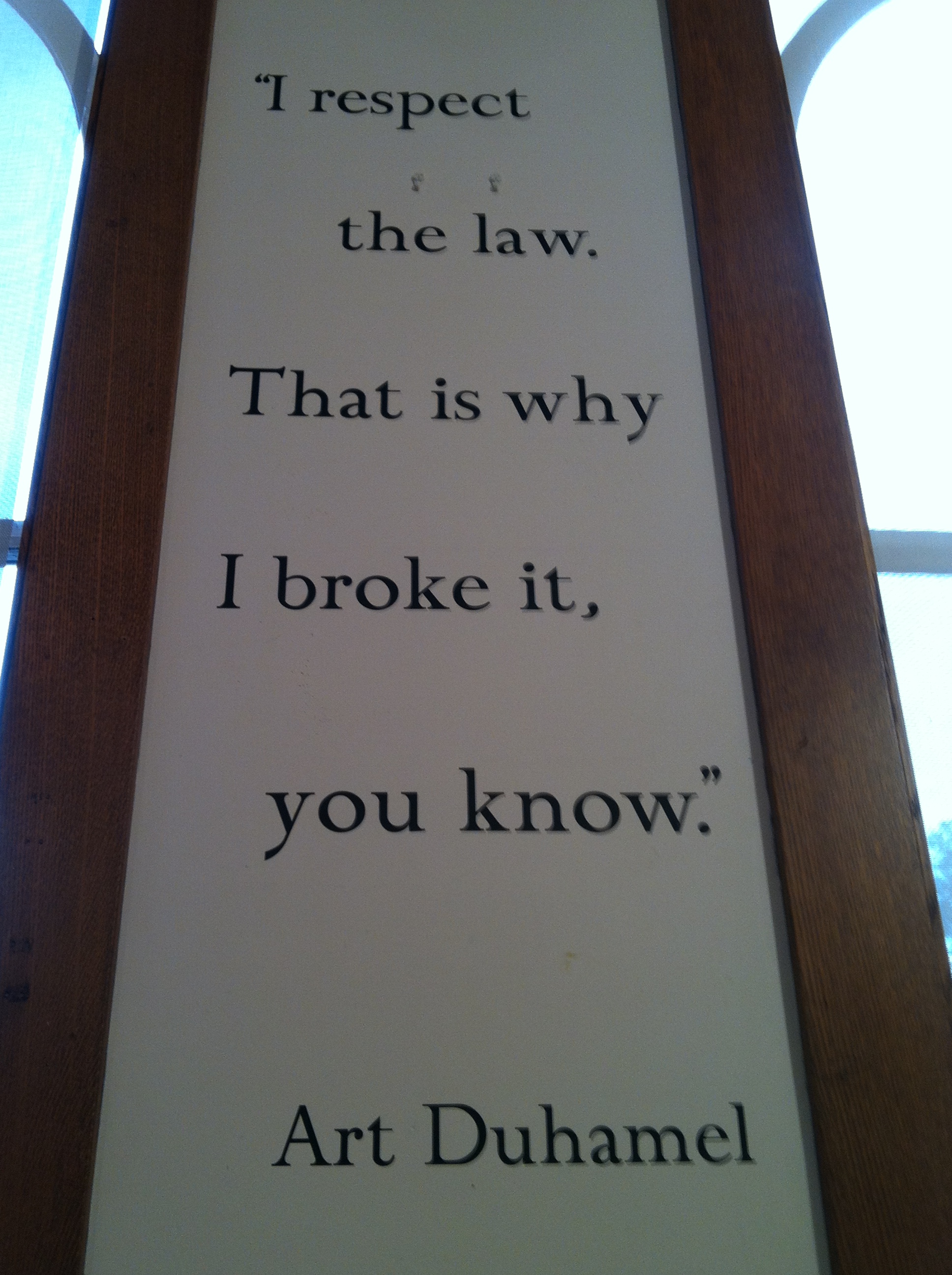
Interlochen Public Radio continues its excellent profiles of northern Michigan history with “Looking Back: The Fight For American Indian Fishing Rights,” profiling Arthur Duhamel.Arthur Duhamel

Here’s my contribution:

The urgency was about more than fish. The federal government had ignored the poverty in Peshawbestown for generations. As Matthew Fletcher puts it, the federal government just stopped returning the tribe’s phone calls in the 1870s.

Fletcher teaches indigenous law at Michigan State University and is a member of the Grand Traverse Band. Fletcher says the tribe needed some way to make the federal government recognize its existence and asserting fishing rights under a treaty signed in 1836 was the way to do that.

“The United States does not sign a treaty with counties or corporations,” says Fletcher. “They sign treaties with nations.”

In Honor of Judge Jim Genia

We’ve been waiting to post on the tragic passing of Judge Jim Genia, a LTBB member who was a judge for both Little Traverse and Grand Traverse bands. Jim walked on a few weeks ago from a long illness — he was only 48 years old. Here is a news profile from the Petoskey News.

Jim was a truly good guy, a great judge, and we will miss him very much. A terrible loss.

More on Fletcher Talk at Traverse City History Center: Legends of the Grand Traverse Region

Here:

Legend’s Grand Opening Announcement:

Don’t miss the exciting Grand Opening of “Legends of the Grand Traverse Region: Community out of Diversity.”  This celebration is on Saturday, Sept. 22nd from 4:00pm to 6:30pm at the History Center of Traverse City.  Attendees will tour the brand new Legends’ Exhibit, listen to the featured speaker, and then socialize at an elegant reception featuring adult beverages and tasty hors d’oeuvres. Admission is free, although good will offerings will be requested and are always appreciated!

The speaker is Matthew L.M. Fletcher, Professor of Law and Director of the Indigenous Law and Policy Center at Michigan State University College of Law, and member of the Grand Traverse Tribe of Ottawa and Chippewa Indians.  He will be speaking on “The Story of the Grand Traverse Band’s Treaty Rights Fight.”

Professor Fletcher’s  talk is designed to complement our fall 2012 Legend’s Exhibit.  It highlights three of the “Legends” of the Traverse area: Art Duhamel of the Grand Traverse Band, well known for his stands regarding native fishing rights and federal recognition of the Grand Traverse Band; The Schaub family and their famous relative, Emelia Schaub, who was the first female prosecutor in Michigan; and Augusta Rosenthal-Thompson, who in 1884 arrived in northern Michigan as the first woman physician to practice in this area.

The Legends’ exhibit will be open through October 25th.  That Thursday this fall’s Legends’ activities will close with an afternoon workshop and evening presentation by Dr. Elizabeth Faue, Professor of American History and the History of Women at Wayne State University. The afternoon workshop is on genealogy and “Lost Mothers.”  The evening talk is entitled: “Barriers and Gateways:  Women, Gender, and the Professions in the United States.”

Don’t miss this opening celebration of the Legends of the Grand Traverse Region. These fall 2012 Legends events are only an introduction to continuing Legends activities.  Over the next several years we will celebrating more Legends: People and families from diverse backgrounds who came together to build the community we live in today. Our next three Legends will be celebrated starting in March of 2013, with more Legends being announced in Fall of 2013, Spring of 2014, and hopefully far into the future.

The History Center of Traverse City thanks the Michigan Humanities Council for its crucial support of the Legends’ project.  We also thank our Legends’ partners: The Grand Traverse Genealogical Society, the Northwest Lower Michigan Women’s History Project, Congregation Beth El, the Hispanic Apostolate of the Diocese of Gaylord, the Traverse City Human Rights Commission, Professor Jim Press of Northwestern Michigan College’s History Department, and Cindy Patek of the Grand Traverse Tribe’s Eyaawing Museum and Cultural Center