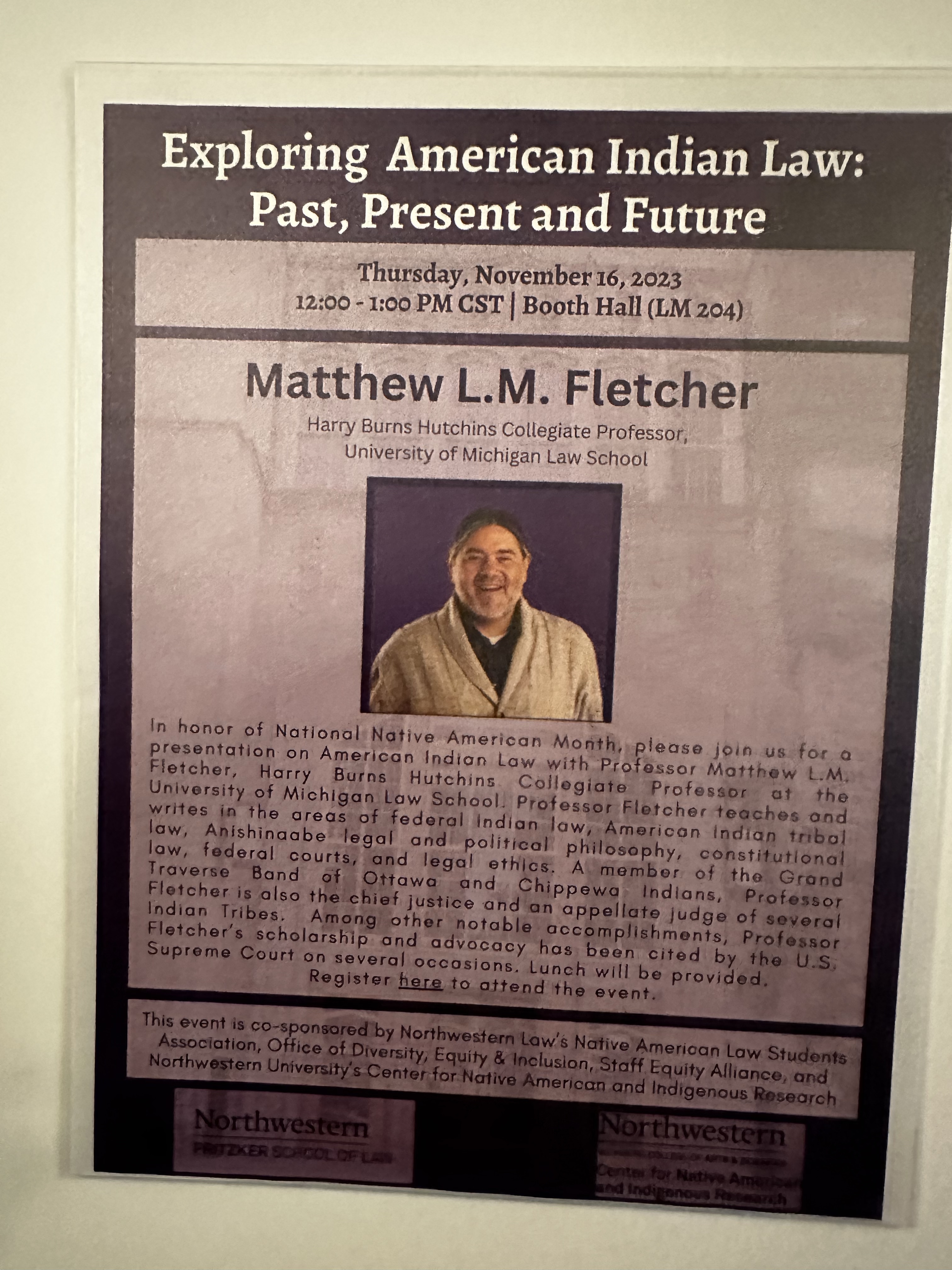
Here:
Reply TK
Lower court materials here.

Here are the materials in Skull Valley Health Care LLC v. NorStar Consultants (D. Utah):

Here are the materials in United States v. Kills Warrior (D.S.D.):
Here is the complaint in Cordova v. Mendocino County Sheriff’s Office (N.D. Cal.):

Nicholas Stamates has posted “The Aftermath of McGirt and Castro-Huerta: Problems and Possible Solutions relating to White Collar Crime in the City of Tulsa,” recently published in the Texas Tech Law Review, on SSRN.
Here is the abstract:
The Supreme Court ruling in McGirt v. Oklahoma drastically changed the legal jurisdiction of most of the state of Oklahoma under federal law. In 2017 the 10th Circuit held in Murphy v. Royal that the Oklahoma Enabling Act of 1906 never disestablished the reservations of the Five Civilized Tribes and the Supreme Court would concur with that opinion in McGirt v. Oklahoma which means that the Major Crimes Act and other federal and tribal laws relating to Indians now apply in Eastern Oklahoma, including the City of Tulsa, and not Oklahoma law in applicable cases. In doing so, the Supreme Court inadvertently created a white-collar crime jurisdictional nightmare but one that has many solutions that enshrine tribal sovereignty and corporate responsibility among Tulsa based businesses. These solutions include state and tribal compacts, congressional legislation and proactive measures by Tulsa corporations such as “McGirt forms” that list Indian status of involved parties under federal law in case of a crime, choice of law provisions in contracts for civil suits in Tribal Courts so that corporations know what to expect and can shape the outcome of a case and working with local law schools so that new hires are prepared for the post McGirt and Castro-Huerta landscape.
Kevin Washburn has posted “The March of Co-Management — The Biden-Harris Administration’s Expanding Work with Tribes” on SSRN.
Here is the abstract:
In response to a request from the Foundation of Natural Resources and Environmental Law for a description of the Biden-Harris Administration’s efforts to increase the role of tribal communities in federal land management, this essay provides a variety of ways that the Biden-Harris Administration has worked to provide a stronger relationship between the federal government and tribal governments. These efforts include historic appointments of Native Americans to significant positions, especially in the areas governing natural resources in the federal government. It also includes better processes for incorporating traditional ecological knowledge into decision making, enhancing efforts at tribal consultation, and dramatically increased appropriations for tribal governments. The essay also explains how tribes fit within broader administration priorities, such as the American the Beautiful initiative to conserve 30 percent of American land by 2030, and the Justice 40 initiative, providing 40 percent of federally-appropriated funds invested in support of the clean energy transition to communities burdened by traditional energy infrastructure.
You must be logged in to post a comment.