Here is yesterday’s order list.
The Oklahoma case was Oklahoma v. Wadkins. Lower court materials here.
The Court also denied cert in the Clarkson case.
Here is yesterday’s order list.
The Oklahoma case was Oklahoma v. Wadkins. Lower court materials here.
The Court also denied cert in the Clarkson case.
Here:
Question presented:
Whether the Ninth Circuit’s mootness ruling warrants summary reversal where the panel clearly misapprehended governing law on mootness and on the authority of federal courts to order equitable relief affecting nonparties.
Lower court materials here.
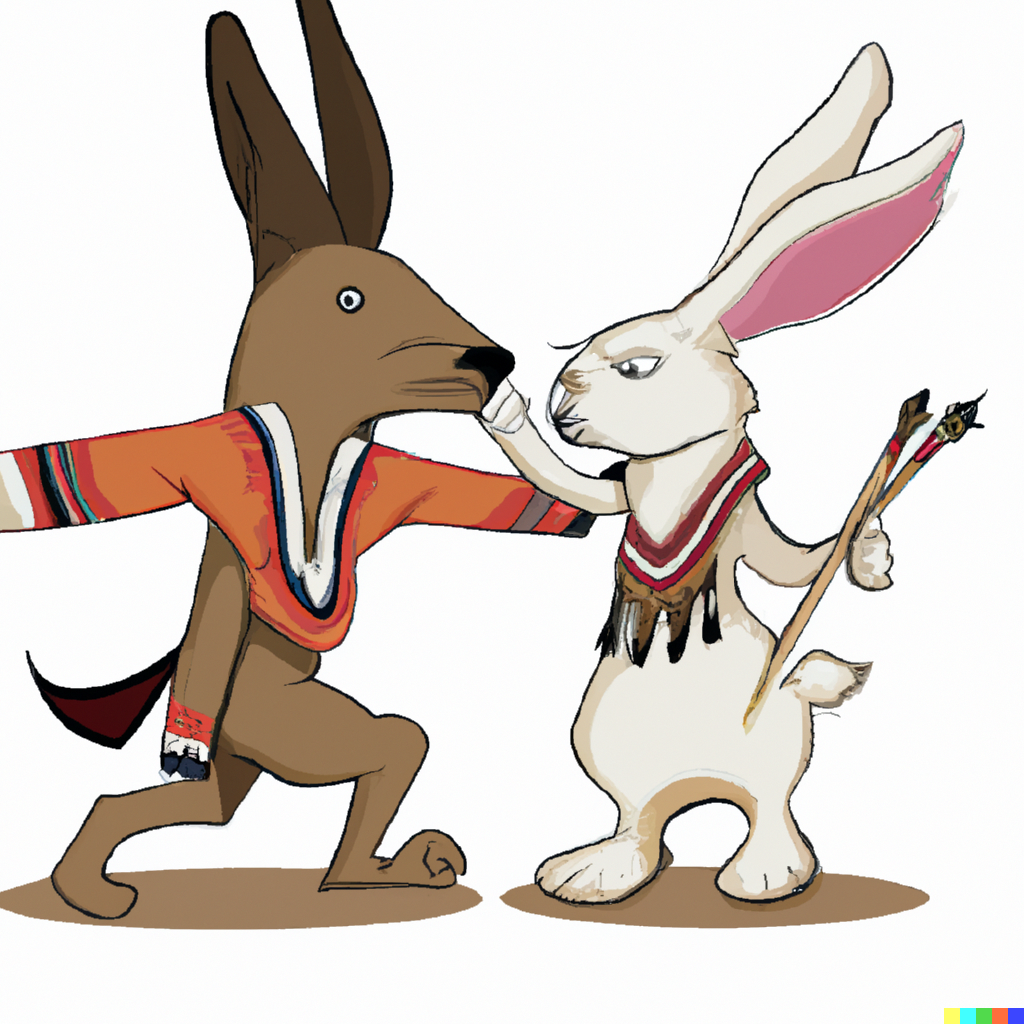
Tamera Begay and Matthew Fletcher have posted “Ma’ii and Nanaboozhoo Fistfight in Heaven,” forthcoming in the Southwestern Law Review, on SSRN. Here is the abstract (more of a blurb, really):
The Navajo trickster Ma’ii and the Anishinaabe trickster Nanaboozhoo debate the future of tribal economic development [ostensibly reviewing Ezra Rosser’s new book].
Dylan Hedden-Nicely has posted “The Reports of My Death Are Greatly Exaggerated: The Continued Vitality of Worcester v. Georgia,” forthcoming in the Southwestern Law Review, on SSRN.
Here is the abstract:
Rumors abound among the academy, practitioners, and the judiciary about the death of Worcester v. Georgia since the Court’s recent decision in Oklahoma v. Castro-Huerta. The misunderstanding is compounded by those that fail to take the time necessary to appreciate the rich nuance of Chief Justice John Marshall’s decision or in the subtle ways the Court has since modified its holding from Worcester. However, the importance of this case, which is integral to our entire system of federal Indian law, to major components of our constitutional system, as well as to our claim to leader in the human rights arena, mandates we proceed with caution and demand precision in its treatment. We cannot presume the abrogation of such a significant case based on veiled rhetoric that stitches together dicta built upon dicta. Instead, we should proceed by acknowledging the broad scope of Worcester’s original holding and carefully examining where and how the Supreme Court has since circumscribed its breadth.
In furtherance of that call, this paper focusses on the Court’s Indian law jurisprudence around the middle of the twentieth century to provide a clearer picture of how the Court has treated Worcester in the modern era and the ways in which it has been limited. That analysis leads to the inescapable conclusion that although the Court has abandoned Worcester’s categorical prohibition on state jurisdiction in Indian country, “the broad principles of that decision came to be accepted as law.” Accordingly, until such time as the Court “openly avow[s]” its intent to overrule Worcester, we must remain faithful to its narrow authorization of state power in Indian country, as well as its broad recognition of tribal sovereignty and federal primacy over the relationship with tribal nations.
Here.

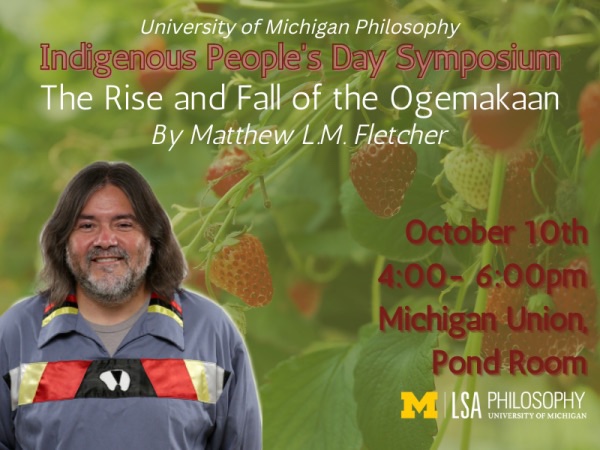
UM law asked me to write something for an internal newsletter, so I did. Hope you like it.
Indigenous Peoples’ Day, a holiday I celebrate instead of Columbus Day (both are federal holidays), offers an opportunity to reflect on legal education, professionalism, and the future of American Indian law.
I grew up in a mixed Anishinaabe family where Christopher Columbus was considered no hero. Learning about Columbus as the discoverer of America in Kentwood and Wayland public schools in southwest Michigan was confusing to me. Michigan was a long way from the Caribbean. I never understood how someone who never set foot in what is now the United States could be called its “discoverer.” My parents, Richard and June, taught me that Columbus was an incompetent adventurer who got lost on his way to India and that he died destitute and a failure.
As a U-M student in 1992, the 500th year anniversary of Columbus’ first voyage, I learned more about this man. Notably, I learned his name was not Columbus. He was known as Cristoforo Columbo when he lived in Italy and then Cristóbal Colón when he lived in Spain. Changing his name in the public arena to Columbus, a more English-sounding name, was apparently a prerequisite to building broad support for celebrations of American patriotism that culminated in the establishment of a national holiday in 1971. I also learned Columbus was a slaver and a murderer, which by that moment in my education was unsurprising to me. (U-M history professor Greg Dowd’s recent op-ed on this subject is required reading. It always surprised me that so many people I knew didn’t seem to care—or believe—Columbus was no hero.)
In law school, my introduction to American Indian law started with the Doctrine of Discovery. So instead of my being able to leave Columbus the discoverer behind, his nasty ghost crept into my property class. The discovery doctrine is a legal fiction presuming that Indigenous people did not possess full ownership of their lands at the time of contact with European nations because Indigenous people were subhuman. This doctrine made as much sense as claiming that Columbus discovered America. What’s worse (and makes even less sense) about the narrative of the discovery doctrine is that it forms the basis of all American property titles. So not true.
I wrote about my initial impressions of the discovery doctrine in my first law review article, “Listen.” Moreover, the discovery doctrine didn’t harmonize with what I would come to know about why Anishinaabe people lost their lands. My ancestors didn’t lose their land because of some far-off discoverer; they lost the land because of pure political and economic power. Law didn’t matter much at all. I wrote about this in a narrative law review article, “Stick Houses in Peshawbestown.”
I practiced law for nearly seven years before I became a law teacher, working in-house for tribal governments. I used to get teased as the “baby attorney” by the other lawyers. And sometimes I got teased for being the Native lawyer who never took a class in Indian law. I found out quickly that my training in general law courses like contracts, tax, secured transactions, and legal writing mattered more than my knowledge (or lack thereof) in Indian law. There was a part of me that wanted to be a sovereignty warrior who pounded on the tables in Congress and the Supreme Court, but what my clients needed more than that was practical advice on how to develop legal infrastructure and negotiate business deals.
What I was most surprised by as a practicing attorney were the fictions perpetuated by lawyers and judges. The courts often wrote about my clients (tribal governments) as if they were foreign, exotic, unknowable, and dangerous. Reading these opinions was surreal, given that they described a universe that didn’t exist in my experience. My friends on the other side of the negotiating table or the courtroom representing non-Indian business interests and individuals took the language of the courts and weaponized it against my client, often at the expense of their own clients’ interests. I recently wrote about these experiences in a paper that will be published in the Michigan Bar Journal this fall, “Reflections on Professionalism in Tribal Jurisdictions.”
When I started college in 1990, there were only seven federally recognized tribes in Michigan. Now there are 12.
In 1990, most Michigan tribes had nascent governments and tiny economies. Now, Michigan tribes are hugely influential in state and national government and tend to be their regions’ largest employers.
Also, over those years, fewer and fewer people ask me about Columbus. Despite the name being all over the place, Columbus the man is fading into history— justifiably so. Defenders of Columbus Day mostly focus on the day as a holiday celebrating Italian history and culture. President Biden’s 2021 parallel declarations announcing two federal holidays, Indigenous Peoples’ Day and Columbus Day, appear to be a reflection of the best of both things.
I have been a law teacher for 18 years now. I take my experiences learning about Columbus and managing his legacy into account in my teaching. I want law students to know that in my Indian law classes, they are going to learn a different history—one derived from the lived experiences of Indigenous peoples. Some of that history will conflict with what they have been taught.
But not all of it. History, like law, is a construct. Lawyers take the evidence and put together a persuasive narrative to effectuate their clients’ needs. So I also want the students to realize that good lawyers must be willing to acknowledge that the principles they take for granted can be disrupted. Indian law can be very, very disruptive—in both good and bad ways. I wrote about this, too. Our students are acquiring the training they need to assist their clients in navigating those disrupted waterways. Hopefully better than Columbus did.
Here are the new materials in Red Lake Band of Chippewa Indians v. United States Army Corps of Engineers (D.D.C.):
52 Friends of the Headwaters MSJ
53-1 Tribes and Tribal Orgs MSJ
Prior post here.
The Notorious Acknowledgement. It is B.I.G.
The entire debate over Columbus Day and Indigenous Peoples Day is less about who discovered America, and more about America discovering oneself.
His story of the United States of America:
Manifest Destiny is a projection of guilt. The crux of having a superiority complex is that the only thing manifesting is self-sabotaged fate. Denial of guilt is a short term fix that leads to long term problems. Self consumption ensues as the guilt feeds displaced aggression in attempts to hide the grief.
The self-infliction started when historical tokens, past figures, and significant events were chosen worthy and highlighted in history to be the medium of collective conception boasting how the United States of America (America) achieved self proclaimed superiority. When there isn’t anything deemed worthy enough to highlight, those things were created.
This version of history is always partnered with a downplayed acknowledgement that his-story is even slightly interpreted to his chosen advantage; having been the one who provided the interpretation.
This self-righteous story of the past leading to the present ignores its bias and is given as a natural order of occurrences, events, and historical figures that established a pure, balanced, and finessed present state.
Albeit, self-esteem development takes many forms; and they aren’t always positive.
Doctrine of Discovery as self-serving consumption:
Christopher Colulmbus’ Life Matters™
That is, it matters to the extent of American fragility. Discussing Native American plights and ill conceived Western annexation is not being stuck in the past or trying to erase history. It is the exact opposite. Erroneous history is not erased, rather it is rendered obsolete.
The apathetic annoyance that America displays while being challenged to uphold its liability is a problem. Accepting accountability is always hard when the defendant refuses to understand the impact of their crime on the plaintiff.
Columbus Day is more than a catalyst for the world’s modern experience of Western luxury. It is also certainly more than a debate about cultural superiority or Columbus simply being a man of his times.
Rather, the attempt to uphold those ideals symbolically through Columbus Day reflects the deep conflicting truth that America’s prerogative is narcissistic, arbitrary, and heinous towards the collective Native American psyche.
The challenges & problems that the United States of America is facing are:
Native Americans are the original problem. America’s psyche is struggling to conceive of such tenacity. Somewhere in America’s not so distant past, and hidden in plain sight, is an aggressive experience that transcends the present. The collective amnesia and dismissal that America projects towards the reality of the disenfranchised indigenous experience is haunting and debilitating towards America’s ability to mature.
Being the original problem, America’s relationship with their indigenous other is firmly rooted in the collective shadow. Straddling the line between being Native and being American, which is an external and internal struggle for both Americans and Natives, is one of the original uncomfortable dichotomies of this land. The whole thing is a paradox.
The impact of that is:
Naturally, because this relationship exists so deep in America’s collective shadow, the state of this relationship reflects the overall health of America as a whole. Notwithstanding the collective health of indigenous communities.
That’s not meant to downplay the collective indigenous plight, rather it should illuminate the indigenous plight for its deep impact on America’s collective maturity and vitality. Therefore an upplay.
America is contending with the reality that traumas hidden in the shadow control what is exposed in the light. The health of America’s relationship with cultural and ethnic plurality is contingent on its health with the collective indigenous psyche.
So, how do we….
Make peace with this embarrassing and traumatic experience that exists in America’s collective shadow? How does America release its original sin back to the devil so that healing and growth can begin for all Americans?
Our approach to solving the problem is:
Shine light onto the indigenous experiences hidden in the collective American shadow, and receive the love and guidance that comes glimmering back.
Acknowledge that the conception of Christopher Columbus and his voyage as a pillar of advanced humanity is a paradox.
Celebrating Columbus Day is the embodiment of celebrating the sweet taste of that first apple in the Garden of Eden.
Celebrating Columbus day renews and upholds a God complex that pigeonholed Native Americans as inferior and sabotages their access to life, liberty, and their pursuit of happiness to this day.
Let go of collective perceptions about the relationship between Native Americans and Western Culture. Support a platform for authentic indigenous experiences to be heralded and followed for what they are; original ways.
The original way:
To be original is not synonymous with antiquity or nostalgia. Being original is a concept that embraces creation’s conception of life prior to the corruption of man.
Everything in Native American Culture(s) has a meaning and purpose that upholds order and authority for life. Native American Culture(s) is the source of health and happiness for Native American families, communities, and their subsequent nations.
This will not be at risk for the sake of American pride or an excuse for a paid day off of work. Native American Culture won’t be at risk to accommodate the arbitrary legacy of American heroes and their unworthy holidays. Alas, it most certainly won’t be risked because America needs a fabricated legacy at the expense of the malicious destitution that Native Americans have endured.
 Turtle Talk
You must be logged in to post a comment.