Wednesday, I was delighted to attend a reception for Joy Harjo (who read later on before a bigger audience).

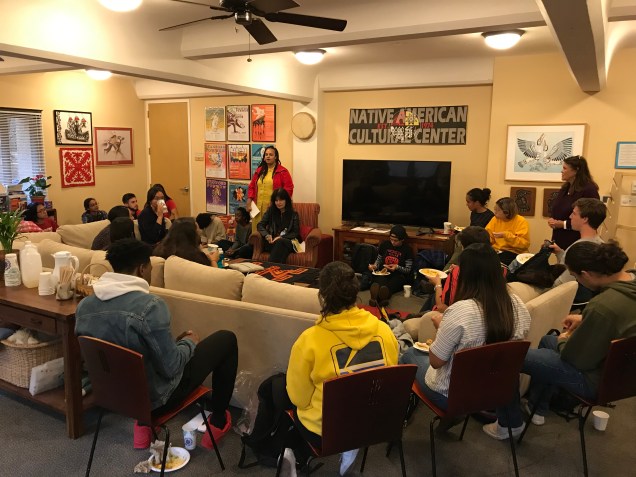


Wednesday, I was delighted to attend a reception for Joy Harjo (who read later on before a bigger audience).
Here:
The National Indian Law Library added new content to the Indian Law Bulletins on 5/14/19.
Federal Courts Bulletin
https://www.narf.org/nill/bulletins/federal/2019.html
Diné Citizens Against Ruining Our Environment v. Bernhardt (Hydraulic Fracking; Environmental Assessments)
Standing Rock Sioux Tribe and Cheyenne River Sioux Tribe v. U.S. Army Corps of Engineers and Dakota Access, LLC (Oil & Gas Pipelines; Documents for Administrative Record)
State Courts Bulletin
https://www.narf.org/nill/bulletins/state/2019.html
The People of the State of Colorado, In the Interest of Z.C., a Child, and Concerning S.C. (Indian Child Welfare Act – Notice)
State of Minnesota v. Randy Lee Thompson (Arrest; Expulsion)
Tribal Courts Bulletin
http://www.narf.org/nill/bulletins/tribal/2019.html
Swinomish Tribal Community v. Peters (Domestic Violence)
Swinomish Tribal Community v. McCleod (Juries)
Law Review & Bar Journal Bulletin (contact us if you need help finding a copy of an article)
https://www.narf.org/nill/bulletins/lawreviews/2019.html
News Bulletin
https://www.narf.org/nill/bulletins/news/currentnews.html
In the Tribal Jurisdiction section, we feature an article about a Maine bill aiming to restore tribal sovereignty in certain crimes committed by non-Natives.
Regulatory Bulletin
http://www.narf.org/nill/bulletins/regulatory/2019.html
We feature notice of the Department of Health & Human Services, Administration for Children and Families, regarding tribal consultation meetings for tribal governments operating Head Start.
Legislation Bulletin
https://www.narf.org/nill/bulletins/legislation/116_uslegislation.html
Here is the order in Bruner v. Muscogee (Creek) Nation.
Gregory Ablavsky has published “Empire States: The Coming of Dual Federalism” in the Yale Law Journal (PDF).
Here is the abstract:
This Article offers an alternate account of federalism’s late eighteenth-century origins. In place of scholarly and doctrinal accounts that portray federalism as a repudiation of models of unitary sovereignty, it emphasizes the federalist ideology of dual sovereignty as a form of centralization—a shift from a world of diffuse sovereignty to one where authority was increasingly imagined as concentrated in the hands of only two legitimate sovereigns.
In making this claim, the Article focuses on two sequential late eighteenth-century transformations. The first concerned sovereignty. Pre-Revolutionary ideas about sovereignty reflected early modern corporatist understandings of authority as well as imperial realities of uneven jurisdiction. But the Revolution elevated a new understanding of sovereignty in which power derived from the consent of a uniform people. This conception empowered state legislatures, which, throughout the 1780s, sought to use their status under new state constitutions as the sole repositories of popular authority to subordinate competing claims to authority made by corporations, local institutions, Native nations, and separatist movements.
The second shift came with the drafting and ratification of the U.S. Constitution, which bolstered federal authority partly in order to protect state authority against internal competitors—an aim reflected in the Guarantee and New State Clauses. Ultimately, the Constitution both limited and enhanced state authority; it entrenched a framework of dual sovereignty. After ratification, competitors to state sovereignty were increasingly constrained to appeal to some federal right or power. What had previously been contests among supposedly coequal sovereigns—what modern scholars would call horizontal federalism—became questions of vertical federalism, issues of whether federal authority would vindicate states or their opponents.
Although the Article concludes with some implications of this history for present-day federalism doctrine and theory, its primary contribution is descriptive. Judges and lawyers routinely and almost unthinkingly invoke localism and power diffusion as the historical values of federalism. Yet the history explored here challenges whether these near-universal assumptions about federalism’s aims actually reflect what federalism was designed to accomplish.
Here is the opinion in State v. Thompson.
The court’s syllabus:
If a tribal police officer suspects a person who is not an Indian of violating a Minnesota criminal statute on an Indian reservation, and if the victim is not an Indian or there is no victim, the tribal police officer lawfully may detain the person and deliver him or her to state law-enforcement authorities for further investigation and prosecution.
Here.
Maggie Blackhawk has published “Federal Indian Law as Paradigm Within Public Law” in the Harvard Law Review (PDF).
Here is an excerpt from the abstract:
U.S. public law has long taken slavery and Jim Crow segregation as a paradigm case through which to understand our constitutional law: cases adjudicating issues of slavery and segregation form the keystones of our constitutional canon. Reconstruction, or the so-called “Second Founding,” and the Civil Rights Era periodize our constitutional histories. Slavery and Jim Crow segregation supply normative lessons about the strengths and failings of our constitutional framework. This paradigm teaches that if there is too much power in the states and not enough limitation on state power in the form of national power or rights, America might again reenact similar atrocities. Although there is much to learn from the United States’ tragic history with slavery and Jim Crow segregation, resting our public law on this binary paradigm has led to incomplete models and theories. This Nation’s tragic history of colonialism and violent dispossession of Native lands, resources, culture, and even children offers different, yet equally important, lessons about our constitutional framework.
In this Article, I argue for a more inclusive paradigm that reaches beyond the black/white binary, and I highlight the centrality of federal Indian law and this Nation’s tragic history with colonialism to public law. Currently, to the extent that federal Indian law is discussed at all within public law, it is generally considered sui generis and consigned to a “tiny backwater.” While I concede that the colonial status of Native peoples and the recognition of inherent tribal sovereignty do render aspects of federal Indian law exceptional, federal Indian law and Native history have much to teach about reimagining the constitutional history of the United States. Interactions between the national government and Native Nations have shaped the warp and woof of our constitutional law from the Founding across a range of substantive areas, including vertical and horizontal separation of powers, the Treaty Clause, war powers, executive powers in times of exigency, and many others. I aim to open a conversation as to whether these doctrines ought to take their rightful place in the canon or, perhaps, the anticanon.
Here is the order in Standing Rock Sioux Tribe v. United States Army Corps of Engineers (D.D.C.):
 Turtle Talk
You must be logged in to post a comment.