| The National Indian Law Library added new content to the Indian Law Bulletins on 2/18/16.
U.S. Supreme Court Bulletin U.S. Federal Trial Courts Bulletin News Bulletin Law Review & Bar Journal Bulletin |
Author: Matthew L.M. Fletcher
NABA-AZ Annual Golf Tourney

Nez Perce Tribe Seeks Chief Judge
Nez Perce Tribe seeks applicants for CHIEF JUDGE HR-15-122. This 4-yr. contract position requires a wide range of legal and administrative skills, handling all phases of civil and criminal litigation, drafting orders, opinions, etc., and assuring effective operation of the Tribal Court. Requires 3 yrs. experience as a judge, tribal court judicial experience preferred. Requires thorough knowledge of Indian law, a Juris Doctorate from an accredited law school and membership in good standing in any state bar. A complete application includes a NPT application including current resume and contact information for 4 work-related references including 2 judges. Application form and information and full position announcement is at www.nezpercetribe.org. or contact Robert Kipp at 208-843-7332. Tribal preference applies. Open until filled.
Enterprise Rancheria Prevails in IGRA Good Faith Negotiations Suit against California
Here are the materials in Estom Yumeka Maidu Tribe of the Enterprise Rancheria v. State of California (E.D. Cal.):
14-1 Tribe Motion for Judgment on the Pleadings
New from Fletcher: Federal Indian Law Hornbook

Matthew L.M. Fletcher (that’s me) just published “Federal Indian Law” as part of the West Academic hornbook series. Here’s the blurb:
Fletcher’s Hornbook on Federal Indian Law is a deep survey of the history and substantive law governing the relations between the three American sovereigns, federal, state, and tribal. Interwoven are issues of federalism, administrative law, constitutional rights, and international relations. This hornbook includes original research and novel analysis of foundational Supreme Court decisions and critical federal statutory schemes – the stories beyond the stories. In addition to delving into the origins and histories of cases and statutes, the hornbook analyzes modern Indian rights settlements, the international and comparative frontiers of Indian law, and the future of the field.
If you want a preview of the table of contents and the index, see here (PDF).
New on the TT Bookshelf: John Low’s New Book on the Pokagon Band and the City of Chicago
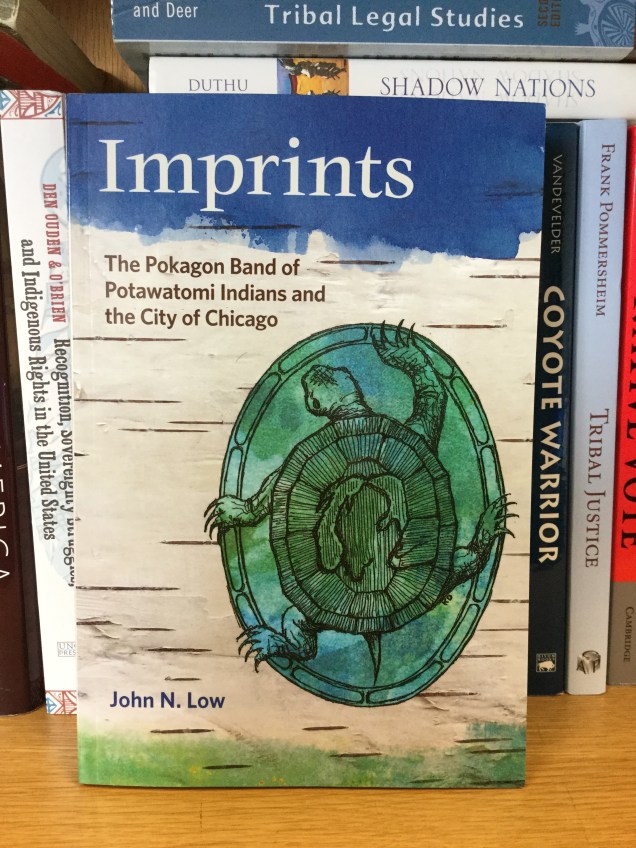
John Low has published “Imprints: The Pokagon Band of Potawatomi Indians and the City of Chicago” with Michigan State University Press (book page here).
From the website:
Imprints: The Pokagon Band of Potawatomi Indians and the City of Chicago
The Pokagon Band of Potawatomi Indians has been a part of Chicago since its founding. In very public expressions of indigeneity, they have refused to hide in plain sight or assimilate. Instead, throughout the city’s history, the Pokagon Potawatomi Indians have openly and aggressively expressed their refusal to be marginalized or forgotten—and in doing so, they have contributed to the fabric and history of the city.Imprints: The Pokagon Band of Potawatomi Indians and the City of Chicago examines the ways some Pokagon Potawatomi tribal members have maintained a distinct Native identity, their rejection of assimilation into the mainstream, and their desire for inclusion in the larger contemporary society without forfeiting their “Indianness.” Mindful that contact is never a one-way street, Low also examines the ways in which experiences in Chicago have influenced the Pokagon Potawatomi. Imprints continues the recent scholarship on the urban Indian experience before as well as after World War II.
NNALSA To Name Highest Honor Received At NNALSA’s Annual Moot Court Competition, The “G. William Rice Best Oralist Award”
Montana Native Law Student Recalls Babbitt v. Youpee and Meeting Justice Scalia
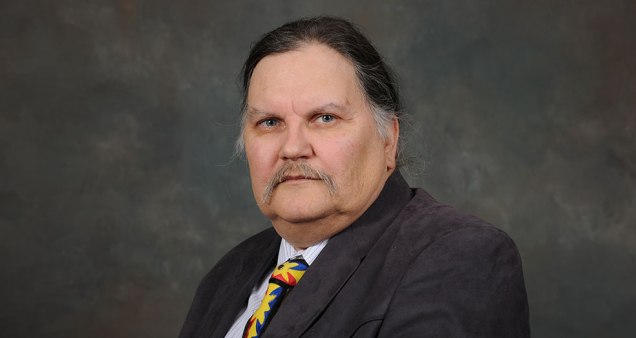
April Youpee-Roll has published “Just making it up — On Justice Scalia, Indian law and the Supreme Court’s future” in the Missoula Independent (2/16/16, at A11). Great stuff.
An excerpt:
Justice Scalia, who died last weekend, was kind, funny and met the audience’s questions with patience and enthusiasm. (Most of them were about raising his nine children, but a couple touched on his trademark constitutional originalism.) At the end, the organizers of the event sold copies of his book and Justice Scalia graciously signed them. I bought one as a gift for my mother and took a moment to gather myself while I waited in line, wondering what exactly one says to a Supreme Court justice.
As I handed over my book, I decided to go with, “I just wanted to thank you. When I was 10, I came to watch oral arguments in my family’s case, and you joined the majority in our favor.”
Justice Scalia looked up at me and smiled, “What was the case?”
“Babbitt v. Youpee. It was in 1997.”
He paused and I prepared to be ushered along in line. “That was a takings case, right?”
I nodded, more than a little surprised at his memory.
He signed my book, and as he handed it back to me, he said something I’ll never forget: “You know, when it comes to Indian law, most of the time we’re just making it up.”

National Indian Law Library Bulletin 2/11/16
| The National Indian Law Library added new content to the Indian Law Bulletins on 2/12/16.
U.S. Federal Trial Courts Bulletin State Courts Bulletin News Bulletin U.S. Regulatory Bulletin U.S. Legislation Bulletin Law Review & Bar Journal Bulletin |
Contempt Citation in Squaxin Island Indian Tribe v. Gold Coast Oyster LLC
Here are the materials in United States v. Washington (W.D. Wash.) (subproceeding 89-3-10):
20 Squaxin Petn for Order to Show Cause
Earlier proceedings in this matter are here.
 Turtle Talk
You must be logged in to post a comment.