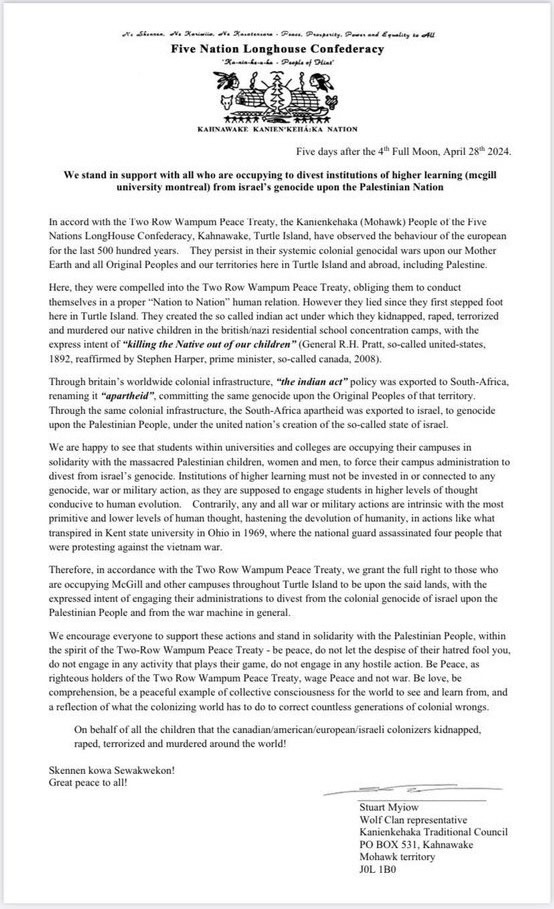
Mohawk Org Authorizes Student Protests Over Gaza @ McGill and Other Campuses
Here is the complaint in United States v. Crowley Marine Services Inc. (W.D. Wash.):

Here:
Oklahoma v. Castro-Huerta: Oklahoma’s Latest Power Grab and Its Implications for Native Women in a Post-Roe World
Camryn A. Conroy
A Note on Navajo Nation v. Urban Outfitters, Inc.
Brantly J. Stockton
Removing the Stain Without Undermining Military Awards: Revoking Medals Earned at Wounded Knee Creek in 1890
Dwight S. Mears

Please join the California Indian Law Association as we host a one-hour webinar: Introduction to Federal Indian Law with Drew Pollam, Tuesday April 30th at 12pm PT/3pmET.
Registration Required: https://rb.gy/qgfwak
1.0 California MCLE offered to current CILA Members.
Here are the materials so far in Great American Insurance Co. v. Hughes (S.D. Fla.):

John Beaty has published “The Impact of the Inflation Reduction Act on Energy Justice and Green Energy Development in Indian Country” in the LSU Journal of Energy Law and Resources. PDF
Here is the abstract:
In the past two decades, many American Indian Tribes have been experimenting with generating power from renewable sources on reservations. The growth of tribal green energy is a positive step towards energy justice, but current projects are hampered by insufficient funding, jurisdictional confusion, lack of needed infrastructure, and a baroque permitting process that leaves necessary projects languishing. The recent omnibus spending bill, the Inflation Reduction Act (IRA) was trumped by Congress as the largest investment into tribal green energy ever. This Article critically analyzes the impact of the IRA on tribal energy. While the IRA represents a necessary move towards a more effective funding structure for tribal energy projects, it failed to address other barriers to tribal green energy development. The Article concludes by proposing steps Congress, States, and Tribes can take to improve upon the IRA.



 Turtle Talk
You must be logged in to post a comment.