DEPARTMENT OF JUSTICE RELEASES SECOND REPORT TO CONGRESS ON INDIAN COUNTRY INVESTIGATIONS AND PROSECUTIONS

DEPARTMENT OF JUSTICE RELEASES SECOND REPORT TO CONGRESS ON INDIAN COUNTRY INVESTIGATIONS AND PROSECUTIONS


Report to Congress is Requirement under the Tribal Law and Order Act of 2010


WASHINGTON – The Department of Justice released today its second report to Congress entitled Indian Country Investigations and Prosecutions, which provides a range of enforcement statistics required under the Tribal Law and Order Act of 2010, as well as information about the progress of the Attorney General’s initiatives to reduce violent crime and strengthen tribal justice systems. 


The report, based on data compiled from the case management system used by U.S. Attorney’s Offices (USAO), shows prosecutors in 2013 continued to bring substantial numbers of cases to federal court (a 34 percent increase over FY 2009 numbers) and prosecute a substantial majority of all cases referred to them.  Of the cases that were declined for federal prosecution, most were declined for insufficient evidence or because they were referred to another prosecuting authority, such as the tribe, for potential prosecution.  


“As detailed in this report, the Department of Justice is making good on our commitment to strengthen cooperation with sovereign tribes, reduce violent crime, and ensure justice for every individual,” said Attorney General Eric Holder.  “From our work to empower Indian women under the landmark Violence Against Women Reauthorization Act, to the task force we established to safeguard children in Indian country from violence and abuse, we have made significant strides – in close partnership with tribal nations – to bolster the safety and security of all American Indian and Alaska Native communities.   As we move forward, we will continue to expand on this critical work; to deepen our ongoing efforts; and to reaffirm our dedication to the promise of equal rights, equal protection, and equal justice for all.”


Although declination rates are an imperfect means of evaluating the effectiveness of criminal justice in Indian country or elsewhere, the report shows that with few exceptions, areas where the largest populations of American Indian people live and suffer from the most serious crime rates, such as the Southwest and the northern plains states (which together handled approximately 70 percent of the 2,542 cases resolved in 2013), federal declination rates were the lowest in the nation.  For instance, South Dakota had the second to highest number of cases resolved in the country last year, 470 cases, and one of the lowest declination rates of 26 percent.  Arizona resolved the highest number of cases, 733 cases, and had a declination rate of 28 percent.


Associate Attorney General Tony West announced the findings in remarks to the Four Corners Indian Country Conference today on the Navajo Nation in Flagstaff, and met separately with the Attorney General’s advisory subcommittee on Native American issues to discuss the report, among other matters.


“We are witnessing an unprecedented era of collaboration among U.S. Attorneys’ offices and tribal law enforcement and prosecutors across the country,” said Associate Attorney General West.  “This report shows the fruits of this continuing partnership between the federal government and American Indian tribes, including enhancing training and capacity building for tribal court systems and improving responses to victims in Indian country.”


“Over the past five years, the Justice Department and our tribal partners have taken important steps forward on our journey toward a safer Indian Country,” said Timothy Purdon, U.S. Attorney for the District of North Dakota and chair of the Attorney General’s advisory subcommittee on Native American issues.  “Vigorous enforcement of federal laws is vitally important to strengthening public safety on American Indian reservations.  We are pleased to see in this report that U.S. Attorney’s Offices across the country continue to work hard to remove the most dangerous offenders and work closely with tribal law enforcement and prosecutors.  These promising numbers are the direct result of this enhanced communication and collaboration.” 


“The FBI continues to be committed to public safety in Indian Country,” said FBI Assistant Director Joseph S. Campbell. “Our partnership with federal, state, local, and tribal agencies remains strong as we continue to aggressively address violent crime and victimization in tribal communities.”


The information contained in the report shows the following: Continue reading →
Federal Court Holds Alleging Jay Treaty Rights Does Not Create FTCA Jurisdiction

Here are the materials in Hodgson v. United States (W.D. Tex.):

7 US Motion to Dismiss

10 Hodgson Response

11 US Reply

17 DCT Order

Berkey Williams LLP 2015 Summer Associate Posting

Summer Associate – 2015

Berkey Williams LLP serves Indian tribes and tribal organizations throughout the United States, with offices in Berkeley, California and Washington D.C. Our law firm works  exclusively with Tribes and Tribal organizations to promote and protect their political, cultural, social and economic self-determination. The Berkeley office is seeking a 2nd year law student for a summer associate position in 2015. The position requires excellent research and writing skills. We especially encourage First Nations/Native American students to apply, as well as students with a demonstrated commitment to serving Indian communities. Please forward a resume and one writing sample to Gloria Coronado, gcoronado@berkeywilliams.com. The deadline to apply is December 31, 2014. No phone calls, please.

Tribal Court Materials in Competing State/Tribal Court Actions in North Dakota Oil Transport Contract Controversies

Here are the materials in the Fort Berthold Tribal Court action, TJMD LLP v. Dakota Petroleum Transport Solutions LLC:

DOCS-#390943-v1-defendants__motion_to_dismiss

DOCS-#390944-v1-defendants__brief_-_motion_to_dismiss

DOCS-#390945-v1-defendants__appendix_-_motion_to_dismiss

Plaintiff’s Brief in Opposition to Defendants Motion to Dismiss for Lack of Non-Trail Member Jur

Affidavit of Virgil White Owl

DOCS-#407079-v1-PDF_2013_02_06_2nd_Aff_Claypool

DOCS-#407080-v1-PDF_2013_02_06_Def_Reply_Brief_Support_Motion_Dismiss

DOCS-#440826-v1-PDF_interim_order_on_jurisdiction

Prior post here.

Materials in Competing State/Tribal Court Actions in North Dakota Oil Transport Contract Controversies

In the most recent Bench & Bar (Minnesota State Bar Journal) article “Boomtown: Risks and Rewards in the Peace Garden State,” Kristin Rowell writes about her experiences in litigating contract claims in both Fort Berthold Tribal Court and North Dakota’s Montrail County District Court where the courts reach opposition conclusions on the same legal question. An excerpt:

In October 2012, I commenced litigation on behalf of my client against four defendants companies.  Two of the companies were organized under the laws of the state of Minnesota, one of the companies was organized under the laws of Nevada, and the other company was organized under the laws of Florida.  All of these out-of-state residents were conducting business with my client on the Fort Berthold Indian Reservation in New Town, North Dakota, as a part of the booming oil industry.  (Another fascinating aspect of North Dakota’s judicial landscape is that there are several independent tribal courts separate from the state and federal court systems.  An in-depth look at North Dakota tribal courts will have to be saved for another article.)  My client is a member of the federally recognized Mandan, Hidatsa, and Arikara Native American Nations, also known collectively as the “MHA Nation” or the “Three Affiliated Tribes.”  For a variety of reasons, my client chose to commence its case in Fort Berthold District (Tribal) Court.

In response to the complaint, the four defendants moved to dismiss my client’s case for “lack of nonmember tribal court jurisdiction.”  We opposed the motion and explained to the tribal court judge that it could and should retain jurisdiction under Montana v. United States, 450 U.S. 544 (1981), the Supreme Court case that gave tribal courts the authority to regulate the activities of nonmembers on reservation land owned in fee by non-Indians.  Under Montana, tribal courts can regulate the activities of nonmembers (and in turn, assert jurisdiction over nonmembers in tribal court) where: (1) the nonmembers “enter consensual relationships with the tribe or its members, through commercial dealing, contracts, leases, or other arrangements,” or (2) the nonmembers’ “conduct threatens or has some direct effect on the political integrity, the economic security, or the health or welfare of the tribe.”15  If the circumstances of a case fit either exception, then the tribal court has jurisdiction over the dispute.16

We argued that the court had jurisdiction over the key non-Indian defendant because we met both Montana exceptions with respect to that defendant.  The focus of our analysis was that the defendant contracted with my client so the first Montana exception was easily met.  Defendants argued that because my client is a company and not a human, it could not be a “member” of the tribe for jurisdictional purposes.  We argued that my client, a limited liability partnership, was owned by an Indian, which meant that it was a “member” of the tribe for jurisdictional purposes.

The Fort Berthold Tribal Court agreed with us.  The court’s decision turned on the novel and narrow legal issue of whether a limited liability partnership was more akin to a limited liability company or a corporation for jurisdictional purposes.  We argued that the United States Supreme Court has held that the citizenship of a limited partnership for purposes of diversity jurisdiction is determined according to the citizenship of its limited and general partners, citing Carden v. Arkoma Associates, 494 U.S. 185, 195-96 (1990).  Several courts have held that this holds true for limited liability partnerships too.17  Defendants argued that the limited liability partnership was more analogous to a corporation, should be treated as a separate legal “person,” and cited cases in which the courts held that a corporate person could not be a “member” of an Indian tribe.

We have been proceeding in the tribal court ever since and we will eventually have a trial.  But there is a conundrum.  While the other side’s motion to dismiss was under advisement in tribal court, the contracting party defendant in the tribal court action started an action against my client in North Dakota state court related to alleged oil spills at the exact property they are fighting about in tribal court.  My client moved to dismiss or transfer the state court case, and the same issues were argued to the state court judge that had just been decided in tribal court.  The short story is that the state court judge disagreed with the tribal court judge and retained jurisdiction over the second case.  In other words, we now have two cases pending in two courts involving the same two parties and the same contract.  Suffice it to say that we are working hard to resolve both.

The materials in the Montrail County matter (Dakota Petroleum Transport Solutions LLC v. TJMD LLP are here:

DOCS-#424808-v1-PDF_notice_of_motion_&_motion_to_dismiss_or_transfer

DOCS-#424809-v1-PDF_Mem_Supp_Motion_Transfer_Venue_and_Dismiss

DOCS-#424810-v1-pdf_KBR_Affidavit_motion_to_dismiss_or_transfer

DOCS-#424811-v1-PDF_proposed_order_motion_to_dismiss_or_transfer

DOCS-#430259-v1-pdf_Dak_Pet_response_brief_to_motion_to_dismiss

DOCS-#430260-v1-PDF_exs_to_Dak_Pet_response_brief

DOCS-#430276-v1-PDF_authorities_cited_DP_response_motion_to_dismiss

DOCS-#431865-v1-PDF_Reply_Mem_Supp_Motion_to_Dismiss_or_Transfer

DOCS-#431866-v1-PDF_Supp_Aff_KBR_motion_to_dismiss_or_transfer

DOCS-#449184-v1-Order_denying_motion_to_dismiss_transfer_(mountrail)

Materials in the parallel tribal court litigation TJMD LLP v. Dakota Petroleum Transport Solutions LLC are included as exhibits to these pleadings. We will post those materials in a separate post.

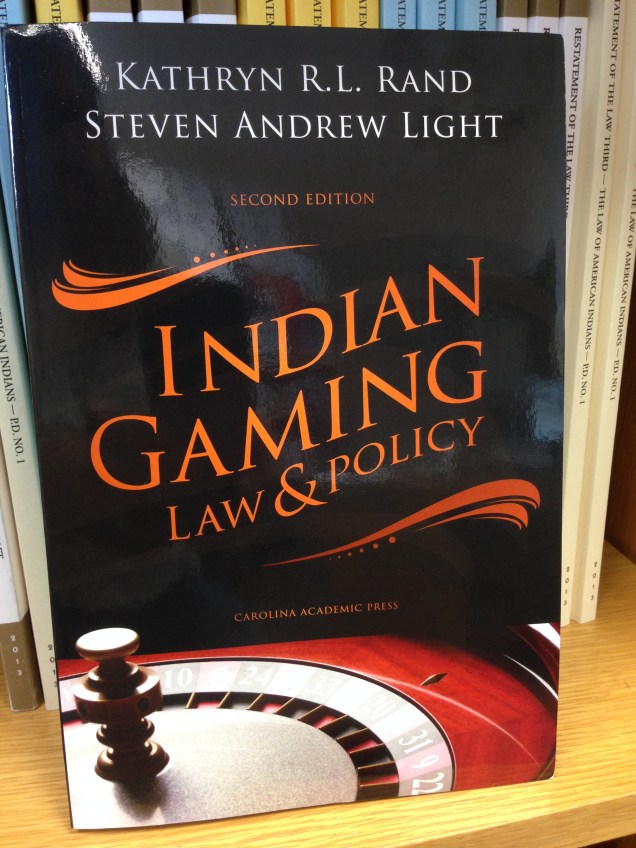
Second Edition of Indian Gaming Law and Policy by Rand & Light

Here:

R&L

U.S. Sentencing Commission Tribal Issues Advisory Group

From Mary Smith at NABA:

The Sentencing Commission recently published a Federal Register notice seeking comment on the possible formation of a Tribal Issues Advisory Group.  Links to that notice and a new publication on Native American federal offenders are below:

http://www.ussc.gov/sites/default/files/pdf/amendment-process/federal-register-notices/20140814_TIAG.pdf

http://www.ussc.gov/sites/default/files/pdf/research-and-publications/quick-facts/Quick_Facts_Native_American_Offenders.pdf

The group is soliciting comments widely and would welcome comment from the Native American community.

PDFs:

20140814_TIAG

Quick_Facts_Native_American_Offenders

NYTs: “Rarest Native Animals Find Haven on Tribal Lands”

Here.

Top 15 or so American Indian Law Articles by SSRN Download from 2014

We did this for 2013 last December, and in 2012. We are trying again by popular demand. And because MSU soon will begin hosting the SSRN Indigenous Nations & Peoples Law eJournal.

1. Human Rights to Culture, Family, and Self-Determination: The Case of Adoptive Couple v. Baby Girl
Forthcoming in STEFAN KIRCHNER AND JOAN POLICASTRI, EDS., INDIGENOUS RIGHTS IN INTERNATIONAL LAW.
Kristen A. Carpenter and Lorie Graham
University of Colorado Law School and Suffolk University Law School
Date Posted: February 28, 2014
Working Paper Series
231 downloads

2. Constitutionalism, Federal Common Law, and the Inherent Powers of Indian Tribes
Forthcoming, American Indian Law Review, University of Utah College of Law Research Paper No. 76
Alexander Tallchief Skibine
University of Utah – S.J. Quinney College of Law
Date Posted: April 17, 2014
Last Revised: April 29, 2014
Accepted Paper Series
213 downloads

3. Native American Lands and the Supreme Court
Journal of Supreme Court History, 38: 369-385, 2013
Angela Riley
University of California, Los Angeles (UCLA)
Date Posted: June 19, 2014
Accepted Paper Series
196 downloads

4. Mapping Intergenerational Memories (Part I): Proving the Contemporary Truth of the Indigenous Past
Arizona Legal Studies Discussion Paper No. 14-01
Robert Hershey , Jennifer McCormack and Gillian E. Newell
University of Arizona – James E. Rogers College of Law , University of Arizona – Department of Geography and Regional Development and Independent
Date Posted: January 12, 2014
Working Paper Series
163 downloads

5. Constitutional Concern, Membership, and Race
Florida International Law Review, 2014, Forthcoming , U of Colorado Law Legal Studies Research Paper No. 14-3
Sarah Krakoff
University of Colorado Law School
Date Posted: April 04, 2014
Accepted Paper Series
126 downloads

6. No Sticks in My Bundle: Rethinking the Indian Land Tenure Problem
Kansas Law Review, Forthcoming
Jessica A. Shoemaker
University of Nebraska – College of Law
Date Posted: May 01, 2014
Accepted Paper Series
107 downloads

7. In Search of a Civil Solution: Tribal Authority to Regulate Nonmember Conduct in Indian Country
Tulsa Law Review, September 2014, Forthcoming
Philip H. Tinker
Kanji & Katzen, PLLC
Date Posted: February 22, 2014
Accepted Paper Series
82 downloads

8. Consumer Credit on American Indian Reservations
Valentina P. Dimitrova-Grajzl , Peter Grajzl , A. Joseph Guse and Richard M. Todd
Virginia Military Institute , Washington and Lee University – Department of Economics , Washington and Lee University – Williams School of Commerce, Economics, and Politics and Federal Reserve Bank of Minneapolis
Date Posted: March 14, 2014
Last Revised: May 28, 2014
Working Paper Series
81 downloads

9. Tribes as Innovative Environmental ‘Laboratories’
Elizabeth Ann Kronk Warner
University of Kansas – School of Law
Date Posted: February 14, 2014
Last Revised: February 22, 2014
Working Paper Series
80 downloads

10. Balancing between Two Worlds: A Dakota Woman’s Reflections on Being a Law Professor
Berkeley Journal of Gender, Law & Justice, Vol. 29, No. 2, 2014
Angelique Townsend EagleWoman
University of Idaho – College of Law
Date Posted: June 15, 2014
Accepted Paper Series
72 downloads

11. Finance and Foreclosure in the Colonial Present
Radical History Review, Issue 118 (Winter 2014)
Alyosha Goldstein
University of New Mexico
Date Posted: January 30, 2014
Accepted Paper Series
71 downloads

12. Rising Waters, Rising Threats: The Human Trafficking of Indigenous Women in the Circumpolar Region of the United States and Canada
MSU Legal Studies Research Paper No. 12-01
Victoria Sweet
Michigan State University College of Law
Date Posted: February 22, 2014
Accepted Paper Series
73 downloads

13. Tribal Laws & Same-Sex Marriage: Theory, Process, and Content
Ann E. Tweedy
Hamline University School of Law
Date Posted: January 12, 2014
Last Revised: July 18, 2014
Working Paper Series
59 downloads

14. What Does Indigenous Participatory Democracy Look Like? Kahnawà:Ke’s Community Decision Making Process
Review of Constitutional Studies, Vol. 18, No. 1, 2013
Kahente Horn-Miller
Mohawk Council of Kahnawake
Date Posted: May 17, 2014
Accepted Paper Series
57 downloads

15t. In the Name of the Child: Race, Gender, and Economics in Adoptive Couple v. Baby Girl
Florida Law Review, Forthcoming
Bethany Berger
University of Connecticut School of Law
Date Posted: March 30, 2014
Last Revised: May 29, 2014
Accepted Paper Series
50 downloads

15t. Essay: Tribal Trustees in Climate Crisis
American Indian Law Journal, Vol. II, Issue II, Spring 2014, Forthcoming
Mary C. Wood
University of Oregon – School of Law
Date Posted: April 05, 2014
Working Paper Series
50 downloads

15t. International and Domestic Law Dimensions of Climate Justice for Arctic Indigenous Peoples
Ottawa Law Review, Vol. 43, No. 113, 2013
Elizabeth Ann Kronk Warner and Randall S. Abate
University of Kansas – School of Law and Florida A&M University – College of Law
Date Posted: February 03, 2014
Accepted Paper Series
50 downloads

18 (honorable mention). Tribal Rights of Action
Columbia Human Rights Law Review, Vol. 45, No. 2, 2014
Seth Davis
University of California, Irvine School of Law
Date Posted: April 04, 2014
Accepted Paper Series
47 downloads

This one is not yet available for download but I’m sure it would have made the list:

Beyond the Indian Commerce Clause
Yale Law Journal, Forthcoming
Gregory Ablavsky
University of Pennsylvania Law School
Date Posted: August 14, 2014
Accepted Paper Series

We skipped out on articles about Indigenous peoples outside of the US, so here is a sampling of articles focusing on more international questions: Continue reading →

Federal Court Dismisses D.V. Offender’s Challenge to Revocation of Probation for Violation of Tribal Court Exclusion Order…With Concerns

Here are the materials in United States v. Nichols (D. S.D.):

44 Nichols Motion to Dismiss

45 US Response

49 DCT Order Denying Motion to Dismiss

An excerpt:

Steven Nichols, a non-Indian, was excluded from the Rosebud Sioux Indian Reservation. While his exclusion was in effect, he was seen driving on a public road within the reservation. Tribal officers stopped and detained him until an FBI agent arrived. The agent then arrested him for criminal trespass. Nichols claims that the tribe did not have the authority to ban him from using the road and that his federal trespass charge — built upon a tribal writ and order of exclusion — should be dismissed. Because (1) there exists latent factual issues that require an evidentiary foundation, (2)there has been no exhaustion of tribal remedies or any showing that some exception to the exhaustion prescription applies, and (3) there is no ambiguity in the language of the revocation petition as amended, Nichols’s dismissal motion must be denied, but without prejudice.