Kronk Warner on Tribes as Environmental “Laboratories”

Elizabeth Kronk Warner has posted “Tribes as Innovative Environmental ‘Laboratories‘” on SSRN.

Here is the abstract:

Indian tribes, because of their distinctive regulatory authority and significant connection to the environment, possess unique capacities to innovate within the field of environmental law in the over 56 million acres that makes up Indian country. In this first scholarly work to address this aspect of tribal environmental law, this article advocates for the idea of tribes as “laboratories” for examining environmental regulation. Tribes enact environmental regulation by two primary means – in their capacity as “tribes as states” (TAS) and in their capacity as inherent sovereigns – both of which create unparalleled space for innovation. Moving first to the TAS setting, the article examines synergies between federal and tribal environmental law. Following an expansive discussion of laws adopted by several tribes under their TAS authority, the article next turns to a discussion of the implications of tribal environmental innovations. Here, the article begins by looking at the emerging trends in tribal adaptation of federal environmental law. The article turns next to a look at tribal environmental law adopted purely as a result of tribal inherent sovereignty. Here, the article begins the foundational discussion of how tribes may take lessons learned from the TAS setting and, by the exercise of inherent sovereignty, truly be innovators in the development of environmental law. The article then develops some initial thoughts of how tribes, the states and the federal government may benefit from innovations occurring within the tribal environmental laboratory. Tribal environmental law is particularly exciting given its ability to transcend federal environmental law. Ultimately, the article concludes that, by enacting environmental laws to meet their unique tribal needs, many tribes are creating and innovating in the field under their unique powers as separate sovereigns within the United States, truly acting as laboratories of the future.

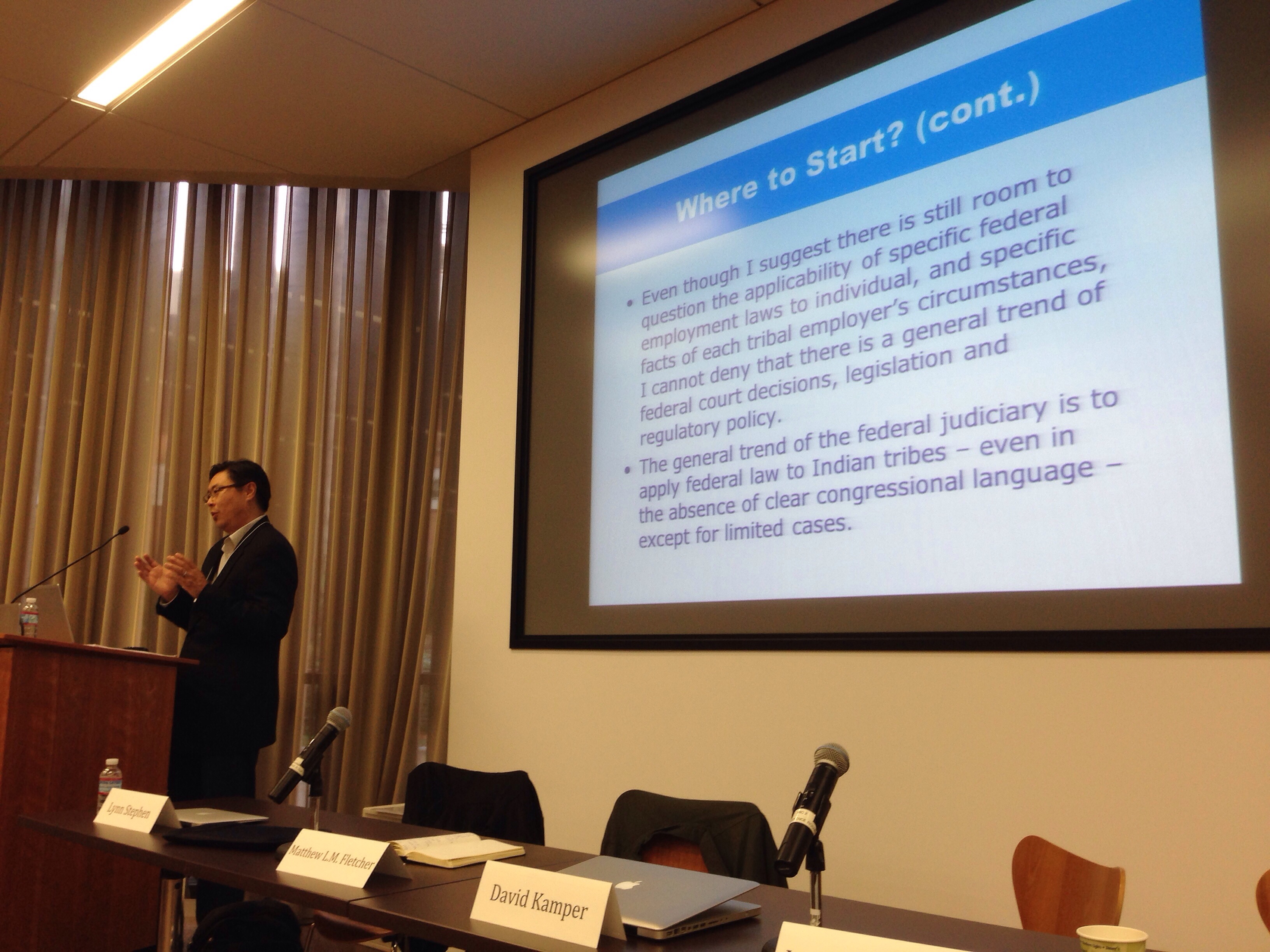
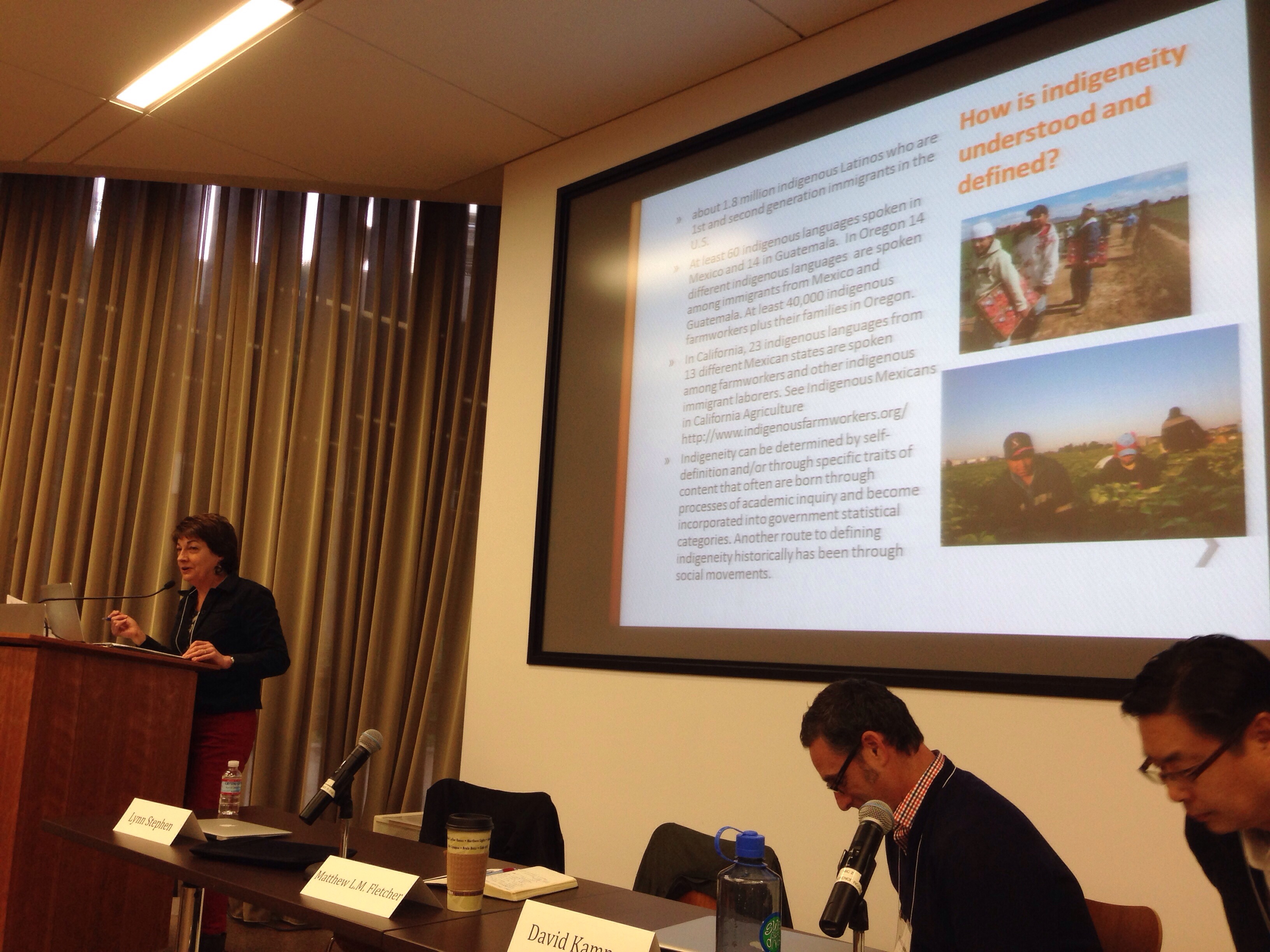
UCLA IRLE Indigenous Peoples Panel

Lynn Stephen, MF, David Kamper, and James Kawahara

20140301-105514.jpg

James Kawahara

20140301-105617.jpg

Lynn Stephen

20140301-105648.jpg

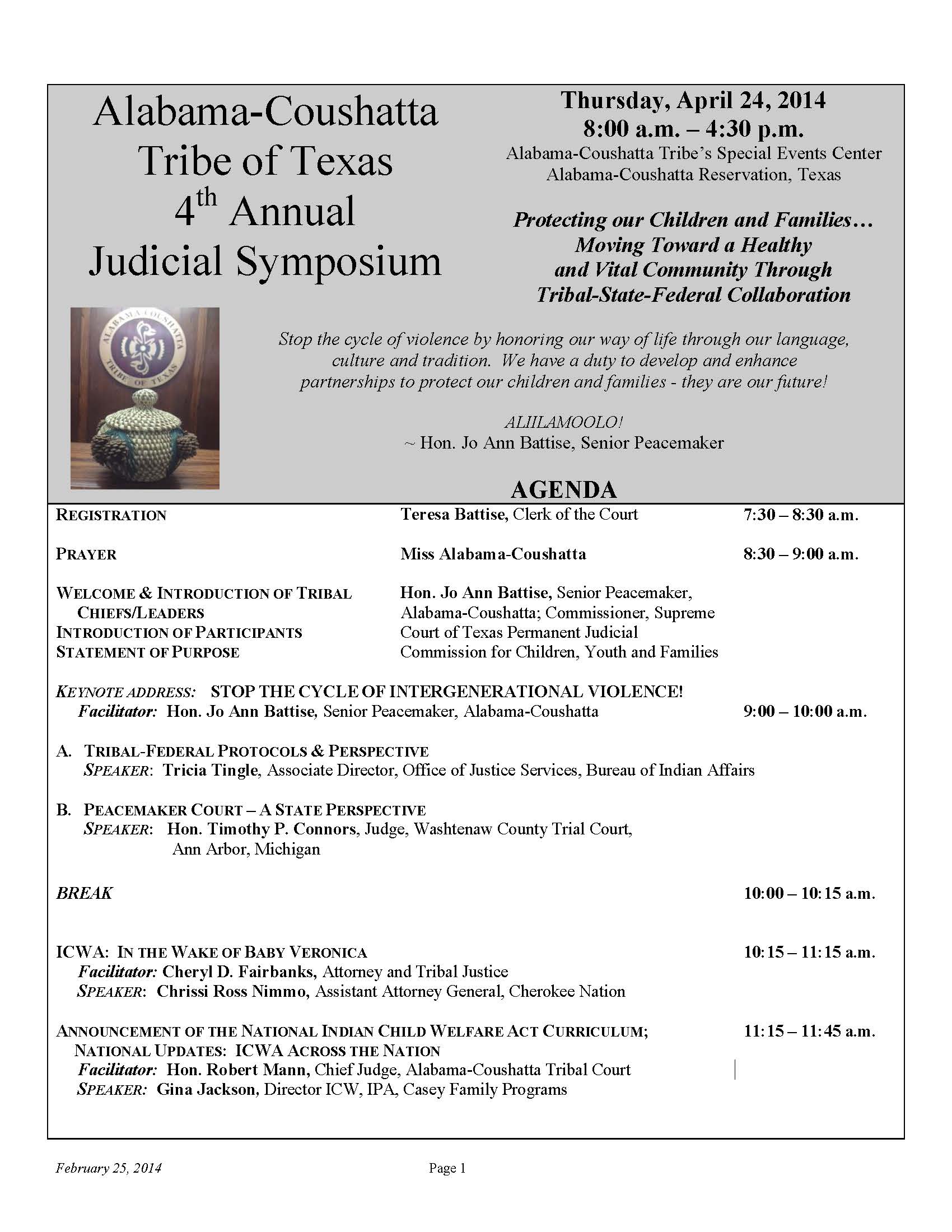
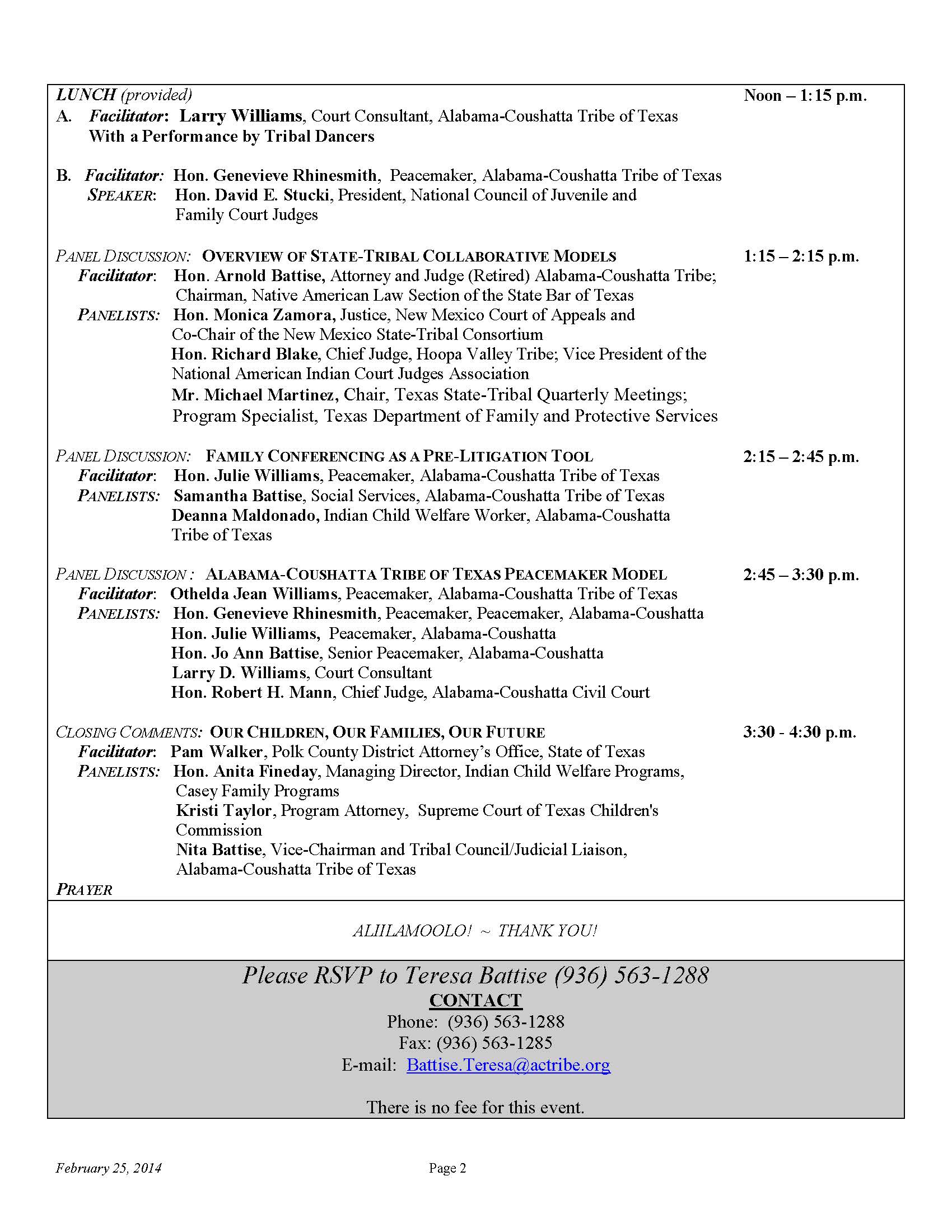
Agenda for Alabama-Coushatta Judicial Symposium April 24, 2014

Here (PDF):

Agenda 25FEB2014_Page_1 Agenda 25FEB2014_Page_2

New Mexico Appleseed Job Posting

New Mexico Appleseed

STAFF ATTORNEY

Albuquerque, New Mexico or Santa Fe, New Mexico

Practice Areas:  Hunger, homelessness, community development, poverty law, Native American

Job Description

Reporting to Executive Director, the Staff Attorney is responsible for research, analysis, and writing for the organization on a wide variety of poverty-related issues such hunger, homelessness, and foster care.  Primary responsibilities include legal research and writing, policy analysis and advocacy, legislative drafting, negotiation, community education, and collaboration with non-profit, community-based, and governmental organizations.  This position does not involve litigation.  Diverse candidates are encouraged to apply.

Continue reading →

Sault Ste. Marie Tribes Moves Sixth Circuit to Reconsider Stay Order

Here is the motion:

Sault Tribe Motion to Reconsider Stay Order

The stay order materials are here.


Ninth Circuit Briefs in Shingle Springs of Miwok Indians v. Caballeros

This is a trademark dispute between the federally recognized Shingle Springs Band of Miwok Indians and an unaffiliated man purporting to act as “Chief” of the “Shingle Springs Band of Miwok Indians.”

Here:

034 – Brief of Appellant Cesar Caballero(81539037_1)

040-1 – Answering Brief of Appellee Shingle Springs Band of Miwok Indians(81902896_1)

Lower court materials here.

UCLA Race, Labor & the Law Conference February 28-March 1, 2014

Here. Agenda here. Fletcher/Fort/Singel paper here.

Fletcher’s panel:

Saturday, March 1

Labor and Employment Issues Facing Indigenous Peoples in the U.S.
Matthew L.M. Fletcher, J.D. | Professor of Law & Director of the Indigenous Law & Policy Center, Michigan State University
James Kawahara, J.D. | Adjunct Professor in Practice, UCLA School of Law, UC Los Angeles; Attorney, Kawahara Law P.C.
  • “Judicial Application of Federal Labor and Employment Laws to Indian Tribes When Congress is Silent: What Fills the Vacuum?”
Lynn Stephen, Ph.D. | Professor of Anthropology and Director of the Center for Latino/a and Latin American Studies, University of Oregon
  • “Indigenous Mexican Workers in the U.S.: Labor Conditions, Health, and Identity”
David Kamper, Ph.D. | Associate Professor and Chair of American Indian Studies, San Diego State University
  • “The Work around Tribal Sovereignty: Negotiating Notions of Labor, Jobs, & Class in Tribal Governmental Gaming and Economic Development”
Moderated by: Pamela A. Izvănariu, J.D., LL.M. | Director of Research & Development, UCLA Institute for Research on Labor and Employment, UC Los Angeles

Federal Circuit Briefs in Council for Tribal Employment Rights v. United States

Here:

CTER Brief

US Brief

CTER Reply Brief

Lower court materials here.

News Coverage of the Suit over the Missing $316K at Chukchansi

Here.

FIU Law Review Symposium on the History of S. Fla. Tribes

Here. A description:

This symposium examines the history of the present day Indian tribes in South Florida commencing with the early Seminole Wars. Indian tribes are uniquer governmental entities enjoying inherent sovereignty over a wide range of issues and conduct. The tribal nations in South Florida are no different. This Symposium explores the legal status of tribal governments through in-depth examination of their histories.