MGM Resorts Sues Connecticut over New Tribal Gaming Act

The complaint, filed in federal district court in Connecticut on August 4, is here: 273548545-MGM-v-Malloy Complaint.

The state law, signed by the Governor on June 19, 2015, is here.

From the complaint:

MGM seeks to have the Act declared invalid and enjoined on two principle bases:

a. The Act violates the Equal Protection Clause because it is a race-based set-aside in favor of the two Preferred Tribes at the expense of all other tribes, races, and entities; and

b. The Act violates the dormant Commerce Clause because it discriminates on its face in favor of the two in-state Preferred Tribes at the expense of out-of-state competitors, all of whom are barred from attempting to develop a casino gaming facility in Connecticut.

EPA Announces Proposed Interpretive Rule for Tribal Treatment as State (TAS) status under the Clean Water Act

The proposed rule would streamline the TAS process for many tribes seeking eligibility to administer water quality standards and other Clean Water Act programs.

See the Federal Register announcement here.  The deadline for comments is October 6, 2015.

From the announcement:

The effect of this proposal would be to relieve tribes of the need to demonstrate their inherent authority when they apply for TAS to administer CWA regulatory programs. In particular, this proposal would eliminate any need to demonstrate that the applicant tribe retains inherent authority to regulate the conduct of nonmembers of the tribe on fee lands under the test established by the Supreme Court in Montana. Instead, applicant tribes would be able to rely on the congressional delegation of authority in section 518 as the source of their authority to regulate their entire reservations under the CWA, without distinguishing among various categories of on-reservation land. As EPA explained in connection with the CAA, such a territorial approach that treats Indian reservations uniformly promotes rational, sound management of environmental resources that might be subjected to mobile pollutants that disperse over wide areas without regard to land ownership. See 59 FR at 43959. As specifically recognized by the district court in Montana v. EPA, the same holds true for regulation under the CWA. Montana, 941 F. Supp. at 952.

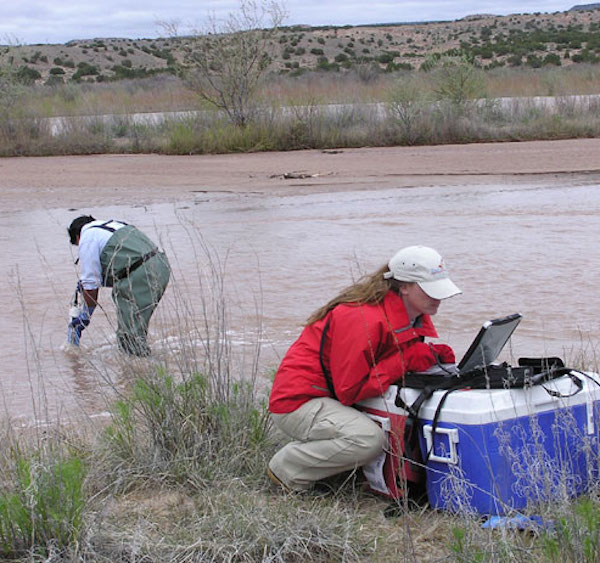
Pueblo of Santa Ana members measure water quality under the tribe's extensive water-monitoring program, recently certified as autonomous under the Clean Air Act by the U.S. Environmental Protection Agency. Read more at http://indiancountrytodaymedianetwork.com/2015/07/22/santa-ana-pueblo-get-epa-certified-administer-clean-water-act-tribal-land-161159
Pueblo of Santa Ana members measure water quality under the tribe’s extensive water-monitoring program, recently certified as autonomous under the Clean Air Act by the U.S. Environmental Protection Agency.
Read more at http://indiancountrytodaymedianetwork.com/2015/07/22/santa-ana-pueblo-get-epa-certified-administer-clean-water-act-tribal-land-161159

NYTs Article on Controversy over Navajo Fluency Requirement for Political Candidates

Here is “Presidential Candidate in Navajo Nation Protests a Language Requirement.

MSU seeks new Director for Native American Institute

The official position announcement is located here, and the job posting number is 9891.

The Native American Institute (NAI) works with tribes, Native American organizations, and various Michigan State University units to enhance the sovereignty, cultural continuity, and well-being of tribes, Native American communities, and Native American people.

Located in MSU’s College of Agriculture and Natural Resources, NAI undertakes outreach and engagement scholarship. NAI works across units in the College and the University. Of special note is NAI’s close working relationship with MSU Extension (MSUE). NAI and MSUE jointly administer two tribally-focused MSU Extension programs.

NAI is undergoing a reorganization of purpose, approach, and strategy to best assist Michigan’s Native American population. The Director will provide leadership for this effort in concert with Native American communities and university stakeholders, thereby carrying NAI into its next phase of vibrant community engagement.

The Director will be responsible for all aspects of leading and managing NAI. Specific responsibilities include: managing NAI faculty and academic staff; coordinating program planning efforts in partnership with community members and the NAI Advisory Group; co-directing the Building Strong Sovereign Nations tribal governance training program undertaken collaboratively with MSU Extension and the Indigenous Law and Policy Center; co-directing the Michigan Federally-recognized Tribes Extension Program and MSU Extension; nurturing new scholarly initiatives tied to NAI’s outreach and research-oriented mission; generating external funding; and building productive collaborations across the university. The Director will hire and conduct academic staff evaluations; manage NAI resources and its budget; promote program excellence; ensure program accountability; and network with a variety of related units and constituencies, on- and off-campus.

The minimum qualifications include a Ph.D. in urban and regional development or a related field. The Director duties will extend for 5 years with the possibility of renewal. Additional duties of the faculty member selected will be devoted to work in what will become the director’s tenure academic department or school. Academic record must be commensurate with tenure system appointment.
Alaska Supreme Court considers whether Adoptive Couple v. Baby Girl applies to State-initiated child protection proceedings

In June 2013, the Alaska Supreme Court held in Native Village of Tununak v. Dep’t of Health & Soc. Servs (Tununak I) that ICWA implicitly mandates that good cause to deviate from ICWA’s adoptive placement preferences must be proven by clear and convincing evidence, rather than a mere preponderance of the evidence. That opinion is here.

Four days later, the Supreme Court issued its ruling in Adoptive Couple v. Baby Girl.  The adoptive parents in Tununak I asked the Alaska Supreme Court to revise its ruling in light of it, based on their argument that ICWA’s placement preferences do not apply in cases where no other party has formally sought to adopt the child. This argument would extend the Baby Girl decision beyond the realm of voluntary private adoptions like the one at issue in Baby Girl and apply it to state-initiated child protection proceedings involving the removal of a Native child from her custodial parent by state authorities.

The parties and the Native Village of Kotzebue, acting as amicus curiae, filed the following supplemental briefs on the issue in November 2013:

Appellee State of Alaska’s is here:  Tununak – Supplemental Brief of Appellee State of Alaska

Appellees H.S. and K.S.’s (the adoptive couple) is here:  Tununak – Supplemental Brief of Appellees H.S. and K.S. – adoptive couple

Appellant Village of Tununak’s is here:  Tununak – Appellant Village of Tununak’s Supplemental Brief

Amicus Curiae Native Village of Kotzebue’s, prepared by NARF, is here:  Tununak – Brief of Amicus Curiae Native Village of Kotzebue

Oral argument before the Alaska Supreme Court was held on January 14, 2014, and can be viewed here.

Canadian Federal Court of Appeal affirms that 400,000 Métis have Indian status

In a historic decision, Canada’s Federal Court of Appeal today affirmed a 2013 Federal Court ruling that Métis are “Indians” under section 91(24) of the Constitution Act, 1867.  The decision impacts approximately 350,00 – 400,000 Métis in Canada.  The court did not include non-status Indians in the decision, opting instead to decide Indian status for these groups on a case-by-case basis.

From CBC News:  “[The Daniels decision] could be one of the most significant cases dealing with aboriginal peoples in Canadian history,” said University of Ottawa law professor Larry Chartrand in an interview with CBC News. “It has the potential of completely changing the landscape of aboriginal-Canadian relations.”

News reports are here and here.

A copy of the Daniels decision is here.

In a statement posted here, President Clément Chartier of the Métis National Council stated that “I applaud today’s decision of the Federal Court of Appeal in the Daniels case. It reinforces our longstanding position that the federal government has constitutional responsibility to deal with the Métis.”


Native Hawaiian Derrick Kahala Watson nominated for Federal Judgeship

Congratulations to Derrick Kahala Watson!  Below is his bio, released by the White House on Wednesday.

Derrick Kahala Watson:  Nominee for the United States District Court for the District of Hawaii
Derrick Kahala Watson has been an Assistant United States Attorney in the District of Hawaii since 2007, and has served as Chief of the Civil Division since 2009.  Previously, he worked at the San Francisco law firm of Farella Braun + Martel LLP, where his practice focused on product liability, toxic tort, and environmental cost recovery litigation.  He joined the firm in 2000 and was named partner in 2003.  Watson was an Assistant United States Attorney in the Northern District of California from 1995 to 2000, serving as Deputy Chief of the Civil Division from 1999 to 2000.  He began his legal career at the law firm of Landels, Ripley & Diamond in San Francisco, where he was an associate from 1991 to 1995.  Watson received his J.D. in 1991 from Harvard Law School, his A.B. in 1988 from Harvard College, and is a 1984 graduate of The Kamehameha Schools.

New Study Documents Disproportionate Impact of Climate Change on Indian Tribes

From the National Wildlife Federation (link here).

Here’s an excerpt:

In collaboration with the Tribal Lands Program, Institute for Tribal Environmental Professionals, National Congress of American Indians, Native American Fish & Wildlife Society, National Tribal Environmental Council, Native American Rights Fund, and University of Colorado Law School, the National Wildlife Federation released Indian Tribes, Climate-Induced Weather Extremes, and the Future for Indian Country. The report details how climate change is adversely and disproportionately affecting Indian Tribes in North America, people who rely on a healthy environment to sustain their economic, cultural and spiritual lives.

“The Indian Nations face profound challenges to their cultures, economies and livelihoods, because of climate change,” said Jose Aguto, policy advisor on Climate Change for the National Congress of American Indians. “Yet tribal peoples possess valuable knowledge and practices of their ecosystems that are resilient and cost-effective methods to address climate change impacts, for the benefit of all peoples. This study is a clear call for the Administration, Congress, state and local governments, and all peoples, to support and join tribal efforts to stem climate change.”

Here’s the report:

NWF_TribalLandsExtremeWeather_FINAL

Environmental Justice Memorandum of Understanding Announced

From the EPA’s press release, issued August 4 (link here):

Building on its commitment to ensuring strong protection from environmental and health hazards for all Americans, the Obama Administration today announced Federal agencies have agreed to develop environmental justice strategies to protect the health of people living in communities overburdened by pollution and provide the public with annual progress reports on their efforts. Environmental Protection Agency Administrator Lisa P. Jackson, White House Council on Environmental Quality Chair Nancy Sutley and U.S. Attorney General Eric Holder were joined by agency heads across the Administration in signing the “Memorandum of Understanding on Environmental Justice and Executive Order 12898” (EJ MOU).

“All too often, low-income, minority and Native Americans live in the shadows of our society’s worst pollution, facing disproportionate health impacts and greater obstacles to economic growth in communities that can’t attract businesses and new jobs. Expanding the conversation on environmentalism and working for environmental justice are some of my top priorities for the work of the EPA, and we’re glad to have President Obama’s leadership and the help of our federal partners in this important effort,” said EPA Administrator Lisa P. Jackson. “Every agency has a unique and important role to play in ensuring that all communities receive the health and environmental protections they deserve. Our broad collaboration will mean real progress for overburdened communities.”

Here’s the summary description of the MOU provided by the Federal Interagency Working Group on Environmental Justice website (link here):

The EJ MOU broadens the EJ IWG, to include:

  • Agencies not named in Executive Order 12898 as participants
  • An EJ IWG Charter (PDF) (4 pp, 33K) to add more structure and efficiency to the Workgroup
  • Formal environmental justice commitments that agencies have made over the past year
  • A roadmap for agencies to better coordinate their efforts
  • Processes and procedures to help communities more efficiently
  • Effective engagement of agencies as they make decisions

Also, under the EJ MOU, each agency will be responsible for meeting various commitments, including:

  • Finalizing and publicizing an environmental justice strategy;
  • Providing the pubic with annual implementation reports that discuss progress in carrying out the Agency’s EJ commitments and responsibilities; and
  • Focusing on, when appropriate, the implementation of the National Environmental Policy Act, implementation of Title VI of the Civil Rights Act of 1964, impacts from climate change, and impacts from commercial transportation and supporting infrastructure, or goods movement.

MOU on Environmental Justice and EO 12898

IWG Charter 2011

Executive Order 12898

Cobell Settlement Land Consolidations to Require New Appraisal Tracking System

From the NYTimes on July 29 (link here).

Here’s an excerpt:

The Interior Department’s inspector general released audits yesterday that shed light on two long-standing problems: divided Indian lands and interagency contracting.

The department faces a difficult task in consolidating tribal ownership of lands as part of a $3.4 billion settlement over federal mismanagement of American Indian trust accounts. More than 21,000 parcels of land have 50 or more owners, and Interior now must spend $1.9 billion to buy back such parcels and consolidate them for redistribution to tribes.

A federal judge approved the Cobell v. Salazar settlement last month, but Interior’s inspector general found that the department has work to do to ensure it can keep up with appraisal requests. A previous IG audit found that 1,000 appraisal reports were past due; now the agency is hoping to replace its old appraisal system to clear the backlog, according to the IG report.

When complete, the Office of Appraisal Services Information System will track appraisal requests and be a one-stop shop for information on tribal land.

DOI OIG Report on Appraisal Tracking System needs