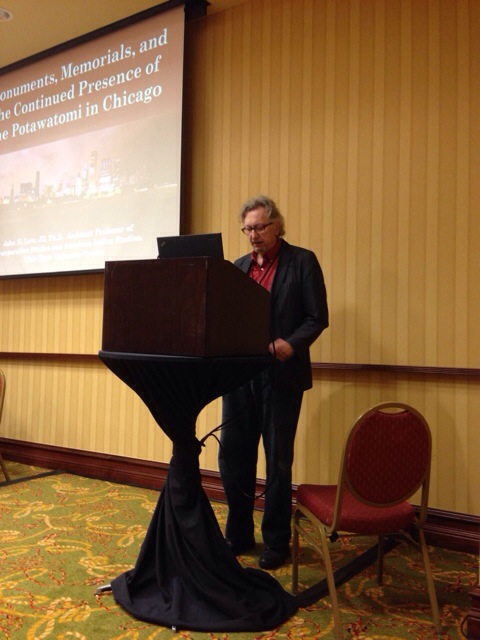
John Low, a Pokagon Band member, opened it up
MSU Press is here displaying Simon’s novel

John Low, a Pokagon Band member, opened it up
MSU Press is here displaying Simon’s novel
Here are the new materials in Freeman v. Freeman (Paskenta Band of Nomlaki Indians Tribal Court):
PTCV-14-001 – 2014-5-27 Motion for Preliminary Injuction and Default Judgment
PTCV-14-001 – 2014-5-27 – Declaration of M Jones
PTCV-14-001 – 2014-5-27 – Second Declaration of G. Freeman
Prior posts on this issue here, here, and here.
And a related document:
… to me anyway.
The agenda is here.
Thursday at 10 AM:
Panel 21: The Impact of American Indian Boarding School Education on Great Lakes Indigenous Foodways
Amelia Katanski, Kalamazoo College
Panel 29: Preaching to the Choir: Teaching Ojibwe Hymns to Indigenous Singers Who are not Fluent but Who Value Indigenous Identity
Janis A. Fairbanks, Michigan State University
Thursday at 2PM
Panel 39. Simon Pokagon: Cultural and Literary Legacies [P69]: Meeting Room 616B
Chair: Ray Fogelson, University of Chicago
Monuments, Memorials, and the Continued Presence of the Potawatomi in Chicago
John Low, Ohio State University, Newark
A History of the Native Book: Simon Pokagon’s Queen of the Woods
Kiara M. Vigil, Amherst College
Pokagon without Pokagon: Queen of the Woods, Marietta Walker, and Indian Temperance
Kathleen Washburn, University of New Mexico
Comment: Ray Fogelson, University of Chicago
Friday, 8 AM
Panel 68. Contesting Boundaries in the Upper Mississippi and Great Lakes, Part 2: Translating Identities in Anishinaabe Aking [P42]: Meeting Room 616B
Organizer: Cary Miller, University of Wisconsin, Milwaukee
Chair: Bruce White, Turnstone Historical Research
Problematizing Half Breeds in the Early 19th Century Great Lakes Country
Rebecca Kugel, University of California, Riverside
Translating Culture: ABCFM textbooks in Anishinaabeg communities, 1830-1845
Cary Miller, University of Wisconsin, Milwaukee
Context for Curriculum: The Historical Roots of Contemporary Ethnic Terminology in
Anishinaabemowin
Margaret Noodin, University of Wisconsin, Milwaukee
Challenges and Possibilities in the Digitization of Indigenous Toronto
Heather Howard, Michigan State University
Friday, 10 AM
Panel 81: Criminal Acts: Sovereignty, Indigeneity, and The Transit of Empire
Heidi Kiiwetinepinesiik Stark, University of Victoria
Panel 88. Contemporary Quandaries of Tribal Citizenship: Cultural, Legal, and Political Concerns [R5]: Salon J, Sixth Floor
Organizer and Chair: Jill Doerfler, University of Minnesota, Duluth
Participants:
Sarah Deer, William Mitchell College of Law, Associate Judge for the Prairie Island Community; Jill Doerfler, University of Minnesota, Duluth, member Constitutional Writing Team of the White Earth nation; Matthew L.M. Fletcher, Michigan State University College of Law, Chief Justice of the Poarch Band of Creek Indians Supreme Court, Appellate Judge for the Nottawaseppi Huron Band of Potawatomi Indians and the
Pokagon Band of Potawatomi Indians; Colette Routel, William Mitchell College of Law
Saturday, 10 AM
Panel 125. ᏣᎳᎩ ᎠᎴ ᎣᏥᏪ ᏗᎧᏁᏍᏗ Cherokee and Ojibwe Dictionary: Decolonizing the Digital Archive
Ellen Cushman, Michigan State University
Homeschool Heroes YouTube Plea: https://www.youtube.com/watch?v=Nlf7PoRVTRg
Homeschool Heroes Petition: https://petitions.whitehouse.gov/petition/take-andrew-jackson-20-bill-and-replace-him-someone-who-was-more-committed-liberty-and-justice-all/C9DVjkt9
Here is the unpublished opinion in United States v. Pego.This one is Samuel John Pego. We posted on the earlier appeal by Waylon Pego here.
Here. Second story in the newscast.
Here are the materials in Grand Canyon Skywalk Development LLC v. Steele (D. Nev.):
17 Scutari & Cieslak Motion to Dismiss
20 Tribal Council Defendants Motion to Dismiss
32 Tribal Council Defendants Reply
63 Notice of Voluntary Dismissal of Cesspooch
64 Notice of Voluntary Dismissal of Tribal Council Defendants
Complaint posted here.
David Selden of National Indian Law Library has published “Researching American Indian Tribal Law” in the Colorado Lawyer.
An excerpt:
The ability to research tribal law is becoming increasingly important as 566 sovereign Indian nations and Alaska Native villages exercise their powers of self-governance. “Tribal law” comprises the laws developed by tribes or Indian nations, which apply within their territories and to their members. It can be a difficult area of law to research because few primary and secondary resources are published and made available to the public.
Here. Here is the description:
As a result of tribes’ sovereign status and federally recognized water rights, they have an important place in the management and allocation of California’s water resources. While most water rights are based on state law, federal law recognizes a special type of water right commonly known as “federal reserved rights.” This right was first recognized in 1906 by the United States Supreme Court in Winters v. United States and applies to certain federal lands, including tribal reservations. Many California tribes have established reserved rights or are in the process of asserting them. This class will cover the legal foundation and policy behind Indian water rights and how these rights fit in California’s water allocation system. Students will review recent developments involving Indian water rights, including quantification through litigation and congressionally approved water rights settlement. They will also review Indian water rights issues in the Klamath, Lake Tahoe and Colorado River Basins. This unique class is a continuation of the California Water Law and Policy offered by the UC Davis Extension and would be of interest to policy executives, water and environmental officials, and tribal representatives who wish to better understand California water.


You must be logged in to post a comment.