Barbara Lane Walks On

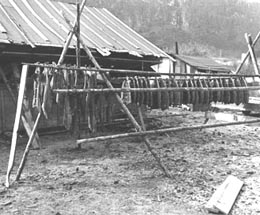
We learned the terrifically sad news that Barbara Lane, the legendary and heroic anthropologist that served as the lead expert witness in the United States v. Washington trial that led to the Boldt decision passed away late last year. Celilo_Village_Salmon
In her honor, we dug up a rare copy of a short article she published in the now-defunct American Indian Journal that summarized some of her written testimony. Here:

Background of Treaty Making in Western Washington

And, of course, the Boldt decision itself:

384_F.Supp._312

UPDATE — we have her obituary now:

Barbara Lane, one of the foremost experts in First Nations anthropology and Native American rights, passed away on December 31, 2013 in Arlington, Washington. Dr. Lane produced exceptional expert reports and testimony in more than 40 court cases, many of which were pivotal in determining the rights of native peoples to access and use natural resources. The United States federal courts that ruled on treaty fishing rights in the Northwest relied heavily on her testimony. Her work was instrumental for the Quinault and other Washington Tribes in numerous treaty fishing rights cases related to the 1974 Boldt Decision (U.S. vs Washington) and for the Quinault in Mitchell vs U.S. in 1977. The United States Supreme Court referenced her findings in affirming the key decision on Northwest treaty rights. (I.e. the “Boldt” Decision.) She also served as an expert witness in cases involving fisheries and land claims of Canadian First Nations. Her work was well known and respected by Indigenous Peoples, the academic community, and legal circles. She was retained as the U.S. Federal Court of Oregon expert in U.S. v. Oregon in 1991.

Barbara was a member of the Society for Applied Anthropology, the Canadian Sociological and Anthropological Association, and the American Ethnological Society. During her illustrious career, she held many research, editorial and administrative positions. Although she authored numerous publications, she often preferred to do her work without seeking public recognition.

She received an A.B. and M.A. from the University of Michigan in the late 1940’s and earned a PhD from the University of Washington in 1953. Barbara held faculty positions at the Universities of Washington, Hawaii, Pittsburg, British Columbia, Victoria and Western Washington University. In 2006, Barbara was awarded an honorary Doctor of Law Degree from the University of Victoria for her expertise and contributions to First Nations anthropology and rights.

Her career took her to far reaches of the world, including Postdoctoral Study at the Australian National University from 1953-1954 and work with Coast Salish peoples, India, and Vanuatu. Much of her early work was done in professional partnership with her Husband, Robert who predeceased her.

As Director for the Quinault Indian Bicentennial Project from 1976-1977, she provided guidance and direction for creating an historical record for the people and culture of the Quinault Nation. This work led to the publication of the Handbook on Legislation and Litigation Affecting the Quinault Reservation and established an invaluable core of records for the Quinault Historical Foundation (now called the Quinault Cultural Center).

Her home and office was located in Victoria, British Columbia for many years. Barbara is survived by a son, two daughters and one grandchild.

IBIA Decision on Cayuga Indian Nation Leadership Issue

Here is the decision in Cayuga Indian Nation v. Eastern Region Director, Bureau of Indian Affairs (IBIA):

58 IBIA 171

And a related press lreease:

01-21-14 Press Release re IBIA 2014

Split Ninth Circuit Panel Reverses Big Lagoon Rancheria v. California

Here is today’s opinion. The court’s syllabus:

Reversing the district court’s summary judgment, the panel held that the State of California did not violate the Indian Gaming Regulatory Act by failing to negotiate in good faith for a tribal-state gaming compact with Big Lagoon Rancheria.

The panel held that a tribe must have jurisdiction over “Indian lands” in order to file suit to compel negotiations under IGRA. Specifically, the tribe must have jurisdiction over the Indian lands upon which the gaming activity is to be conducted.

The panel held that although the State’s objection to the “Indian lands” requirement could be waived because it was not a matter of subject matter jurisdiction, the State preserved this issue for review. The panel held that the parcel at issue was not Indian lands, which include lands held in trust for a tribe, because under Carcieri v. Salazar, 555 U.S. 379 (2009), the Bureau of Indian Affairs’ authority to take lands in trust for a tribe extends only to tribes under federal jurisdiction in 1934. Because Big Lagoon was not such a tribe, the BIA lacked authority to purchase the parcel in trust for Big Lagoon in 1994. Accordingly, Big Lagoon could not demand negotiations to conduct gaming on the parcel, and it could not sue to compel negotiations if the State fails to negotiate in good faith.

Dissenting, Judge Rawlinson wrote that the parcel was Indian lands under IGRA because under Guidiville Band of Pomo Indians v. NGV Gaming, 531 F.3d 767 (9th Cir. 2008), the State could not collaterally attack the BIA’s designation of trust lands years after its administrative and legal remedies had expired.

Briefs are here.

Oakland County, MI Executive Refers to Detroit as Indian Reservation

Pretty messed up. Here is a Freep article on the New Yorker profileL. Brooks Patterson.

From that article is a quote from the New Yorker article (which is under a paywall):

In answer to a question as to how Detroit might fix its financial problems, Patterson was quoted as saying: “I made a prediction a long time ago, and it’s come to pass. I said, ‘What we’re gonna do is turn Detroit into an Indian reservation, where we herd all the Indians into the city, build a fence around it, and then throw in the blankets and the corn.’ ”

Additional Materials in California Valley Miwok Tribe v. Jewell

Here:

2014 01 07 CVMT Background Memo (FINAL)

2014 01 06 Exs 1-9 CVMT Memo

2014 01 06 Exhs 10-23 CVMT Memo 

We posted most recently on this case here and here.

NNABA Survey on Native American Attorneys

PARTICIPATE IN GROUNDBREAKING RESEARCH ON NATIVE AMERICAN ATTORNEYS!  SURVEY IS NOW LIVE!


The National Native American Bar Association (NNABA) is now embarking upon a  comprehensive research study that sheds light on the experiences of Native American attorneys and paints a full picture of Native American attorneys across all settings including private practice; government practice in state, federal and tribal arenas; the judiciary; corporate legal departments; and academia. This research will result in a first-of-its-kind study. Ultimately, the findings from this study will be used to develop educational material and programs that will help improve the retention and advancement of Native American attorneys in the legal profession.

The survey should take you no more than 15-20 minutes to complete, and can be taken by any attorney that identifies as American Indian/Native Alaskan. Given the fact that a study of this magnitude has never been done, it is critical that we capture every one of your voices.

Please do take the time to complete this survey and feel free to forward it to any of your legal colleagues that identify as American Indian/Native Alaskan.

You can start the survey by clicking on the link below. The survey has been developed and distributed in conjunction with the research and consulting firm, Nextions. The survey is being distributed through Nextions’ secure and confidential survey site, and no one but the researchers and staff at Nextions will see any individual data from the surveys. Data will only be reported in the aggregate, so we encourage you to share your thoughts and experiences candidly.

SURVEY LINK:  Please cut and paste the following link onto your browser

http://www.surveymethods.com/EndUser.aspx?7F5B372E7834232D78

If you have questions about the survey, you can contact the National Native American Bar Association at either adminassistant@nativeamericanbar.org or executivedirector@nativeamericanbar.org. Alternately, you may reach out to Jessica Shoemaker at Nextions (Jessica@nextions.com | 312.922.0226). We thank you in advance for your time and energy in contributing to this groundbreaking study.

For more information contact 480-727-0420 or visit www.nativeamericanbar.org.

New Contract Breach Suit against Hualapai Economic Development Enterprise

Here is the complaint in WD at the Canyon LLC v. Hwal’bay Ba:J Enterprises Inc. (D. Ariz.):

Verified Complaint (00135025xC01F0)

Exhibits to Complaint (00135026xC01F0)

Puyallup ICW Attorney Job Postings

Here:

Asst Pros ICW.Child Welfare, closes when filled (Pros.)

ICW Attorney, when filled (Law Office)


Wrongful Termination Suit against Oglala Lakota College Filed in Federal Court Dismissed

Here are the materials in Wilson v. Shortbull (D. S.D.):

13 Motion to Dismiss

18 MJ R&R

21 DCT Order

An excerpt:

Ms. Wilson does not object to the magistrate judge finding she failed to exhaust her tribal remedies. Rather, Ms. Wilson objects on the basis that she does not believe the tribal courts can be impartial because of their connection to OLC. (Docket 19). Ms. Wilson asserted this same argument in her response to defendants’ motion to dismiss. (Docket 16). This contention does not fall within any of the exceptions to the exhaustion requirement noted above. In addition, the court agrees with the magistrate judge in finding exhaustion of tribal remedies in this case is particularly appropriate because Ms. Wilson’s allegations are premised on the employment action of a tribally chartered organization. The court finds Ms. Wilson is required to exhaust her tribal remedies. Because Ms. Wilson has not exhausted those remedies, this court lacks jurisdiction over her action.

D.C. Circuit Strikes Down EPA’s Indian Country NSR as Applied to Oklahoma

Here is the opinion in Oklahoma Dept. of Environmental Quality v. EPA. An excerpt:

The Oklahoma Department of Environmental Quality petitions for review of a final rule promulgated by the Environmental Protection Agency establishing a federal implementation plan for the attainment of national air quality standards in “Indian country.” See Review of New Sources and Modifications in Indian Country, 76 Fed. Reg. 38,748 (2011) (codified at 40 C.F.R. pts. 49 and 51) (hereinafter Indian Country NSR Rule). Jurisdiction to implement the Clean Air Act lies initially in either a state or an Indian tribe. The EPA may in certain circumstances implement a federal program in Indian country, see 42 U.S.C. § 7601(d), but when it does so, in our view, it is subject to the same jurisdictional limitations as the tribe in whose shoes it stands. Because the EPA requires a tribe to show it has jurisdiction before regulating Indian country outside a reservation, yet made no demonstration of tribal jurisdiction before itself regulating those areas, we hold the agency was without authority  to displace Oklahoma’s state implementation plan in non-reservation Indian country. We therefore grant the petition for review and vacate the Indian Country NSR Rule with  respect to non-reservation lands.

Briefs are here.