Here.
By Chief Joseph Brings Plenty, a former chairman of the Cheyenne River Sioux Tribe, teaches Lakota culture at the Takini School on the Cheyenne River Indian Reservation.
Here.
By Chief Joseph Brings Plenty, a former chairman of the Cheyenne River Sioux Tribe, teaches Lakota culture at the Takini School on the Cheyenne River Indian Reservation.
Here is the opinion in State, ex rel., Children, Youth, and Families Department v. Marsalee P.
An excerpt:
We examine in this appeal of a parental termination order circumstances that require the district court and Petitioner Children, Youth and Families Department (the Department) to fulfill obligations under the Abuse and Neglect Act, NMSA 1978, Sections 32A-4-1 to -34 (1993, as amended through 2009). We hold that the district court erred by terminating Mother’s parental rights without ensuring that the Department had complied with Section 32A-4-22(I) of the Abuse and Neglect Act, which mandates that the Department “shall pursue the enrollment” on behalf of children eligible for enrollment in an Indian tribe. Accordingly, we reverse the termination of Mother’s parental rights and remand to the district court.
Please join us for a free webcast of Plenary 7 at this year’s Indian Law Conference. The panel, “Surging Forward in Law Enforcement — Report from the Indian Law and Order Commission and Joint Listening Session with NCAI on VAWA Implementation,” will take place from 3:30-6:30 p.m. Mountain Standard Time, Friday, April 12.
The Indian Law Section is making this panel available free of charge here.
Login: federal2
Password: 112233
A powerful read. Update — We’ll keep this on the front page of Turtle Talk for a few days.
Here.
An excerpt:
The United States Supreme Court next Tuesday hears argument in a head-spinning case that blends the rank bigotry of the nation’s past with the glib sophistry of the country’s present. The case is about a little girl and a Nation, a family and a People. The question at the center of it has been asked (and answered) over and over again on this blessed continent for the past 400 years: Is the law of the land going to preclude or permit yet another attempt to take something precious away from an Indian?
Update: Kate Fort’s post on the case here on the Faculty Lounge.
My favorite rule!
Here are the materials in Timbisha Shoshone Tribe v. Dept. of Interior (E.D. Cal.):
2011 Elected Council Motion to Dismiss
Death Valley Council Opposition
DCT Order Dismissing Complaint
Prior post on the PI stage of this case here.
Laura Saylor has posted “Back to Basics: Special Domestic Violence Jurisdiction in the Violence Against Women Reactivation Act of 2013 and the Expansion of Inherent Tribal Sovereignty” on SSRN.
Here is the abstract:
Indian Country is home to some of the highest rates of violent crime in the United States. Specifically, Indian women are at least twice as likely as women in any other demographic in the United States to be victims of domestic violence, dating violence, and sexual violence, and most Indian women report that their attacker was non-Native. On March 7, 2013, President Obama signed the Violence Against Women Reactivation Act of 2013, which contained provisions to help alleviate this crisis in Indian County. These provisions include Sections 904 and 905, which outline special criminal jurisdiction over certain non-Indian perpetrators of domestic violence, dating violence, and sexual violence in Indian Country. This Student Note proposes a method of interpretation of Sections 904 and 905 and argues that, upon a constitutional challenge to this special domestic violence jurisdiction, the Supreme Court should find that that these provisions validly expand inherent tribal sovereignty and do not represent a delegation of Congressional power. To reach this conclusion, Court should first return to the texts that form the foundation of tribal sovereignty, namely the Constitution and the Marshall Trilogy. Incorporating these early principles of robust inherent tribal sovereignty, the Court should then look to the legislative intent of Congress, as it has many times in Federal Indian law, to confirm that Congress has validly exercised its power to expand inherent tribal sovereignty. However, in explicating Congress’ power to enact such legislation, this Note further proposes that the Court should clarify that Sections 904 and 905 are consistent with a more limited understanding of Congress’ power to legislate in Indian Country that requires legislation to be rationally related to Congress’ unique obligations to the Indian tribes. Thus, on a constitutional challenge, this Note argues that the Court should uphold Sections 904 and 905 because they are both a valid exercise of Congress’ power to expand tribal inherent sovereignty and consistent with Congress’ unique obligations to the tribes.
And thanks again to Greenberg Traurig and Fletcher Law.
Rob’s opening:
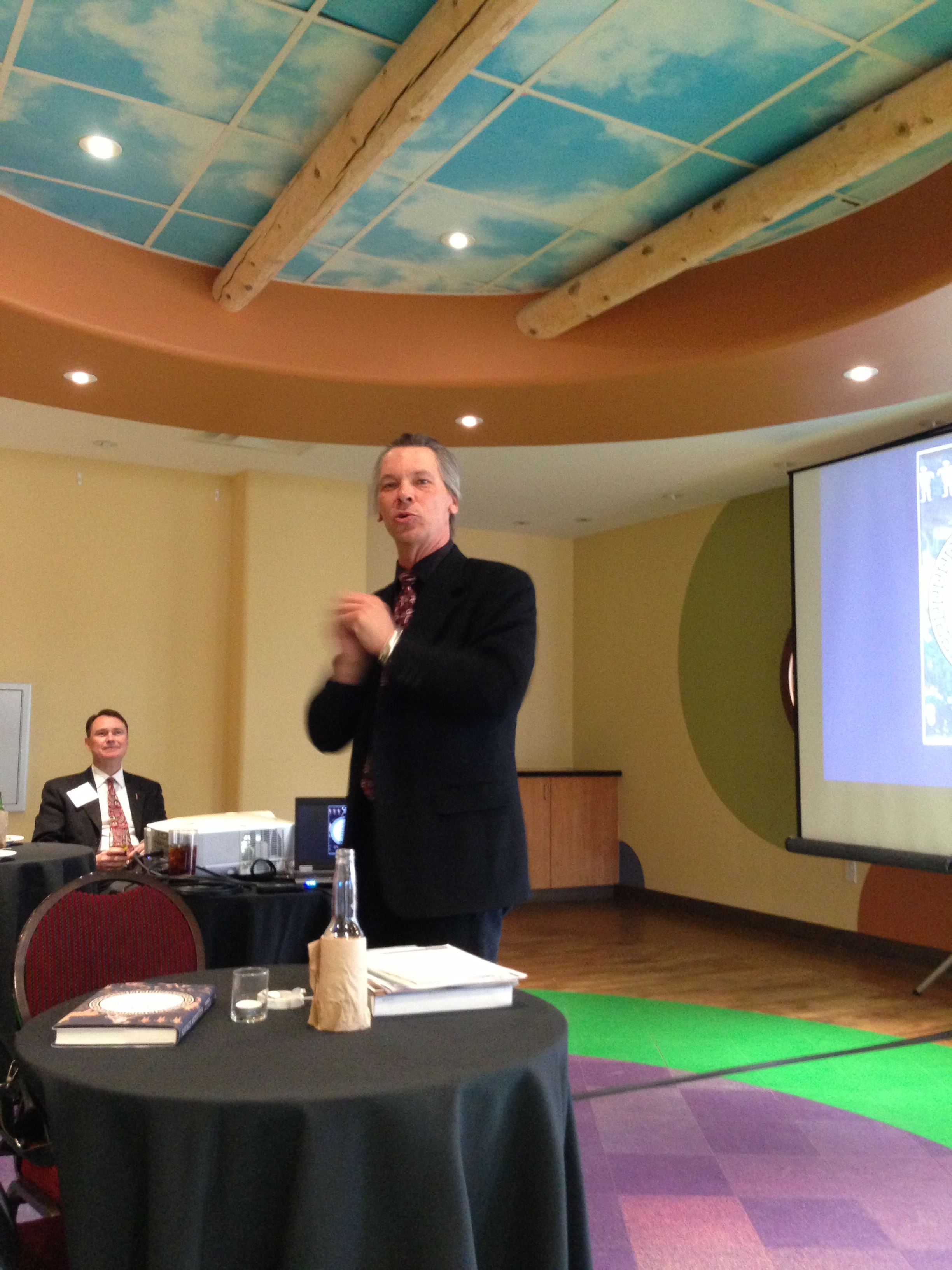
Crowd shots:



Here are the materials:
Wyandotte Motion for Summary J
An excerpt:
Plaintiff Wyandotte Nation, a federally recognized Indian tribe (“the Nation”), filed this lawsuit against Kenneth Salazar, Secretary of the United States Department of the Interior (“the Secretary”), seeking an order from this Court compelling the Secretary to accept title to certain land and hold it in trust for the Nation’s benefit, as specifically required by Public Law 98-602, 98 Stat. 3149 (1984) (“P.L. 98-602”), under both the Administrative Procedure Act (“APA”), 5 U.S.C. § 706(a) and the Mandamus Act, 28 U.S.C. § 1361. The State of Kansas (“the State”) was permitted to intervene as of right under Fed. R. Civ. P. 24(a).1 This matter is before the Court on the Nation’s Motion for Summary Judgment (Doc. 60) and the Secretary and State’s cross-motions for summary judgment (Docs. 66, 69). The Court heard oral arguments on March 14, 2013, at which time the Secretary was directed to supplement the Administrative Record and the matter was taken under advisement. For the reasons explained in detail below, the Court denies the Nation’s motion and grants in part and denies in part the Secretary and the State’s cross- motions, retaining jurisdiction over the case until the agency issues a final decision on the Nation’s pending land-into-trust application.
Prior posts on this case here, here, and here.


You must be logged in to post a comment.