Author: Matthew L.M. Fletcher
FTCA Claim against US for Alleged Negligence of Hannahville Indian Community Employee Dismissed on Jurisdiction Grounds
Here are the materials in Rock v. United States (W.D. Mich.):
DCT Order Dismissing Rock Complaint
Federal Motion to Dismiss 1st Amended Complaint
Horrid story.
FTCA Claim against US for Alleged Negligence of Kickapoo Tribe in Kansas Employee Dismissed on Jurisdiction Grounds
Here are the materials in Dinger v. United States (D. Kan.):
An excerpt:
Plaintiff Tammy Dinger brought suit under the Federal Tort Claims Act, alleging that her husband’s death was the result of the negligent operation of a motor vehicle by a tribal employee who was allegedly working under a grant from the federal government at the time of the accident. Defendant United States of America requests that the Court either dismiss the suit for lack of subject matter jurisdiction (Doc. 8), or in the alternative, grant summary judgment in its favor (Doc. 15).
Federal Court Dismisses Pala Band Membership Claims On Sovereign Immunity Grounds
Here are the materials in Allen v. Smith (S.D. Cal.):
17.1 – Defendants’ Memorandum Supporting Motion to Dismiss
18 – Plaintiffs’ Opposition to Motion to Dismiss
23 – Defendants’ Reply Supporting Motion to Dismiss
26 – Plaintiffs’ Notice of Recent Authorities
28 – Defendants’ Response to Notice of Recent Authorities
31 – Plaintiffs’ Notice of Additional Recent Authorities
33 – Defendants’ Response toNotice of Additional Recent Authorities
36 – District Court Order Dismissing Action
Judge William Q. Hayes of the Southern District of California ruled that sovereign immunity barred claims against the Pala Band of Mission Indians seeking enrollment in the Tribe and money damages. Importantly, the court distinguished the Ninth Circuit’s recent decision in Maxwell v. San Diego County.
Here are some key excerpts:
The Maxwell court distinguished the facts of its case from Hardin v. White Mountain Apache Tribe, 779 F.2d 476 (9th Cir. 1985), a case where the plaintiff sued tribal council members for allegedly ordering tribal police to eject plaintiff from tribal land. Id. at 478. The Court of Appeals for the Ninth Circuit in Hardin concluded that the council members “had act[ed] in their representative capacity and within the scope of their authority.” Id. at 479. “Holding the defendants [in Hardin] liable for their legislative functions would … have attacked the very core of tribal sovereignty.” Maxwell, 2013 WL 542756 at *12.
. . .
Based upon the “essential nature and effect” of the injunctive and declaratory relief sought in the Complaint, the Court finds that the Pala Tribe is the “real, substantial party in interest” in this case. Maxwell, 2013 WL 542756 at *11. Only the Pala Tribe, whose sovereign immunity is unquestioned, could satisfy the relief sought in the Complaint, i.e. the reinstatement of Plaintiffs as members of the Tribe. Defendants, as members of the Executive and Enrollment Committees, “possess the power” to grant Plaintiffs that relief “on behalf of the tribe.” Id. Accordingly, the Court finds that this action, as alleged, is fundamentally one against the Pala Tribe and that Plaintiffs have sued the individual Defendants in their official capacities.
. . .
The Court finds that the relief sought in this Complaint would “require affirmative action by the sovereign,” i.e. the Pala Tribe’s re-enrollment of Plaintiffs. Larson, 337 U.S. at 691 n.11. Such a remedy would operate against the Pala Tribe, impermissibly infringing upon its sovereign immunity. See generally Lewis v. Norton, 424 F.3d 959 (9th Cir. 2005) (“Courts have held that tribal immunity bars suits to force tribes to comply with their membership provisions, as well as suits to force tribes to change their membership provisions.”(citations omitted)); Santa Clara Pueblo, 436 U.S. at 72 n.32 (“A tribe’s right to define its own membership for tribal purposes has long been recognized as central to its existence as an independent political community…. Given the often vast gulf between tribal traditions and those with which federal courts are more intimately familiar, the judiciary should not rush to create causes of action that would intrude on these delicate matters.”); Imperial Granite Co., 940 F.2d at 1272 (“[A] tribe’s immunity is not defeated by an allegation that it acted beyond its powers.”). Based upon the factual allegations of the Complaint and the nature and effect of the relief sought, the Court concludes that Defendants acted in their official capacities and within the scope of their authority when they made the membership determinations at issue in this case.
Tribal Gaming Per Cap Payments May Decrease Labor Productivity and Increase Fertility (?!?!)
Here is a study of the effects of gaming per capita payments on tribal members of three Michigan tribes (Keweenaw Bay Indian Community, Saginaw Chippewa Indian Tribe, and Pokagon Band of Potawatomi Indians). In line with the 1491s’ hilarious video in which a candidate for tribal office runs on the platform of “progression, procreation, per cap,” the study suggests that tribal members receiving per caps leads to “decreased work efforts,” while “weak” evidence exists that per cap payments increase fertility. Enjoy.
Here is the study:
The abstract:
The purpose of this research is to provide a preliminary examination of the effects of per capita tribal payments on the decision making of tribal members. Standard microeconomic theory suggests that unearned income changes the labor-leisure tradeoff in utility maximization models. While the results of per capita payments on hours of work can be easily anticipated, the effects of these payments on human capital accumulation and family size are more ambiguous. Using Census data from 1990 and 2000 we shed some light on the impact of these per capita tribal payments on the lives of the recipients. We concentrate on three tribes in the state of Michigan: the Saginaw Chippewa Tribe, the Keweenaw Bay Indian Community, and the Pokagon Band of Potawatomi Indians of Michigan. The results lend support to the basic labor theory conclusion that an increase in nonlabor income causes individuals to decrease their work efforts. There is also weak evidence that the payment of per capita payments from casino profits is increasing the fertility rate of Saginaw Chippewa tribal families.
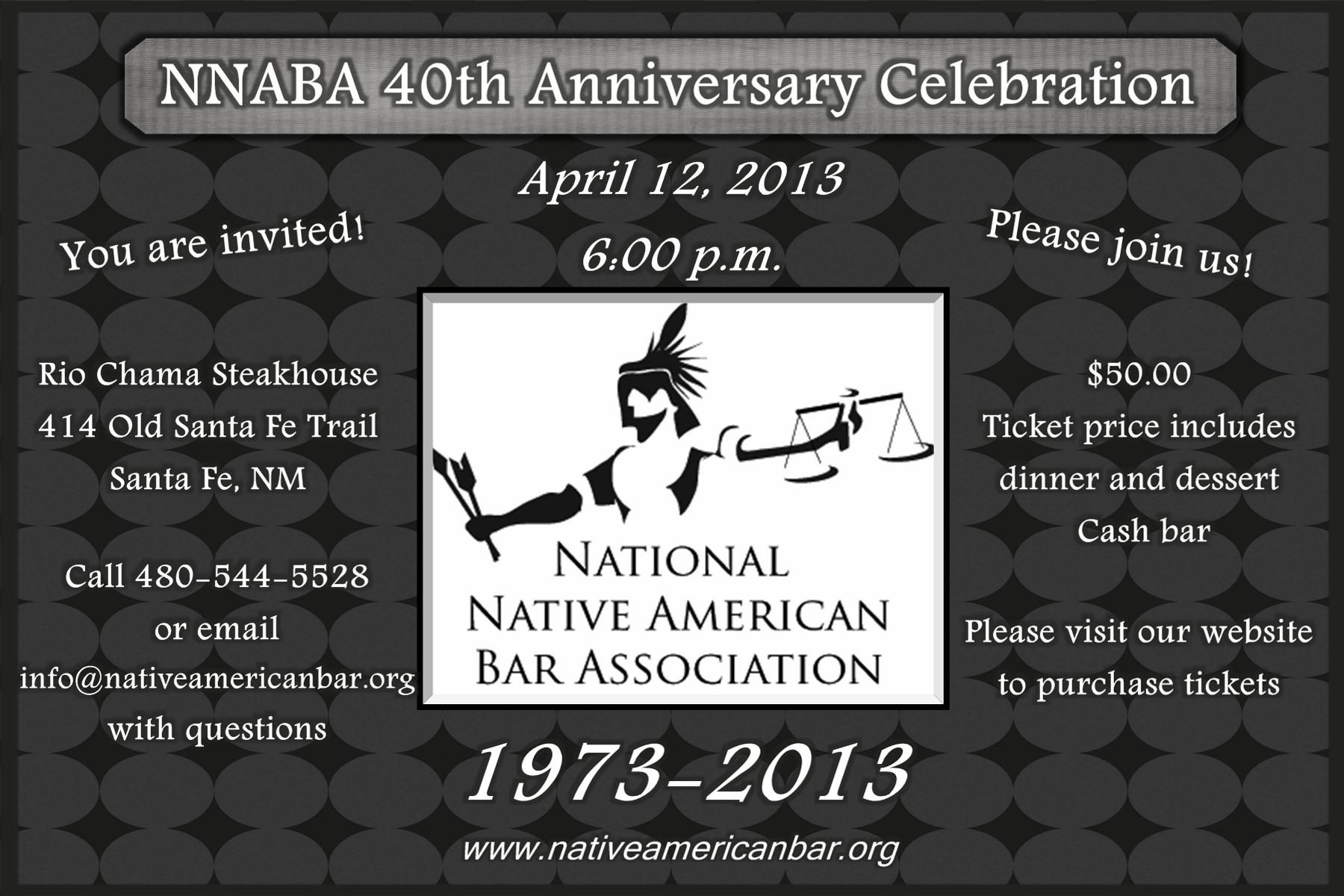
NNABA 40th Anniversary Celebration — April 12 — Santa Fe
Another Update in Winnemucca Leadership Dispute
Eh, nothing changed.
DCT Order Denying Motion to Reconsider
Ayer Group Motion for Reconsideration
The previous order is here.
New Scholarship: “Property Law and American Empire”
Michael Burger and Paul Frymer have posted their paper, “Property Law and American Empire,” forthcoming in the University of Hawai’i Law Review.
Here is the abstract:
Current scholarship by legal commentators and political scientists recognizes that the weapons of American empire have involved non-militaristic activities as much as militaristic ones. Such non-militaristic activities include the hegemonic influence of trade agreements, the imposition of legal and procedural norms, and the dissemination of ideological and cultural predispositions through corporations and diverse medias. In this paper, we examine an under-explored area on the “soft” belly of the American leviathan, focusing specifically on how property and intellectual property law have operated on physical and ideological frontiers to comprehend, participate in, and legitimate the expansion of American empire. We offer new accounts of two historical instances of empire-building: the acquisition and seizure of property from Native Americans in the early- and mid-19th century, and the expropriation of intellectual property rights to plant genetic resources from indigenous communities in the global South in the late 20th century. These two stories, taken together, offer unique insights into both the process and the substance of law’s operation on the frontier of empire. They illuminate how the authority of law has fused with private power and legal legitimacy to enable the nation to expand swiftly, energetically, and powerfully. These insights, in turn, lead toward the more general conclusion that the rhetoric of property has functioned to subjugate peoples and places, cultures and natures, to an imperial regime.
Table Mountain Rancheria Prevails In Membership Dispute Before The Ninth Circuit
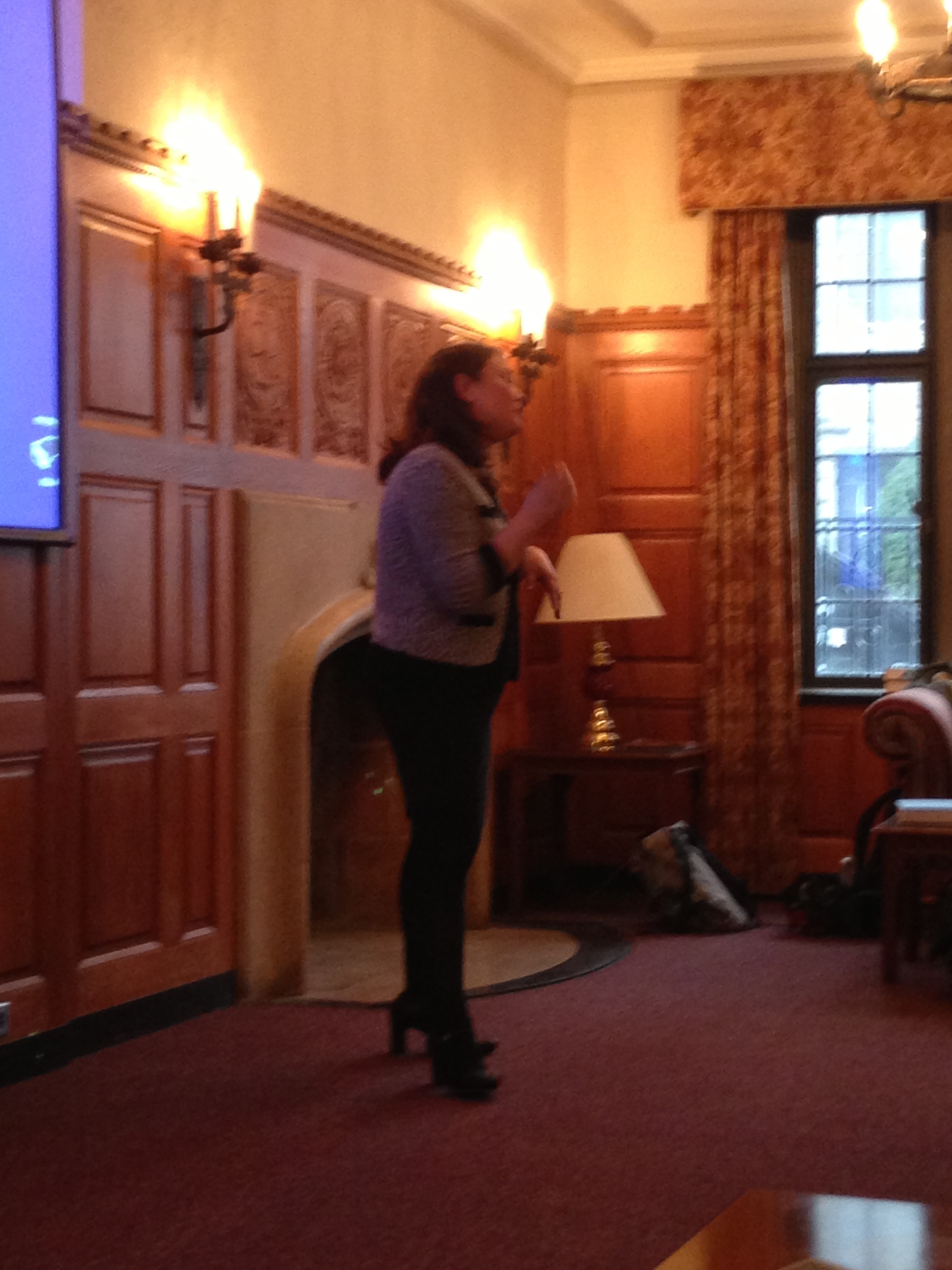
Singel and Fletcher Talk at Cornell
Rose Petoskey, GTB member and Cornell NALSA president

Wenona Singel
Cornell’s excellent A:kwe:kon hall



You must be logged in to post a comment.