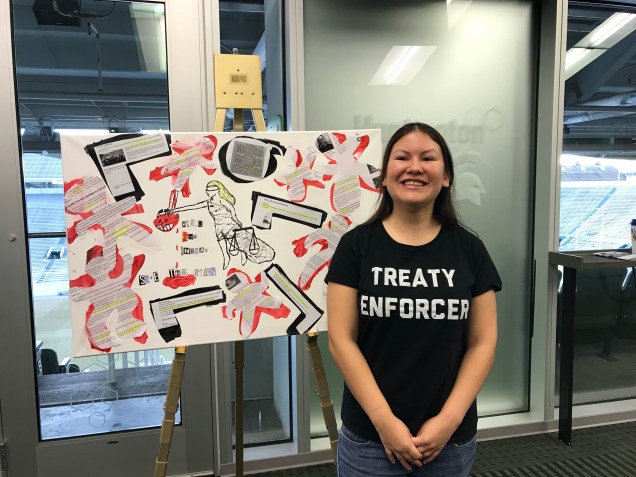
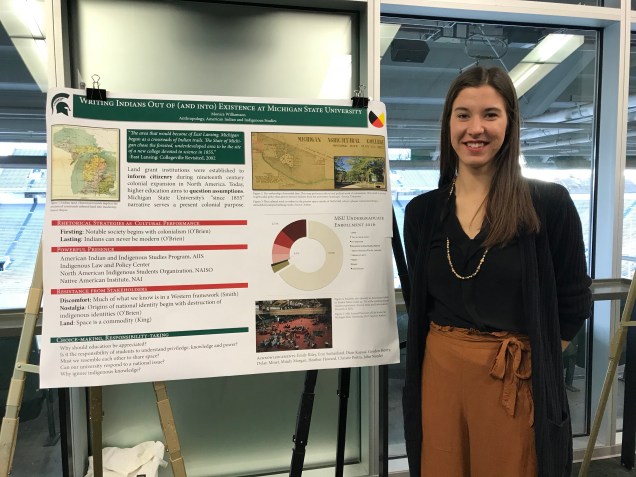
MSU Truth and Reconciliation Conference Poster Presentations: Emmy Scott and Monica Williamson
Here:
Question presented:
Can Congress’s delegation to the Department of the Interior of withdrawal authority over large tracts of land survive without the legislative veto right that Congress included as a check on the exercise of that authority?
Lower court materials here.
Update:
Here.
New York Times Op-Ed:
After dams were built on the river starting in 1912, the salmon were blocked. Today the only “c’iyaals hoches” (salmon runs) are enacted by the Klamath Tribes, whose members carry carved cedar salmon on a 300-mile symbolic journey from the ocean to the traditional spawning grounds to bring home the spirit of the fish.
HERE.
It’s was a month ago, but here goes:
1 CA-CV 16-0521 Hopi v. AZ Snowbowl
Thanks to D.C. for sending this along.
Briefs here.
Here is “‘Decolonizing’ Roller Derby? Team Indigenous Takes Up the Challenge.”
Sarah Krakoff has posted “Public Lands, Conservation, and the Possibility of Justice” on SSRN. The paper is forthcoming in the Harvard Civil Rights-Civil Liberties Law Review.
Here is the abstract:
On December 28, 2016, President Obama issued a proclamation designating the Bears Ears National Monument pursuant to his authority under the Antiquities Act of 1906, which allows the President to create monuments on federal public lands. Bears Ears, which is located in the heart of Utah’s dramatic red rock country, contains a surfeit of ancient Puebloan cliff-dwellings, petroglyphs, pictographs, and archeological artifacts. The area is also famous for its paleontological finds and its desert biodiversity. Like other national monuments, Bears Ears therefore readily meets the statutory objective of preserving “historic and prehistoric structures, and other objects of historic or scientific interest.” Unlike every other monument since the passage of the Antiquities Act, however, Bears Ears was proposed by a coalition of American Indian Tribes. The Bears Ears Inter-Tribal Coalition, which submitted the proposal to protect Bears Ears, included representatives from the Hopi Tribe, Navajo Nation, Ute Mountain Ute, Uintah and Ouray Ute, and Zuni tribal governments.
Historically, the Antiquities Act and other federal conservation laws played very different roles in the lives of Native people. Conservation laws divested Tribes of their lands and cultural heritage in the name of preserving these resources for others. Moreover, federal laws and policies designed to destroy tribal political structures were at their apex during the same period that early conservation policy was formed. Together, and complemented by laws that privatized vast swathes of the federal public domain, conservation law and federal Indian law effected a joint project of Indian elimination. This Article explores that dark side of conservation history, and describes the very different process that led to the Bears Ears designation. It argues that by restoring tribal connections to the landscape, Bears Ears National Monument serves as a partial act of reparations.
Today, Bears Ears National Monument is under threat. President Trump reduced the Monument to a small fraction of its size and divided it into two parcels. The Tribes, along with conservation groups, have sued, arguing that the Antiquities Act authorizes the President only to create monuments, not to eliminate or shrink them unilaterally. As that legal battle plays out, the story of Bears Ears remains worth telling. Its saga explores the intertwined histories of the development of racial attitudes and environmental thought, and fills in an important chapter in the larger story of Indian appropriation. The inter-tribal effort to establish Bears Ears will leave its mark on public lands and conservation law, regardless of the ebbs and flows of current legal disputes.
Here are the materials in Wildearth Guardians v. United States Fish & Wildlife Service (D. Mont.):
Andrew Rome has published “Black Snake on the Periphery: The Dakota Access Pipeline and Tribal Jurisdictional Sovereignty” in the North Dakota Law Review.
 Turtle Talk
You must be logged in to post a comment.