Lac Vieux Desert Band Buys Bellicose Capital, LLC

Link to news coverage here.

In a major deal that will bring millions of dollars in economic development to the Lac Vieux Desert Band of Lake Superior Chippewa Indians (LVD) and its geographically isolated reservation in Watersmeet, MI, LVD has today announced that it has completed the purchase of Bellicose Capital. Bellicose has been a valued service provider to the Tribe’s lending business and talks to acquire Bellicose have been underway for several years.

Ramah Fairness Hearing Minutes

Hearing on Final Approval of Final Settlement Agreement (Doc. No. 1334) and on Application for Attorneys’ Fees and Costs (Doc. Nos. 1313 and 1335)

Things heat up on page 10 when attorneys call as a witness Professor Brian Fitzpatrick of Vanderbilt Law School to convince the court that 8.5% in attorney’s fees is fair when the Lodestar method would have awarded slightly less.  Ramah Class was awarded $940 million so that means $79 million will be fees.  Since class counsel spent just under 20,000 hours on the case the rate comes out to just under $4k/hour.  The court didn’t conduct its own Lodestar check.

Ryan Dreveskracht on Doing Business in Indian Country

From the ABA’s Business Law Today, “Doing Business in Indian Country: A Primer.”

U.S. Brief in Support of Dismissing Menominee’s Hemp Claim

Doc. 16 – Defendants’ Memorandum in Support of Defendants’ Motion to Dismiss

Previous coverage and court documents here and here.

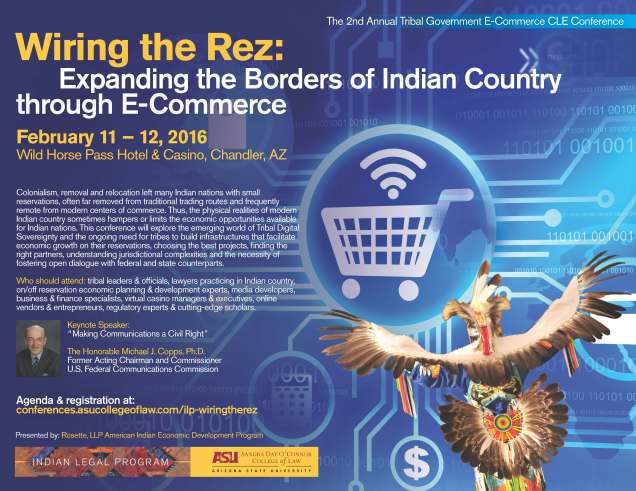
“Wiring the Rez: Expanding the Borders of Indian Country through E-Commerce”

Here (Wiring the Rez E-Commerce Conference_Flyer 2016):

Wiring the Rez E-Commerce Conference_Flyer 2016

Selected Materials in Commonwealth of Penn. v. Think Finance LLC

Here:

67-1 Think Finance Motion to Dismiss Rule 19

68-1 Think Motion to Dismiss Rule 12 and 17

70-1 Think Motion to Dismiss

73 Rees Motion to Dismiss

75 Commonwealth Opposition

93 DCT Order

Excerpts:

In both Hotleva and Chehalis, the actions of the non-party would preclude the relief sought. In contrast, here the relief sought by the Plaintiffs does not require the non-party tribes to do or refrain from doing anything. For example, the Plaintiff seeks disgorgement of the money earned by the Defendants only, not the money the tribes have earned, through the alleged scheme. FAC p. 40. The Plaintiff is not seeking a declaration that the contracts themselves are illegal, but rather a declaration that the Defendants’ conduct violates a number of state and federal laws.FAC p. 39. The Chippewa Cree were engaged in consumer lending prior to their partnership with Think Finance and, since the tribes are not bound by the outcome of this case, they would be permitted to continue that business. The tribes continuing their business (without the services of the Defendants) would in no way limit the relief the Plaintiffs seek. See Dillon v. BMO Harris Bank, N.A., 16 F.Supp.3d 605, 615 (M.D.N.C. 2014) (“[J]udgment…will not prohibit the lenders from lending money or from relying on other mechanisms to collect on their loans.”). The relief the OAG seeks is thus not “hollow.” The tribes are not required underRule 19(a)(1)(a).
Afognak Native Corporation Wins Multi-Million Dollar Contract Dispute Judgment

Here are the materials in Alutiiq International Solutions LLC v. OIC Marinaras Ins. Co. (D. Nev.):

180 DCT Order re Discovery Abuses

208 Magistrate R&R

217 DCT Order

Ninth Circuit Briefs in Hopi Tribe v. EPA

Here:

Federal Brief

Gila River Indian Community Brief

Hopi Tribe Brief

National Parks Conservation Assn Brief

Navajo Nation Brief

Salt River Project Brief

Tribal Conservation Organizations Brief

Tribal Conservation Organizations Reply Brief

Yazzie Brief

Yazzie Reply

Petition here.

New Carla Fredericks Scholarship on Tribal Energy

Carla Fredericks has posted “Plenary Energy,” forthcoming in the West Virginia Law Review, on SSRN.

Here is the abstract:

An incompatible relationship exists between the federal trust responsibility over Indian tribes and tribal sovereignty, the conflicting nature of which has been exacerbated by numerous judicial confirmations of the unbridled congressional plenary power over all tribal affairs. Nowhere is there more conflict between the trust responsibility and sovereignty than within the context of mineral resource development on tribal lands. The evolution of the regulatory framework of Indian mineral development can be viewed as a continuum, with maximum trust obligation and minimum tribal sovereignty on one extreme, and an inversion of these two variables on the other. There currently exists pending legislation that would amend the 2005 Energy Policy Act in a manner that would allow tribes greater autonomy in developing their mineral resources without necessarily compromising the trust relationship. But, as this article suggests in using the Keystone XL Pipeline as a case study, tribes should not rely on Congress to act in the interest of tribal sovereignty unless they can attach this interest to a strong political impetus. Invoking both the United Nations Declaration on the Rights of Indigenous People and Convention No. 169 of the International Labour Organization, this article contends that attaining a understanding of American Indian rights as fundamental through an international human rights framework can help untangle the web of conflicting doctrines that very much defines American Indian law today, opening the door to a paradigm shift in the domestic relationship between tribes and the federal government that would allow tribes to attain economic self-sufficiency through their own assets.

Guardian Series on America’s Poorest Towns Includes Gila River

Link to article here.