Fletcher on Tribal Customary Law and an Indigenous Canon of Construction

Check out “The Three Lives of Mamengwaa: Toward an Indigenous Canon of Construction” on SSRN.

Abstract:

This paper will survey the history of tribal courts, which allows for an explanation for the reasons behind the relatively minimal impact tribal courts have had on Indian country governance, drawing on the work of Rob Porter. The paper will then turn to the monumental changes in tribal judiciaries and in tribal legal practice of the last few decades, which in turn allows for a discussion about several recent tribal court decisions that could signal a future where tribal courts play a far greater role in regulating Indian country governance through the application of customary law, drawing on the work of Wenona Singel. Finally, the paper offers preliminary thoughts on whether adding robust tribal judicial regulation to an already crowded field of Indian country governance is normatively beneficial. Short answer? Yes. Many of the intractable political disputes that plague tribal governance can be traced to the reliance by tribal governments on state and federal legal principles that are deeply flawed and have limited value in Indigenous contexts. I suggest the acknowledgment of an Indigenous Canon of Construction of tribal laws by tribal judiciaries that limit the impact of colonization on tribal nations.
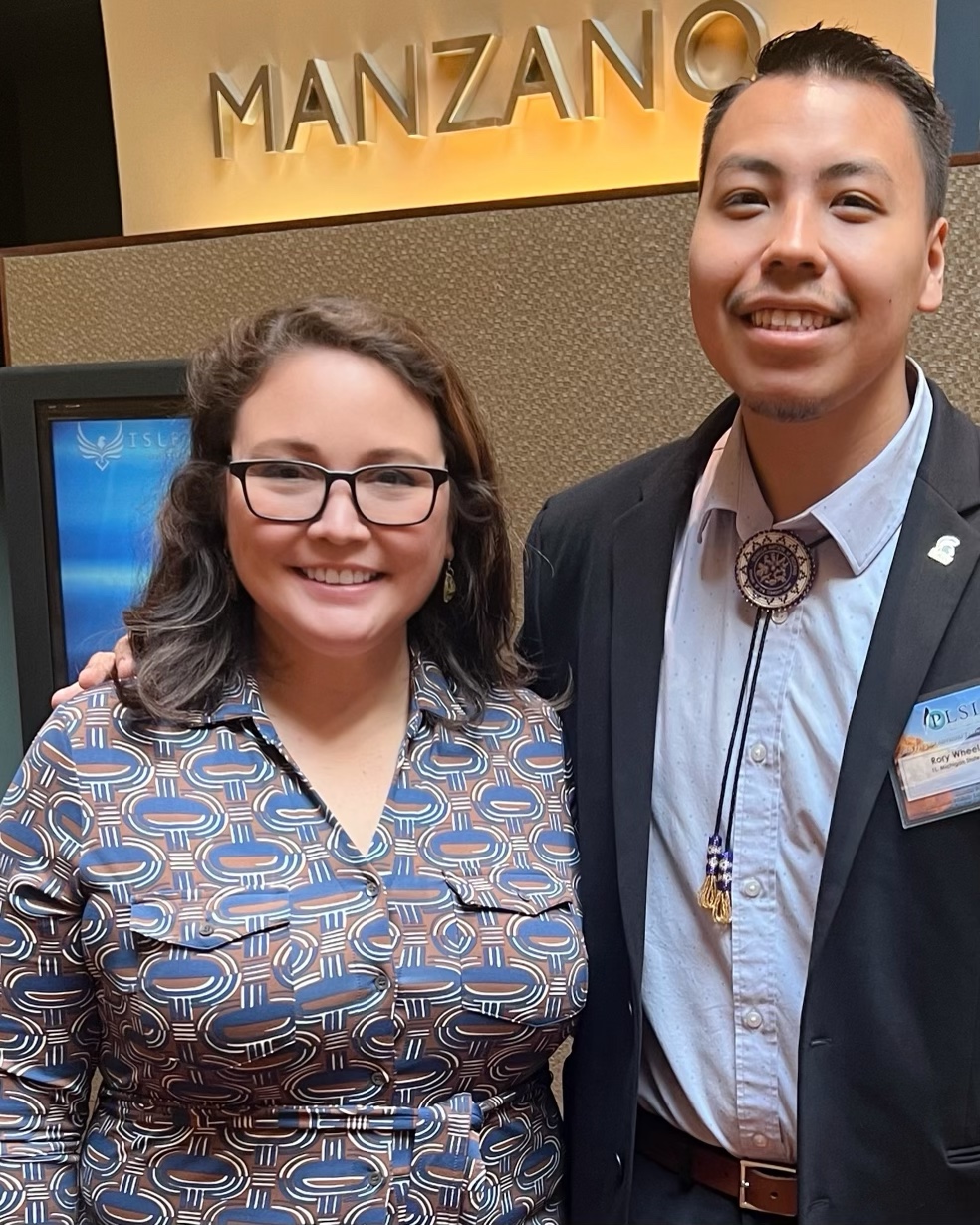
Sparty Representing at PLSI Pre-Law Advisors Training Conference

Wenona Singel and Rory Wheeler

D.C. Federal Court Rejects Sault Tribe’s Third Effort to Force Interior to Acquire Land for Off-Rez Gaming

Here is the order in Sault Ste. Marie Tribe of Chippewa Indians v. Haaland (D.D.C.):

Briefs here.

Tribe and State Offer Additional Evidence in Line 5 Matter before Michigan Public Service Commission

Here are the new materials:

Materials re: Opposition to Proposed U.S. v. Michigan Consent Decree [updated]

Lots of lawyers making money on what appears to be utterly farcical litigation.

Here are the updated materials in United States v. Michigan (W.D. Mich.):

2074 State Opposition to Motion to Reconsider

2075 GTB Response to Motion to Reconsider

2076 Federal and Tribal Opposition to Sault Motion to Reconsider Stay Order

2077 Sault Tribe Objections to Proposed Consent Decree

2078 Sault Tribe Motion

Prior post with the details of the consent decree here.

Here are materials in an interlocutory (?) appeal on whether the amici can formally intervene in the case (there is a federal brief, joined by the four tribes who signed onto the consent decree, that is sealed):

Burt Lake Band Attempting to Re-open Federal Recognition Suit

Here are the new materials in Burt Lake Band of Ottawa and Chippewa Indians v. Haaland (D.D.C.):

63-1 Burt Lake Motion

Docket No. 64: MINUTE ORDER. Federal courts are courts of limited jurisdiction and the law presumes that “a cause lies outside this limited jurisdiction.” Kokkonen v. Guardian Life Ins. Co. of Am., 511 U.S. 375, 377 (1994); see also Gen. Motors Corp. v. EPA, 363 F.3d 442, 448 (D.C. Cir. 2004) (“As a court of limited jurisdiction, we begin, and end, with an examination of our jurisdiction.”). Subject matter jurisdiction may not be waived, and “courts may raise the issue sua sponte.” NetworkIP, LLC v. FCC, 548 F.3d 116, 120 (D.C. Cir. 2008), quoting Athens Cmty. Hosp., Inc. v. Schweiker, 686 F.2d 989, 992 (D.C. Cir. 1982). Indeed, a federal court must raise the issue because it is “forbidden… from acting beyond [its] authority, and ‘no action of the parties can confer subject-matter jurisdiction upon a federal court.'” Id., quoting Akinseye v. Dist. of Columbia, 339 F.3d 970, 971 (D.C. Cir. 2003). In connection with the 63 Motion to Rule Upon Constitutional Claims and For Permanent Injunction, then, plaintiff must show cause by January 6, 2023 why the question of the validity of the proposed rule would be ripe at this time, and why the Court has subject matter jurisdiction to consider the constitutional issues when there is no live controversy before it. The 2015 rule has been vacated but its replacement has not yet been promulgated, so plaintiff must explain why it is not simply seeking an advisory opinion. SO ORDERED. Signed by Judge Amy Berman Jackson on 12/23/2022. (lcabj2) (Entered: 12/23/2022)

65 Burt Lake Response

66 Interior Response

Prior post here.

Fourth Circuit Affirms Certification of Class Action against Tribal Payday Lending Operation [that’s kinda what this case is now, kinda]

Here is the opinion in Williams v. Martorello.

An excerpt:

This class-action proceeding relates to a lending scheme allegedly designed to circumvent state usury laws. Matt Martorello appeals from three district court rulings that (1) reconsidered prior factual findings based on a new finding that Martorello made misrepresentations that substantially impacted the litigation, (2) found that the plaintiffs- appellees—Virginia citizens who took out loans (the “Borrowers”)—did not waive their right to participate in a class-action suit against him, and (3) granted class certification.
In particular, Martorello argues that the district court violated the mandate rule by making factual findings related to the misrepresentations that contradicted this Court’s holding in the prior appeal and then relying on those factual findings when granting class certification. He also contends that the Borrowers entered into enforceable loan agreements with lending entities in which they waived their right to bring class claims against him. In addition, he asserts that common issues do not predominate so as to permit class treatment in this case.
As explained below, we disagree with Martorello. We conclude that the district court did not violate the mandate rule and that the Borrowers did not waive the right to pursue the resolution of their dispute against him in a class-action proceeding. Finally, we conclude that the district court did not abuse its discretion in granting class certification because common issues predominate. Accordingly, we affirm the rulings of the district court.

Briefs here.

Lower court materials here.

Bethany Hughes on 50 Years of Native Student Activism [at Univ. of Michigan]

Sault Tribe/Kewadin Gaming Enjoined from Concealing or Dissipating Assets in Gaming Development Company Dispute [recall the $88M judgment]

Here is the order in JLLJ Development LLC v. Kewadin Casinos Gaming Authority (Mich. Cir. Ct.):

Prior post here.