Here:
Here.
An excerpt, and a little horn tooting:
The most telling argument for the government is the recitation (in an amicus brief filed by a group of law professors) of the dozens of statutes Congress has adopted through the centuries resolving Indian land disputes and dealing high-handedly with Indian lands. It is notable that Bank Markazi emphasized Congress’ supreme authority over foreign affairs in its rejection of the Klein claim in that case. Congress’ plenary authority to regulate and protect Indian tribes leaves room for a similar resolution of this case without explicitly rejecting the Klein rule. Bank Markazi of course said nothing about Congress’s power over Indian affairs, so that result wouldn’t really follow from Bank Markazi. It would, though, afford the justices a way to decide the case narrowly, which seems to have been their goal in these cases. The key thing to watch for in the argument will be any sense that any of the members of the Bank Markazi majority show a willingness to treat this case differently than they did that one.
You can read that amicus brief here, along with the rest of the briefs
Here is the opinion in Paquin v. City of St. Ignace:
An excerpt:
In light of the foregoing, we hold that the Tribe constitutes a local government and that plaintiff’s employment with the Tribe constituted employment in “local, state, or federal government” for purposes of Const 1963, art XI, § 8. Such a holding does not diminish or undermine the Tribe’s inherent sovereign authority. “[S]tate laws are generally not applicable to tribal Indians on an Indian reservation except where Congress has explicitly provided that state law shall apply.” Huron Potawatomi, Inc v Stinger, 227 Mich App 127, 132; 574 NW2d 706 (1997). In the instant case, no one is seeking to prohibit plaintiff from running for a position in the Tribe or otherwise to interfere in the Tribe’s regulation of its internal matters. Instead, Const 1963, art 11, § 8 is being applied to prohibit plaintiff from running for a position on defendant’s city council. In other words, the constitutional provision is being used to assess the qualification of a potential candidate for a position on the city council of a Michigan municipality, not a position in the Tribe. “The members of the various Indian tribes are citizens of the United States and citizens of the state within which they reside.” Mich United Conservation Clubs v Anthony, 90 Mich App 99, 109; 280 NW2d 883 (1979) (citations omitted). In seeking to run for an elective position in a Michigan city, plaintiff was acting in his capacity as a Michigan citizen rather than a member of the Tribe. As a Michigan citizen, plaintiff is subject to the same laws as other Michigan citizens when seeking to run for an office in a Michigan municipality. See generally, Mescalero Apache Tribe v Jones, 411 US 145, 148-149; 93 S Ct 1267; 36 L Ed 2d 114 (1973) (“Absent express federal law to the contrary, Indians going beyond reservation boundaries have generally been held subject to non-discriminatory state law otherwise applicable to all citizens of the State.”).
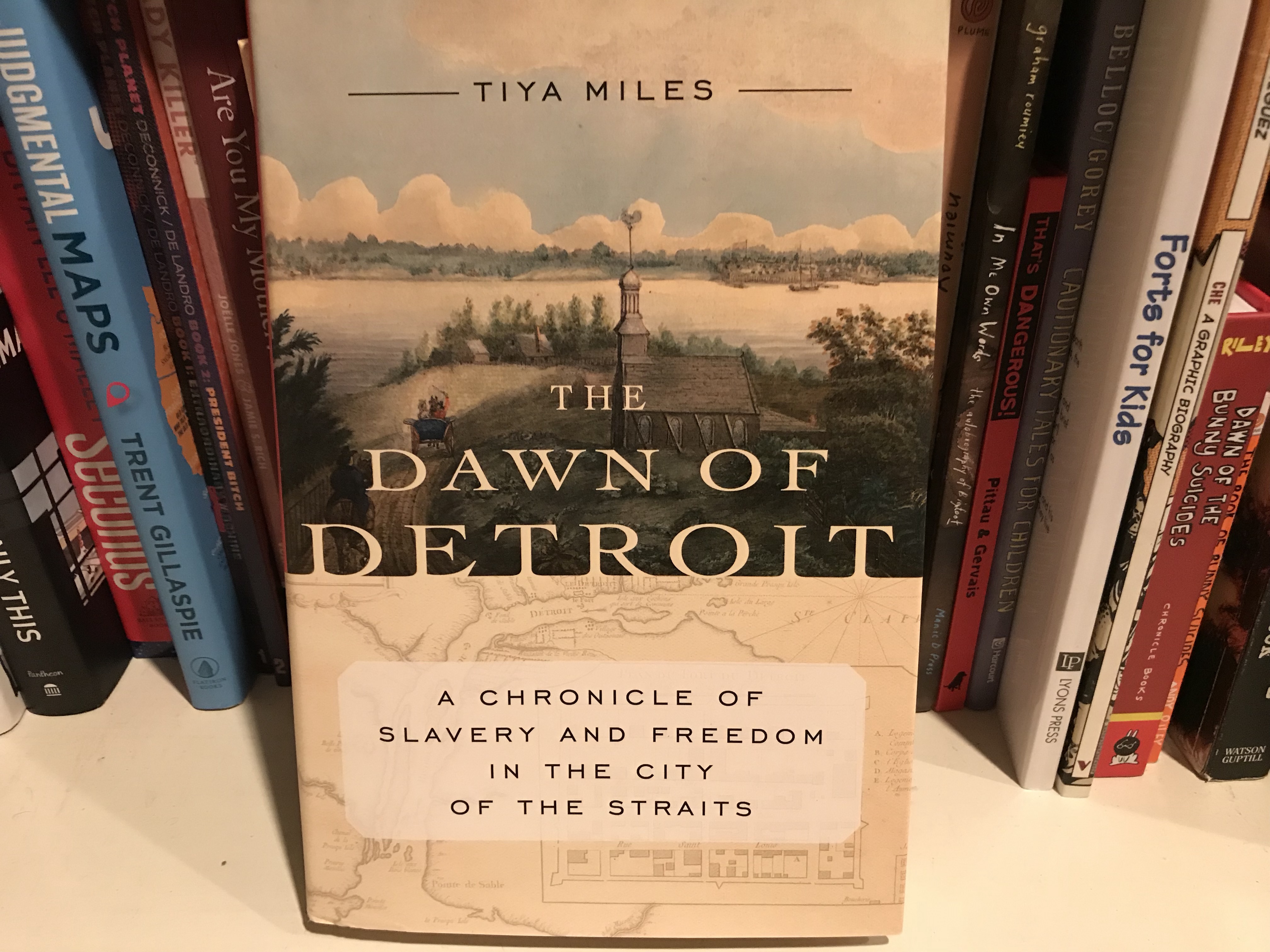
The book page is here. The blurb:
Most Americans believe that slavery was a creature of the South, and that Northern states and territories provided stops on the Underground Railroad for fugitive slaves on their way to Canada. In this paradigm-shifting book, celebrated historian Tiya Miles reveals that slavery was at the heart of the Midwest’s iconic city: Detroit.
In this richly researched and eye-opening book, Miles has pieced together the experience of the unfree—both native and African American—in the frontier outpost of colonial Detroit, a place wildly remote yet at the center of national and international conflict. Skillfully assembling fragments of a distant historical record, Miles introduces new historical figures and unearths struggles that remained hidden from view until now. The result is fascinating history, little explored and eloquently told, of the limits of freedom in early America, one that adds new layers of complexity to the story of a place that exerts a strong fascination in the media and among public intellectuals, artists, and activists.
A book that opens the door on a hidden past, The Dawn of Detroit is a powerful and elegantly written history, one that completely changes our understanding of slavery’s American legacy.
Here:



Here is the opinion in United States v. Verwiebe.
 Turtle Talk
You must be logged in to post a comment.