Here:
Bob Miller on McGirt before the Oregon Historical Association
Here:
Here:
The McGirt v. Oklahoma decision reaffirming the status of the Creek Reservation as Indian country was a watershed. But once the dust settles, we will see that the Supreme Court simply applied the law – only Congress can terminate or modify reservation boundaries and Congress did not terminate or modify the Creek Reservation boundaries. Oklahoma does not have that power.
The State of Oklahoma’s exaggerated complaints about thousands of convicted prisoners suddenly being released from jail did not persuade the Court. The calm and brilliant work of the Muscogee (Creek) Nation demonstrated to the Court that any consequences could be resolved quickly. After all, the tribes and the state and local governments had been working together for decades.
In the heady aftermath of the decision, the tribes and the state came together to reconfirm their intent to cooperate. And that was absolutely the right thing to do, so long as any agreement was consistent with the fact that McGirt preserved tribal rights.
But the agreement in principle document emerging from those negotiations is a dangerous disappointment. The tribes and the state seem to have already admitted defeat by assuming that Congress will immediately step in with legislation. Worse, rather than show – as the tribe showed the Supreme Court – that tribal, state, and local governments can handle any disruptions, the signatories to the agreement in principle seem to be playing defense. Claiming to seek predictability and clarification, the agreement in principle primarily asks Congress to codify existing principles of federal Indian law.
Tribal leaders should reject the agreement in principle. Congress should stay out of tribal-state affairs unless legislation – such as enabling the Department of Justice to expand its law enforcement capabilities – is needed.
For the most part, the agreement in principle expresses an intent to legislatively mandate long-standing principles of federal Indian law that already apply in Indian country. Before and after McGirt, tribes already possess criminal jurisdiction over Indians in Indian country. States are already excluded from prosecuting Indians in Indian country. States, tribes, and the federal government already cooperate on public safety. Tribal powers over nonmembers are governed by the Montana test and its progeny. Counsel for the Creek Nation made this clear in its briefing and in oral argument.
Codifying federal Indian law principles, which are derived from opinions of the Supreme Court, will offer little clarity. Past experience shows that unforeseen consequences are all but guaranteed.
Consider the Class II provisions of Indian Gaming Regulatory Act that Congress enacted after California v. Cabazon Band of Mission Indians. Congress took that decision, which was limited to Public Law 280 states, and codified it for all tribes in the Class II gaming category. Worse, IGRA is a litigation engine, hardly a success if the goal is predictability and clarity. Does anyone even know what “bingo” is anymore? And this is the most successful example.
Consider the Indian country statute itself. In 1948, Congress tried to restate and codify various Supreme Court decisions on what lands qualify as “Indian country.” That effort did little to assist tribal interests. In Alaska v. Native Village of Venetie, the Court held that Indian-owned and controlled lands in Alaska somehow are not Indian country. More importantly, Congress solved little when it codified Indian country. The Venetie Court still relied on its old cases to interpret the law. And Indian country is still a hotly contested, confused area of law.
Consider next the Religious Freedom Restoration Act, which Congress intended to override the Supreme Court’s decision in Employment Division v. Smith, which had overruled the Sherbert v. Verner religious freedom test. Congress failed. Dictating to the Supreme Court the correct test to apply in a constitutional rights matter like religious freedom is nearly always doomed to failure. The Court struck down RFRA as a violation of states’ rights. Again, more importantly, RFRA’s “substantial[] burden” test continues to remain dependent on the unpredictable interpretation of the courts. Infamously, the Ninth Circuit allowed the San Francisco Peaks to be defiled by the Arizona Snowbowl resort, even applying RFRA to the federal government.
The RFRA experience is particularly relevant here. Assume Congress does exactly what the agreement in principle requests. Congress will be codifying the Montana general rule and the two exceptions, authorizing tribes to assume governmental powers over nonmembers. Will the Supreme Court do as it did with the Indian country statute and RFRA, and just apply their old cases? Or will Congress apply the codified text, which could dramatically expand tribal powers over nonmembers. If that last part happens, expect challenges to Congressional Indian affairs powers.
Yes, the Supreme Court has said that tribes could exercise powers over nonmembers, in opinions reached after litigation. But when Congress does it, that is a whole other matter. Courts have flexibility to apply their precedents as each case requires. A statute is an inflexible mandate. With this statute, Congress would give the Court a vehicle to do what Justice Thomas has long demanded – reexamine the scope of Congressional Indian affairs powers. That case, when it comes, could be a close call. I would expect a 5-4 decision. If we go to the wall on Congressional Indian affairs powers, let’s make that case be about something all of Indian country will get behind, like the Indian Child Welfare Act or the tribal jurisdictional provisions of the Violence Against Women Act of 2013.
Finally, codifying common law principles of federal Indian law would end the possibility of law reform. The Supreme Court could revisit decisions on tribal criminal and civil jurisdiction over nonmembers, or state taxation and regulatory powers in Indian country. Recall that most of those cases are from the early years of self-determination before many tribes enjoyed the governance capabilities they now possess. The McGirt decision opens the door to the possibility that the Court will end its interference in Indian affairs. If nothing else, the signatories to the agreement in principle could be left out of beneficial changes to Indian law.
Fear of tribal governance made the McGirt decision close when it should have been an easy case. Tribes didn’t back down then, and they prevailed. The agreement in principle gives in to that same fear. The tribes should reject it. Luckily, the agreement is not yet law. There is still time to talk about it. And reach a better deal.
To post an open Indian law or leadership job to Turtle Talk, send the following information to indigenous@law.msu.edu:
Michigan Indian Legal Services
Staff Attorney, Southwest Michigan. The attorney will provide legal services to members of two tribes and their spouses under contracts with those tribes. Open until filled. Please see the position description for more information.
Hobbs, Straus, Dean & Walker, LLP
Legislative Analyst, Washington, DC. Hobbs, Straus, Dean & Walker, LLP, a national law firm dedicated to promoting and defending the interests of Indian tribal governments and organizations, seeks a non-attorney Legislative Analyst to work in its Washington, DC office. This position is open until filled. Please see the Job Announcement for more information and how to apply.
The Nottawaseppi Huron Band of the Potawatomi
Associate Staff Attorney, Tribal Government, Fulton, MI. Attend meetings of the Tribal Council, Committees, regulatory board/commissions and Membership meetings as requested; Under the general supervision of more senior attorneys in the Legal Department, researches and drafts resolutions, Tribal laws, regulations, and policies for Tribal Council approval; and more. For more information please see the position description. Application closes 07/31/2020 8:30am ET.
Omaha Tribe of Nebraska
Attorney General, Macy, Nebraska. Responsible for protecting all Tribal assets, defending the integrity of the Tribe, assisting and advising all Tribal entities in their pursuit of progress on behalf of Tribal members, and managing and providing legal services and representation to the Tribe, the Tribal Council, the Tribal Government, and its Tribal Entities. Position opens July 17, 2020 and is Open Until Filled. Please see the position description for more information.
See posts from July 10, 2020.
Here.
The Children’s Legal Rights Journal out of the Loyola University Chicago School of Law is now accepting papers that discuss the beneficial aspects of ICWA for Native American children, families, and tribes. Submissions are accepted on a rolling basis. Please see the call for papers here.
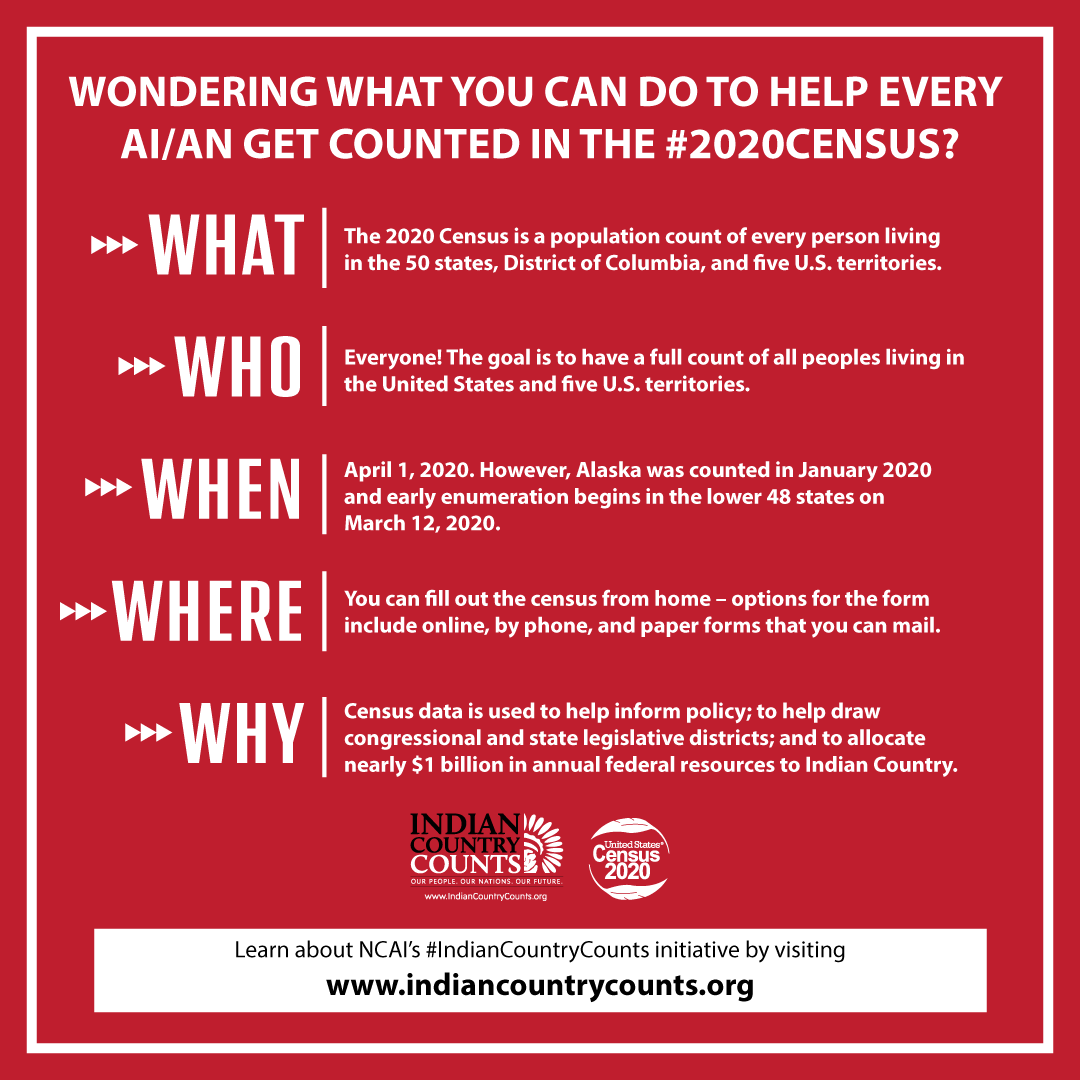
Complete the 2020 census by October 31, 2020. Start here to complete the census online, and learn more at NCAI’s indiancountrycounts.org.
 Turtle Talk
You must be logged in to post a comment.