Here:
Supreme Court
SCOTUS Denies Unkechauge and Stitt Petitions [Update: And Maverick, too]
Stroble v. Oklahoma Tax Commission Cert Petition
Here:
Question presented:
Whether Oklahoma may tax the income of a Muscogee (Creek) Nation citizen who lives and works within the Muscogee (Creek) Reservation that McGirt v. Oklahoma, 591 U.S. 894 (2020), held remains Indian country.
Lower court materials here.
CashCall v. Consumer Financial Protection Board Cert Petition
Here:
Questions presented:
1. Whether a claim for legal restitution triggers the Seventh Amendment right to a jury trial. 2. Whether a litigant may validly waive a constitutional right at a time when binding circuit precedent clearly forecloses any exercise of that right.
Lower court materials here.
Chinook Indian Nation v. Burgum Cert Petition [federal recognition]
Here:
Question presented:
Does a federal court have jurisdiction to recognize the existence of an Indian tribe where the findings in the Indian Tribe List Act, Public Law 103-454, sec. 103(3), provide that “Indian Tribes presently may be recognized by . . . a decision of a United States court,” and no other federal statute addresses the question of tribal recognition?
Lower court materials here.
Update:
Alaska v. United States Cert Petition [Alaska Native fishing subsistence rights]
Here:
Question presented:
Whether the United States can regulate fishing on Alaska’s navigable waters under the Alaska National Interest Lands Conservation Act, when its statutory authority is limited to “public lands” and that term is defined as “lands, waters, and interests therein … the title to which is in the United States.”
Lower court materials here.

John LaVelle on the Uses and Abuses of Johnson v. McIntosh by the Supreme Court
John LaVelle has published “Uses and Abuses of Johnson v. M’Intosh in Native American Land Rights Cases: Investigative Insights from the Indian Law Justice Files” in the Montana Law Review.
Here is the abstract:
The 200th anniversary of the foundational Indian law decision Johnson v. M’Intosh has come and gone, with many scholars contributing criticism and commentary. The dominant focus has been the case’s notorious embrace of the so-called “doctrine of discovery,” an odious theory for rationalizing European nations’ claims of superior rights to lands occupied by Indigenous Native American peoples. Commanding less attention, however, is the Johnson decision’s core protective legal feature, i.e., its reinforcing the United States government’s duty to guard against the alienation of Indian lands through private, unauthorized acquisitions.
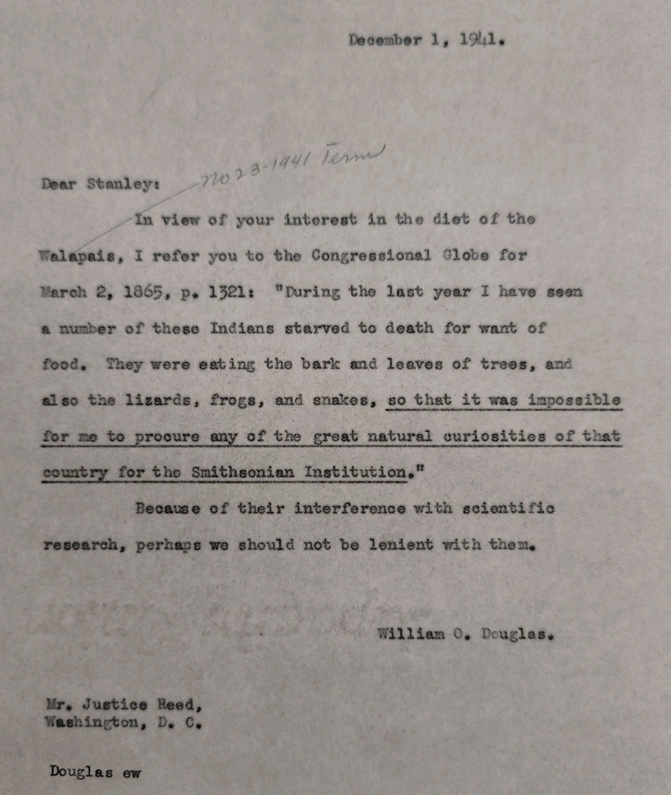
This Article offers a somewhat different appraisal of Johnson v. M’Intosh in the context of controversies over Indigenous rights. Notwithstanding the case’s offensive dicta, the unanimous Johnson opinion retains efficacy in safeguarding Native American land rights, provided certain infamous abuses of the decision as precedent can be identified and rectified. Accordingly, this Article examines instances of the modern Supreme Court’s distorting and misusing Johnson v. M’Intosh to damage, weaken, or deny Indian land rights. In centering attention on this abuse, the Article draws on eye‑opening, seldom‑viewed documents found among the papers of Supreme Court Justices archived at the Library of Congress and various universities across the country. The Article also discusses a series of modern‑era opinions by Supreme Court Justices that exemplify instructive conformity to and reliance upon Johnson’s protective features. Moreover, as a response to the joint call for papers issued by the Montana Law Review and the Public Land & Resources Law Review, the Article does not take merely a rear‑view‑mirror look at Johnson v. M’Intosh. Rather, this Article aspires to cast light on judicial distortions and misrepresentations of Johnson to help illuminate a “Vision for the Future” in legal battles over Indigenous property rights.
An accompanying Compendium of Exhibits from the Papers of Supreme Court Justices is available here.

Tribal Amicus Brief in Prisoner Rights Suit
Here is the brief in Landor v. Louisiana Dept. of Corrections and Public Safety:

Briefs in Opposition to Maverick Gaming Cert Petition
John P. LaVelle’s Compendium of Exhibits From the Papers of Supreme Court Justices
Here:
John P. LaVelle, Compendium of Exhibits From the Papers of Supreme Court Justices, 88 Mont L. Rev. Online (2025).
 Turtle Talk
You must be logged in to post a comment.