Here.
33.541135
-111.869012
Here.
Here (PDF):
Here.
My article. “How Allotment-Era Literature Can Inform Current Controversies on Tribal Jurisdiction and Reservation Diminishment” was recently published in volume 82 of the University of Toronto Quarterly, in a special issue on law and literature.
I looked at non-Native authored and Native-authored literature of the time, specifically in South Dakota and surrounding states and territories, to see whether it helped illuminate the injustices that were being perpetrated on tribes through the allotment process and the takings of surplus lands. The idea was that this literature might have, like the news articles I looked at in “Unjustifiable Expectations: Laying to Rest the Ghosts of Allotment-Era Settlers,” put purchasers on notice that tribal lands were being taken unjustly. Most of the non-Native literature I looked at was not that helpful, but a work by historian/poet Doane Robinson was an exception. On the Native side, Zitkala-Sa’s short stories proved to be the most helpful, but the works I looked at by Luther Standing Bear and Charles Eastman were also somewhat helpful.
Unfortunately, the article isn’t available on Lexis or Westlaw, but it is on Muse, if you have access to that. A sightly older version is on my ssrn page.
Here are the materials in King Mountain Tobacco Co. v. Alcohol and Tobacco Tax and Trade Bureau (E.D. Wash.):
149 DCT Order Granting US Motion
An excerpt:
The Court finds no exemption from federal excise taxes on manufactured tobacco products under the General Allotment Act because the finished tobacco products are not derived directly from the land. The Court finds no exemption under either Article II or III of the Yakama Treaty of 1855 because neither Article contains express exemptive language applicable to the manufacture of tobacco products. Finally, the Court finds no exemption under Section 4225 of the Internal Revenue Code because the exemption for Indian handicrafts on its face does not apply to excise taxes for the manufacture of tobacco products. Therefore, the United States is entitled to summary judgment on all claims.
Matthew L.M. Fletcher, Kathryn E. Fort, and Dr. Nicholas J. Reo have published “Tribal Disruption and Indian Claims” in Michigan Law Review’s First Impressions. PDF. Here is a taste:
Legal claims are inherently disruptive. Plaintiffs’ suits invariably seek to unsettle the status quo. On occasion, the remedies to legal claims can be so disruptive-that is, impossible to enforce or implement in a fair and equitable manner-that courts simply will not issue them. In the area of federal Indian law, American Indian tribal claims not only disrupt the status quo but may even disrupt so-called settled expectations of those affected by the claims.[1] The U.S. Court of Appeals for the Second Circuit has dismissed a round of Indian land claims at the pleading stage, including Onondaga Nation v. New York,[2] because it considered the claims so disruptive.
We agree that Indian legal claims are inherently disruptive and may implicate the centuries-old settled expectations of state and local governments and non-Indians. It is empirically and categorically false, however, that the remedies tribal interests seek are impossible to enforce or implement in a fair or equitable manner. Every year in cases against state governments and their political subdivisions, Indian tribes settle long-standing claims that at their outset, often appear intractable, if not downright impossible, to remedy. The recent settlements of claims by the Oneida Indian Nation of New York,[3] the Saginaw Chippewa Indian Tribe,[4] and five Michigan Anishinaabe tribes[5] demonstrate the falsehood of the idea that Indian claims are too disruptive to be remedied. These negotiated settlements powerfully illustrate that the disruption produced by Indian claims has an important function: forcing federal, state, and tribal governments to creatively seek solutions to difficult governance issues in Indian country.
Part I of this Essay describes recent common law, which dismisses Indian claims on the grounds that they are too disruptive. Part II briefly surveys the history of the relationship between Indians and the United States. Part III describes recent settlements between tribal and local governments. Part IV presents our theory of tribal disruption based on notions of ecological disturbance, studied in ecology and related fields. We argue that ecological disturbance in linked social-ecological systems offers a useful analog to the disruptive nature of Indian claims. These claims can be compared to disturbances in rivers, forests, or other ecosystems. Floods, forest fires, and windstorms break down existing structures, allowing space for reorganization, diversification, and new growth. Tribal claims similarly clear out a legal space for creative and improved governance institutions.
We learned the terrifically sad news that Barbara Lane, the legendary and heroic anthropologist that served as the lead expert witness in the United States v. Washington trial that led to the Boldt decision passed away late last year. 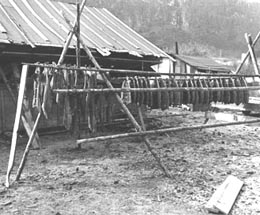
In her honor, we dug up a rare copy of a short article she published in the now-defunct American Indian Journal that summarized some of her written testimony. Here:
Background of Treaty Making in Western Washington
And, of course, the Boldt decision itself:
UPDATE — we have her obituary now:
Barbara Lane, one of the foremost experts in First Nations anthropology and Native American rights, passed away on December 31, 2013 in Arlington, Washington. Dr. Lane produced exceptional expert reports and testimony in more than 40 court cases, many of which were pivotal in determining the rights of native peoples to access and use natural resources. The United States federal courts that ruled on treaty fishing rights in the Northwest relied heavily on her testimony. Her work was instrumental for the Quinault and other Washington Tribes in numerous treaty fishing rights cases related to the 1974 Boldt Decision (U.S. vs Washington) and for the Quinault in Mitchell vs U.S. in 1977. The United States Supreme Court referenced her findings in affirming the key decision on Northwest treaty rights. (I.e. the “Boldt” Decision.) She also served as an expert witness in cases involving fisheries and land claims of Canadian First Nations. Her work was well known and respected by Indigenous Peoples, the academic community, and legal circles. She was retained as the U.S. Federal Court of Oregon expert in U.S. v. Oregon in 1991.
Barbara was a member of the Society for Applied Anthropology, the Canadian Sociological and Anthropological Association, and the American Ethnological Society. During her illustrious career, she held many research, editorial and administrative positions. Although she authored numerous publications, she often preferred to do her work without seeking public recognition.
She received an A.B. and M.A. from the University of Michigan in the late 1940’s and earned a PhD from the University of Washington in 1953. Barbara held faculty positions at the Universities of Washington, Hawaii, Pittsburg, British Columbia, Victoria and Western Washington University. In 2006, Barbara was awarded an honorary Doctor of Law Degree from the University of Victoria for her expertise and contributions to First Nations anthropology and rights.
Her career took her to far reaches of the world, including Postdoctoral Study at the Australian National University from 1953-1954 and work with Coast Salish peoples, India, and Vanuatu. Much of her early work was done in professional partnership with her Husband, Robert who predeceased her.
As Director for the Quinault Indian Bicentennial Project from 1976-1977, she provided guidance and direction for creating an historical record for the people and culture of the Quinault Nation. This work led to the publication of the Handbook on Legislation and Litigation Affecting the Quinault Reservation and established an invaluable core of records for the Quinault Historical Foundation (now called the Quinault Cultural Center).
Her home and office was located in Victoria, British Columbia for many years. Barbara is survived by a son, two daughters and one grandchild.
Here are the materials in Skokomish Indian Tribe v. Goldmark (W.D. Wash.):
59 State Defendants Motion to Dismiss
60 Prosecuting Attys Motion to Dismiss
67 Tribal Amici Motion to Dismiss
116 DCT Order Dismissing Complaint
An excerpt:
Being fully advised, the court GRANTS both motions on grounds that Skokomish Indian Tribe failed to join certain other Indian tribes in this action. These other tribes are required parties under Federal Rule of Civil Procedure 19, but cannot be joined due to their sovereign immunity. Because the court concludes that the action cannot proceed “in equity and good conscience” without these other tribes, see id., the court dismisses Skokomish Indian Tribe’s action without prejudice. With respect to Defendants Goldmark and Young only, the court also grants Defendants’ motions to dismiss on grounds of Eleventh Amendment sovereign immunity and because Skokomish Indian Tribe has failed to state a claim under Federal Rule of Civil Procedure 12(b)(6). Nevertheless, despite granting Defendants’ motions, the court also grants Skokomish Indian Tribe leave to amend its Amended Complaint.
We posted the complaint here.
Matthew Fletcher & Nick Reo published a short paper, “Response to Sanders: Ma’Iignan as Property,” at the Wisconsin Law Review Online. Jason Sanders’ excellent law review note that started all this is here.
Here is an excerpt:
American law has long recognized the state as the owner of wild game within a state’s borders, including gray wolves (or “ma’iingan” in Anishinaabemowin), within the States of Wisconsin, Minnesota, and Michigan. However, as Anishinaabe scholar Jason Sanders forcefully demonstrates, the Anishinaabeg—indigenous people of the western Great Lakes known as the Ottawa (Odawa), Potawatomi (Bodewadmi), and Chippewa (Ojibwe)—considered ma’iingan siblings, not property. One does not hunt one’s siblings.
***
Sanders’s paper is a fine example of cutting edge, pragmatic legal scholarship that will allow the stakeholders, in time, to push through the adversarial rhetoric and move into a more useful cooperative mode. Federal Indian law, often through the assertion of American Indian treaty rights, has historically been a powerful engine for change. Treaty rights cases arising from Anishinaabeg treaties often do not result in a winner-take-all outcome, with either tribes or states prevailing over all opponents. Instead, the rule of law as exemplified by Indian treaty rights forces state interests to reckon with the interests of a discrete and insular minority. As such, regulation of hunting, fishing, gathering, and other activities on or near Indian country is an intergovernmental affair, dominated by cooperative fact finding and negotiation.
 Turtle Talk
You must be logged in to post a comment.