Washington State Bar News Indian Law Issue — July/August 2023

Here:

Includes:


• An overview of the U.S. Supreme Court opinion in Oklahoma v. Castro-Huerta.

• An interview with Tom Tremaine, a retired tribal court judge and long-time Indian law practitioner.

• An inside look at the recently launched state cold case unit for Missing and Murdered Indigenous Women and People.

• The Washington Women Lawyers Yakima scholarship and mentorship program called the Women of Color Legal Education Fund.

• A Q&A with Indian Law Section Chair Bree Black Horse.

A comprehensive Indian law resource guide created by King County law librarians.

Washington Federal Court Affirms Muckleshoot Tribal Court Jurisdiction over Marriage Dissolution

Here are the materials in Turpen v. Muckleshoot Tribal Court (W.D. Wash.):

Angela Riley on Indigenous Property Rights for Jagenenon

Angela R. Riley has published “Before Mine!: Indigenous Property Rights for Jagenagenon,” a review of Michael Heller and James Salzman’s book, “Mine!: How the Hidden Rules of Ownership Control Our Lives,” in the Harvard Law Review. PDF

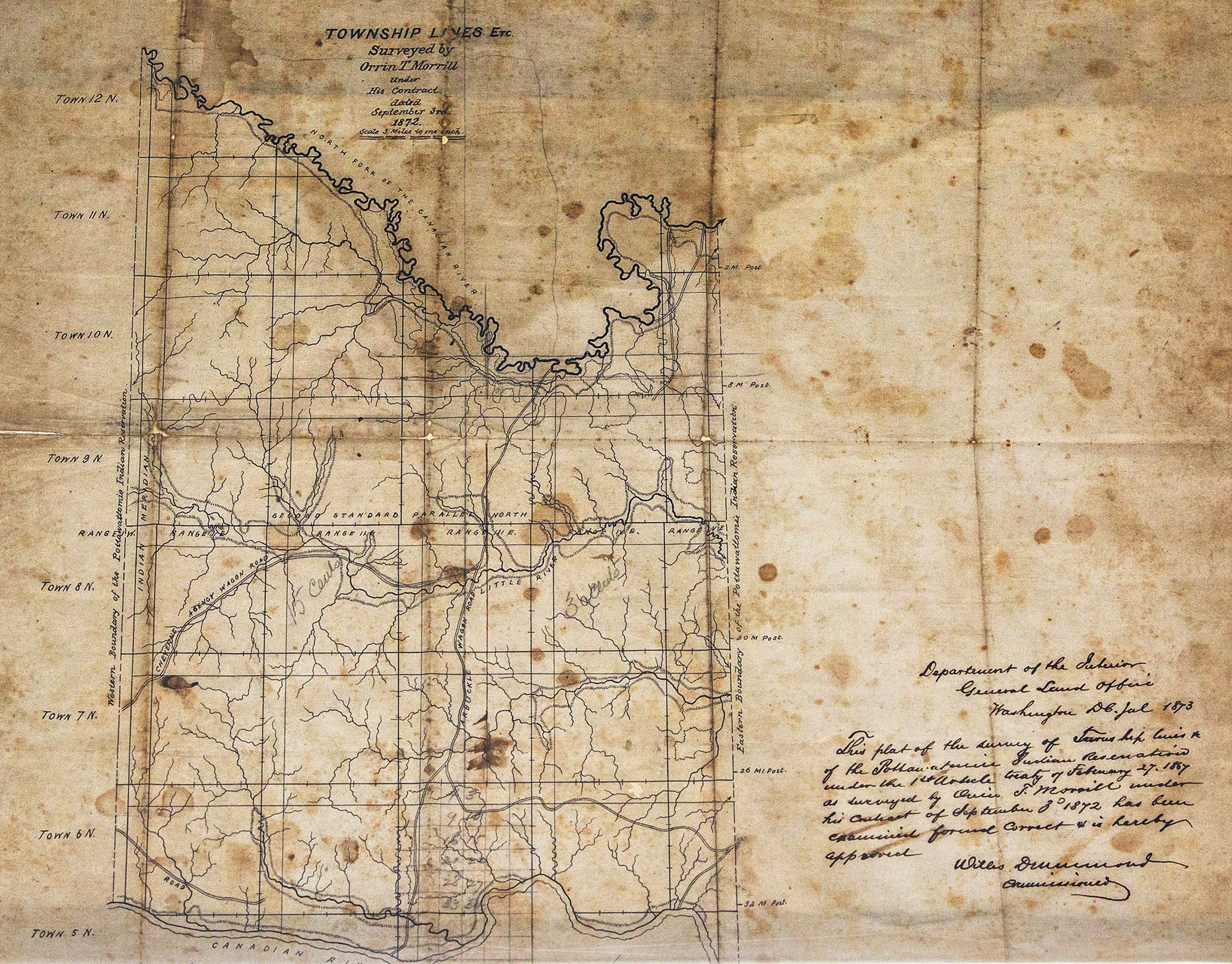
Plat of Pottawatomie Indian Reservation. 1873

California COA Decides Greenville Rancheria v. Martin [tribal leadership dispute]

Here:

Briefs here.

Angelique EagleWoman on the Decolonization of Citation Practices in Scholarship

Angelique EagleWoman has posted “The Capitalization of ‘Tribal Nations’ and the Decolonization of Citation, Nomenclature, and Terminology in the United States,” recently published in the Mitchell Hamline Law Review, on SSRN. Here is the abstract:

Within the U.S. legal profession and field of law, words have consequences that are often detrimental to Native peoples in Native homelands. First, this Article will review the basics on the political status and proper understanding of Tribal Nations in the United States. This background will provide context for the analysis and examination of the colonizer language to follow. Next, this Article will examine the issues and consequences of the English language conventions of capitalization or terms referring to Tribal Nations in the United States. Specific issues with the legal style guides known as The AP Stylebook and The Chicago Manual of Style, and The Bluebook legal citation guide will be discussed for the perpetuation of language, citation, and nomenclature that casts Tribal Nations and peoples in an inferior status. Third, the Article will discuss the rationale for eliminating certain terms and phrases derogatory to Native peoples in the English language. Finally, the decolonization of legal terms, phrases, and citations will be connected to the larger issues of Tribal sovereignty, the Tribal Nations-U.S. relationship, and the self-determination of future generations of Native peoples of the Western Hemisphere.

Tribal Nations are nationalities and therefore, should be capitalized. Likewise, when the word “Tribes” relates to the Tribes in the United States, then the word is referring to nationalities and should be capitalized. Sister Tribal Nations in what is now known as Canada are referred to as the capitalized term, First Nations. There is no principled reason for the written standards in the United States to capitalize First Nations and not capitalize Tribal Nations and Tribes. The lack of capitalization in the United States for Tribal Nations, which have engaged in political diplomacy with the federal government, is a remnant of the colonizing disinformation from a bygone era.

Twin Efforts to Force Interior to Acknowledge Exclusive Tribal Jurisdiction over All Custody Cases is Dismissed by D.C. Federal Court

Here are the materials in Hess v. Dept. of the Interior (D.D.C.):

1 Complaint

7 DOI Motion to Dismiss

9-1 Cherokee Nation Motion to Dismiss

16 Response to 9

17 Response to 7

19 Reply in Support of 7

22 Reply in Support of 9

28 DCT Order

Here are the materials in Sissaudia (D.D.C.):

1 Complaint

7-1 Cherokee Nation Motion to Dismiss

8 Federal Motion to Dismiss

15 Response to 7

16 Response to 8

17 Reply in Support of 8

20 Reply in Support of 7

26 DCT Order

Kristen Carpenter article on “Aspirations”: The United States and Indigenous Peoples’ Human Rights

This article, published in the Harvard Human Rights Journal, is available here.

Abstract

The United States has long positioned itself as a leader in global human rights. Yet, the United States lags curiously behind when it comes to the human rights of Indigenous Peoples. This recalcitrance is particularly apparent in diplomacy regarding the United Nations Declaration on the Rights of Indigenous Peoples. Adopted by the United Nations General Assembly in 2007, the Declaration affirms the rights of Indigenous Peoples to self-determination and equality, as well as religion, culture, land, health, family, and other aspects of human dignity necessary for individual life and collective survival. This instrument was advanced over several decades by Indigenous Peoples themselves as a means to remedy the harms of conquest and colonization, along with legacies of dispossession and discrimination persisting to this day. The United States first voted against the Declaration in 2007, and now, having reversed that position, is still stuck behind international organizations and governments that are working to implement it. The examples are myriad. From a new infrastructure at the UN to legislation in Canada, Mexico City, and the Muscogee (Creek) Nation, the world community is dedicating itself to realizing the aims of the Declaration. Not so the United States. In international meetings, U.S. representatives diminish the Declaration’s legal status when they could be embracing it as a vehicle for human rights advocacy; sharing best practices to and encouraging others to follow suit. At home, federal lawmakers are ignoring the calls of tribal governments to start implementing the Declaration in domestic law and policy. Increasingly, these positions of the United States are difficult to reconcile with respect for the dignity of Indigenous Peoples, much less global human rights leadership. Thus, it is time for the United States to abandon the notion that Indigenous Peoples’ human rights are “aspirational” and instead embrace the legal, political, and moral imperative to advance the Declaration both at home and abroad.

Bird v. Three Affiliated Cert Petition [sovereign immunity]

Here is the petition in Bird v. Tribal Business Council of the Three Affiliated Tribes of the Fort Berthold Indian Reservation:

Question presented:

Does inclusion of a mandatory arbitration clause in an Agreement with an Indian Tribe waive the Tribe’s sovereign immunity?

Eighth Circuit materials:

District court materials here.

State ICWA Law Signed into Law in Nevada

Not sure how this one slipped by–the Governor of Nevada signed this into law just before Brackeen came down.

AB444_EN

Media coverage here.

Assemblywoman Backus (the sponsor of the bill) graduated from ASU with an Indian Law Certificate. She is also a commissioner on the Uniform Law Commission’s study committee for a uniform state ICWA law.