On August 20, 2026, USDA published a proposed rule to rescind the 2001 Roadless Area Conservation Rule, which has restricted road construction, road reconstruction, and timber harvesting across approximately 44.7 million acres of National Forest System lands for the past quarter century. The proposal would replace the existing rule’s nationwide layer of protection and return more decisions about roadless areas to individual forest plans and project-level review.
Alongside the proposed rule, USDA released a 333-page Draft Environmental Impact Statement, a cost-benefit and regulatory-flexibility analysis, and a Tribal Summary Impact Statement. (Links to these documents are below.)
Comments on the proposed rule are due September 21, 2026. The docket is FS-2025-0001.
This isn’t the first time Tribes have weighed in. USDA’s August 2025 Notice of Intent opened a scoping comment period that drew more than 220,000 comments, with about 99% opposed to the rescission. Based on the ILPC’s analysis, the comments included 42 written submissions from 38 distinct Tribal governments and organizations. Scoping comments, however, only shape what an agency studies, and a court asked to review the eventual final rule will look at the record as it stands when the agency acts. As a result, the current 30-day comment period is fundamentally different from the one in 2025, since it’s the last opportunity to place Tribe-specific evidence, legal argument, and disagreement with USDA’s reasoning into the administrative record before the rule is finalized.
The ILPC is sharing four documents to help Tribes and their staff and counsel use that opportunity
a. The first document is a list of tribal comments submitted during the fall 2025 window and found by the ILPC in response to the Notice of Intent. The document includes links to each tribe or tribal organization’s comments.
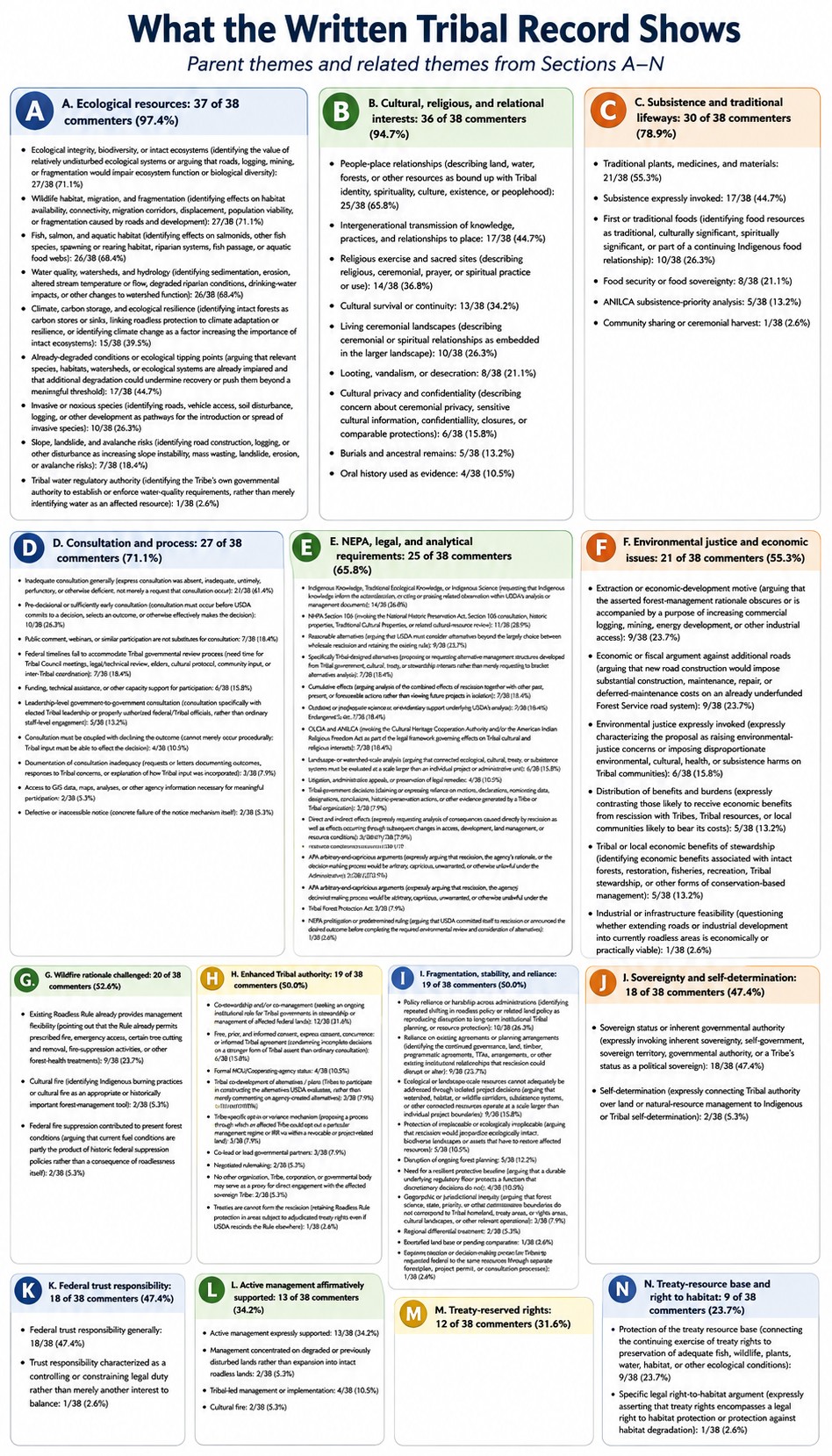
b. The second document, The Tribal Administrative Record on the Roadless Rule, is an ILPC independent empirical review of the 38 distinct Tribal comments filed in 2025. Rather than starting from USDA’s own categories, the ILPC coded the submissions and measured how often fourteen recurring themes appear, from near-universal concerns about ecological resources (94.7%), and cultural and religious interests (94.7%), to concerns raised by roughly half of commenters about consultation adequacy and enhanced Tribal governmental authority beyond ordinary consultation. It then compares that record against USDA’s 2026 Draft EIS line by line. Our finding: USDA’s Draft EIS rhetorically recognizes Tribal sovereignty, treaty rights, and trust obligations. It also concludes that full rescission, the alternative it proposes, would create the greatest potential for adverse effects on Tribal rights and interests of any alternative it studied. The gap this record exposes isn’t whether USDA heard Tribes. It’s what the agency did about what it heard.
b. The third document, Strategic Considerations for Tribal Nations in the 2001 Roadless Rule Rescission Comment Period, moves to strategy. It walks through the administrative law tools a comment filed now can use, including arbitrary and capricious review, record preservation and issue exhaustion doctrine, NEPA’s alternatives requirement, NHPA Section 106, and treaty rights claims where they apply, and explains why the strongest comments this round will do more than restate 2025 positions. The most impactful comments submitted now will name an impact, identify USDA’s specific response in the documents it published in the docket on August 20, and explain concretely why that response does or doesn’t hold up. The memo also addresses the administration’s simultaneous move to weaken the protections of NHPA Section 106 through a proposed rule that is expected to be published soon. If NHPA 106 protections are administratively weakened, Tribes will face a multiplication of interventions as decision-making is returned to the land management planning process at the individual national forest level, on top of diminished leverage under a weakened 106 regime.
The strategic considerations memo also flags a separate problem ILPC ran into directly. USDA’s Tribal Summary Impact Statement rests heavily on 29 completed (and 34 scheduled) government-to-government consultations (out of 64 Tribal requests for consultation), but the underlying consultation records aren’t in the public docket, and ILPC couldn’t locate any posted log of them. After an August 28 letter to the Forest Service’s Office of Tribal Relations went unanswered, ILPC filed a formal FOIA request the same day. Because of FOIA’s ordinary processing timeline, that request may not be resolved before the comment period closes. As it stands, Tribes and the public are being asked to evaluate USDA’s account of what it heard in consultation without being able to see the records that account is based on. That timing problem is itself worth putting directly into a comment.
Below is a full set of links to the docket, including the proposed rule, the complete Draft EIS, the Tribal Summary Impact Statement, the economic analysis, and the ILPC-generated documents referred to above.
Additional Resources
Link to the Docket for the 2001 Roadless Rule Rescission
- USDA proposed rule
- The Draft EIS (Vol. I – III) (Vol. II includes maps of all roadless rule affected areas organized by state; Vol. III includes copies of all Tribal comments submitted in response to the NOI in fall 2025)
- The Tribal Summary Impact Statement for Proposed Rule to Rescind the 2001 Roadless Area Conservation Rule
- The Economic Analysis for the 2004 Roadless Rule Rescission
List of Tribes with Comments Submitted Fall 2025 (with links) UPDATE: pdfs of all Tribal comments are included in Vol. III of the EIS.
ILPC Memo: The Tribal Administrative Record on the Roadless Rule
ILPC Graphic: Chart of Tribal Comments Grouped by Theme
ILPC Memo: Strategic Considerations for Tribal Nations in the 2001 Roadless Rule Rescission Comment Period
ILPC Email to FS OTR for Consultation Records
ILPC FOIA Request to FS OTR for Consultation Records
NCAI Resolution Opposing the Legislative Repeal of the 2001 Roadless Area Conservation Rule and Supporting its Retention
Roadless Rule Tribal Hub : “The Tribal Hub is an informational platform created to support Tribal leaders, staff, and community members in responding to the proposed rescission of the 2001 Roadless Rule. Our goal is to ensure that Tribes have timely access to resources, information, and tools to protect sovereignty, treaty and reserved rights, and cultural lifeways throughout this federal rulemaking process.”




 Turtle Talk
You must be logged in to post a comment.