Here:
Jemez Pueblo brief sealed
Indian Advocacy Groups Amicus Brief
Lower court materials here.
Here are the materials in Mille Lacs Band of Chippewa Indians v. County of Mille Lacs (D. Minn.):
225 Tribe Motion for Summary Judgment
241 County Motion for Summary Judgment
250 State of Minnesota Amicus Brief
Prior post here.
Here: “Oliphant: four decades of hampered tribal jurisdiction.”
The blurb:
A U.S. Supreme Court decision in March, 1978 continues to hinder tribal sovereignty on a daily basis. The ruling in Oliphant v. Suquamish Indian Tribe stripped tribes of most criminal prosecutions against non-Indians. Those cases became the responsibility of the federal government. In his dissent, Justice Thurgood Marshall wrote “I am of the view that Indian tribes enjoy, as a necessary aspect of their retained sovereignty, the right to try and punish all persons who commit offenses against tribal law within the reservation.” The Violence Against Women Act was an attempt to remedy the persistent trend of non-Native abusers of Native women slipping through the cracks of the federal justice system. We’ll look at the distressing consequences of Oliphant and efforts through the years to fix it.
We’ve been looking forward to this article for a while. Highly recommended.
Here.
This Note argues that ICWA does not commandeer the States. Part I grounds the discussion in the history of genocide and colonization of Indian peoples. This historical context is crucial to understanding the passage of ICWA and the current reactionary effort to dismantle it. Part II provides a brief overview of the anti-commandeering doctrine and lays out the commandeering claims that opponents have leveled against ICWA. Additionally, this Part argues that ICWA fully aligns with modern anti-commandeering doctrine for four reasons. First, it is settled doctrine that state courts must enforce federal law. As such, anti-commandeering doctrine does not apply to state courts in the same way as it applies to the state political branches. Second, Congress may impose federal procedures on state courts to vindicate federal rights, federal causes of action, and–we argue–vital federal interests, including the protection of the federal trust obligation to Indian tribes. The procedural requirements imposed by ICWA on state courts fall within all three of these categories. Third, it is established doctrine that Congress may impose record-keeping requirements on the States, including the record-keeping required by ICWA. Fourth, contrary to the claims of its opponents, ICWA even-handedly regulates states and private entities, consistent with the Constitution’s anti-commandeering requirements. Part III explains the dangerous implications of the anti-commandeering argument for tribal sovereignty, demonstrating the high stakes of ICWA litigation for federal Indian law more broadly. The Note concludes with an exploration of how attacks on ICWA based on anti-commandeering doctrine threaten the very structure of federalism in the United States.
Here is the press release from Rep. Raúl Grijalva on the matter. Gizmodo coverage here.
And the briefs in Apache Stronghold v. United States (9th Cir.):
Religious Liberty Scholars Amicus Brief
Lower court materials here.
Update:

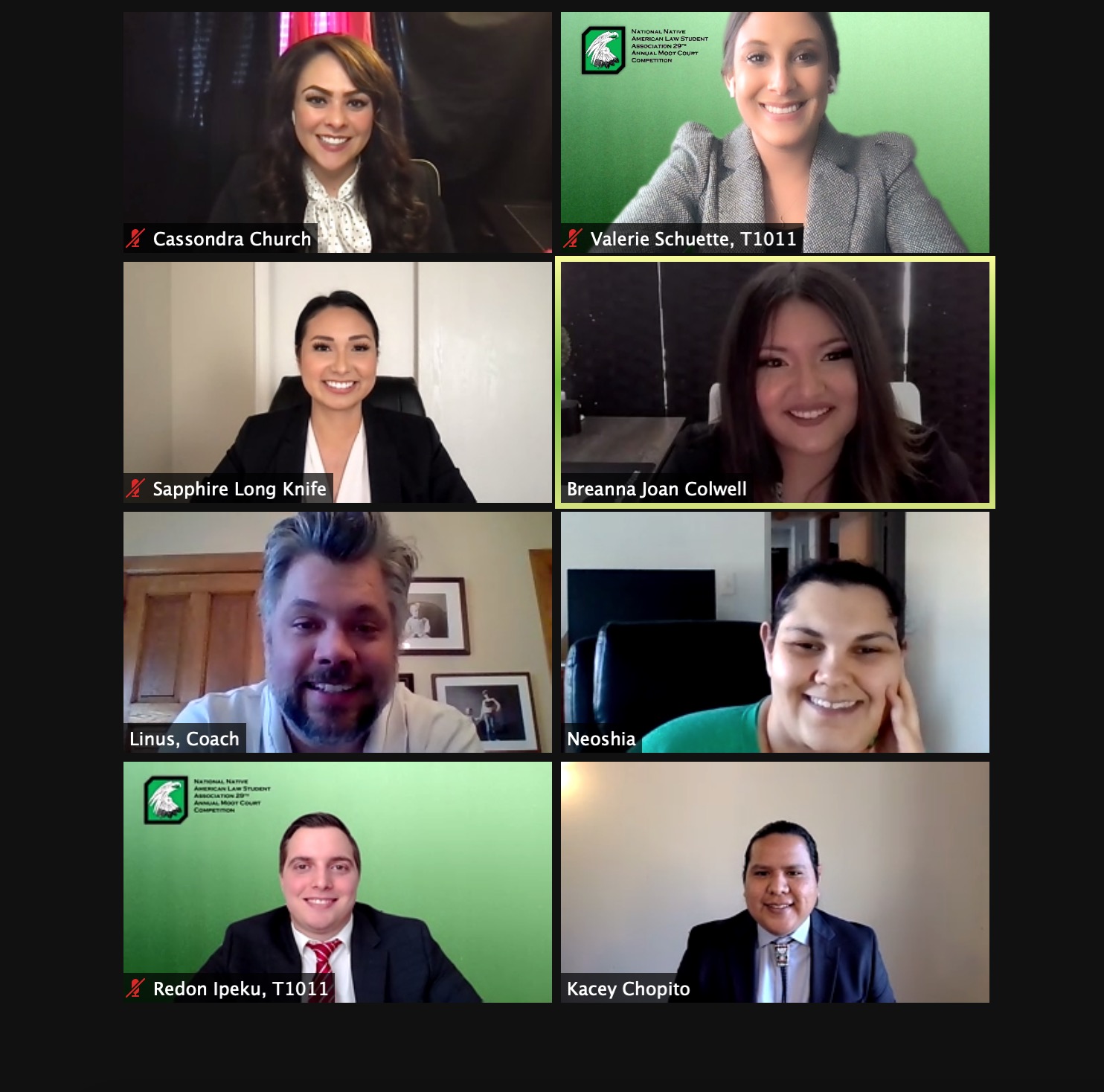
This weekend, three MSU LAW teams competed in the National NALSA Moot Court Competition at the University of North Dakota School of Law. While we are proud of all three of our teams, we are especially pleased to announce that 3Ls Kacey Chopito and Cassondra Church (pictured above) advanced to the Final Four round of this year’s competition, winning both a Semi-Finalist Award and 2nd Place for Best Written Advocates!
We are very proud of all three of our teams (pictured below), who were coached by Linus Banghart-Linn and Neoshia R. Roemer! Please join us in congratulating them on their hard work!
Here are the materials in Picard v. Colville Tribal Correction Facility (E.D. Wash.):
Previous post on this litigation here.
On Wednesday, February 24, 2021, in an order from Klamath County Circuit Court Judge Cameron F. Wogan, the Oregon court again affirmed the Klamath Tribes’ water and treaty rights. Wednesday’s order rejected attacks on the Tribes’ water rights determined by the Oregon Water Resources Department (OWRD) during the administrative phase of the Klamath Basin Adjudication (KBA), affirmed the senior priority date of the Klamath Tribes’ water rights in the Klamath Basin, and upheld the need to maintain a healthy and productive habitat to meet the Tribes’ treaty right to fish, hunt, trap, and gather.
Klamath Tribes Chairman Don Gentry responded to the order, “We are pleased that Judge Wogan upheld the rulings from the administrative phase of the KBA. He reaffirmed that the 1864 treaty entered into between the Klamath Tribes and the United States reserved to the Tribes sufficient water to keep our fisheries and other aquatic resources healthy so that we can protect our natural resources and cultural traditions.”
NARF Staff Attorney Sue Noe explained, “Judge Wogan correctly affirmed quantification of the Tribal water rights based on the habitat needs of the fish, wildlife, and plants. Although he ruled that opponents of the Tribal rights will have another chance to try to reduce the amounts by showing the Tribes don’t need all the water awarded by OWRD to meet their livelihood needs, Judge Wogan made clear in no uncertain terms that the amounts cannot be below what is necessary to provide healthy and productive habitat.”
Importantly, like all other courts that have considered the issue, Judge Wogan ruled that the Klamath Tribes’ water rights extend to Upper Klamath Lake. Upper Klamath Lake forms part of the border of the former Reservation and provides critical habitat for the endangered c’waam and koptu (Lost River and shortnose sucker fish), which are sacred fish species traditionally harvested by the Tribes.
Represented by NARF, the Klamath Tribes successfully achieved recognition of their treaty-reserved water rights in federal court litigation in the 1970s and 1980s in United States v. Adair, but the federal courts left quantification of the water rights to the state adjudication in the KBA. After the successful conclusion of the KBA’s 38-year administrative phase, the Tribes were able to begin enforcing their water rights for the first time in 2013. The administrative determinations are presently on review in the Klamath County Circuit Court and Judge Wogan’s ruling is the latest to come out of that process.
 Turtle Talk
You must be logged in to post a comment.