Here is the opinion in Cherokee Nation v. Bernhardt.
Briefs:
cherokee-nation-answer-brief.pdf
lower court materials here.
UPDATE:
Here is the opinion in Cherokee Nation v. Bernhardt.
Briefs:
cherokee-nation-answer-brief.pdf
lower court materials here.
UPDATE:

If you would like to sponsor this presentation or others, please contact Tribal In-House Counsel Association President Doreen McPaul at dmcpaul@nndoj.org.
For information about the agenda, sponsorships, and registration visit the event page.
Addison W. Bennett has published “Partially Tribal Land: The Case for Limiting State Eminent Domain Power under 25 USC § 357” in the University of Chicago Law Review (PDF).
The abstract:
When a state utility wishes to cross land located within a Native American reservation, but the landowners refuse to allow it, the utility in most circumstances may exercise eminent domain over the land. Under the authority of a federal statute, 25 USC § 357, states may generally condemn allotments, plots owned by individuals that lie within the sovereign boundaries of a tribal reservation. Courts have long recognized that the state authority to condemn these allotments under § 357 arises from the principle that individually owned allotments are no longer “tribal” land and, as a result, they are not protected by tribal sovereignty.
Congress’s failure to transition away from the allotment system has resulted in an ownership structure for certain plots of reservation land that it did not antic- ipate when it enacted § 357. Today, not all allotments are held entirely by individu- als, and many now contain fractional, undivided interests that belong to tribes themselves. This status of joint ownership between individuals and tribes, which this Comment refers to as “partially tribal,” leads to considerable complications with respect to the scope of § 357. Courts have routinely held that land owned by a sover- eign Native American tribe is not subject to state condemnation and that this prin- ciple protects tribal interests in allotments. Unresolved, however, is whether a tribal interest in an allotment—which can be as small as a fraction of 1 percent—should immunize even the nontribal interest in the plot from state condemnation proceed- ings. In other words, should a fractional tribal interest place an entire parcel out of the state’s reach?
This Comment argues that it should. The courts that have attempted to allow condemnations to proceed against partially tribal allotments run into the problem that all ownership interests in an allotment are undivided; each owner holds an undivided share of the whole parcel. This means there is no way to divide the tribal interests from the nontribal ones without effecting some kind of incursion on a tribal land interest without the tribe’s or Congress’s consent, a result that principles of tribal sovereignty squarely reject. This Comment recognizes that Congress’s intent when it passed § 357 was to eliminate tribal landholdings, but it argues that Congress has since changed course such that courts should disregard that original intent. This Comment also concedes that diminishing eminent domain power may lead to holdout problems, though it argues that protecting tribal sovereignty is the more important interest. Consistent with the principle that states may not diminish any tribal sovereignty without Congress’s consent, this Comment concludes that a state utility has multiple avenues for seeking access to a partially tribal allotment, including opportunities for negotiation with the tribe and the federal government. Courts should not permit states to use § 357 unilaterally to divest a nonconsenting tribe from its interest in land.
Here.
More information here.
The Journal of Race, Ethnicity and Politics (JREP), under the editorship of Alexandra Filindra (University of Illinois—Chicago), is pleased to announce a call for papers on Indigenous politics. The issue seeks papers from all subfields in political science that explore Indigenous politics including work that focuses on public policy, law, intergovernmental relations, and political participation as well as theoretical approaches to understanding Indigenous groups in the US, Canada, and around the world. Research that addresses issues internal to Indigenous groups, First Nations and tribal governments is also appropriate. We welcome rigorous, theoretically grounded work regardless of topic or approach including theoretical and empirical examinations of Indigenous groups, individual behavior, and intergovernmental relations.
The editors for the special issue are Dr. Richard Witmer, Creighton University (witmer@creighton.edu), Dr. Laura Evans, University of Washington (evansle@uw.edu) and Dr. Kirsten Matoy Carlson, Wayne State University (kirsten.carlson@wayne.edu). Proposals must be submitted to the guest editors by December 31, 2019. The publication schedule for the journal will require accepted papers to be completed in accordance with the journal’s editorial style by January 15, 2021.
Please submit your abstract to Rick Witmer (witmer@creighton.edu) and to Alexandra Filindra (aleka@uic.edu). Please indicate in the subject line that this is a submission for the special issue of JREP.
Abstracts should be up to 500 words and provide a concise description of the argument, data, and analytical approach. For empirical research, please summarize the research question, theoretical importance, hypotheses, and data to be used.
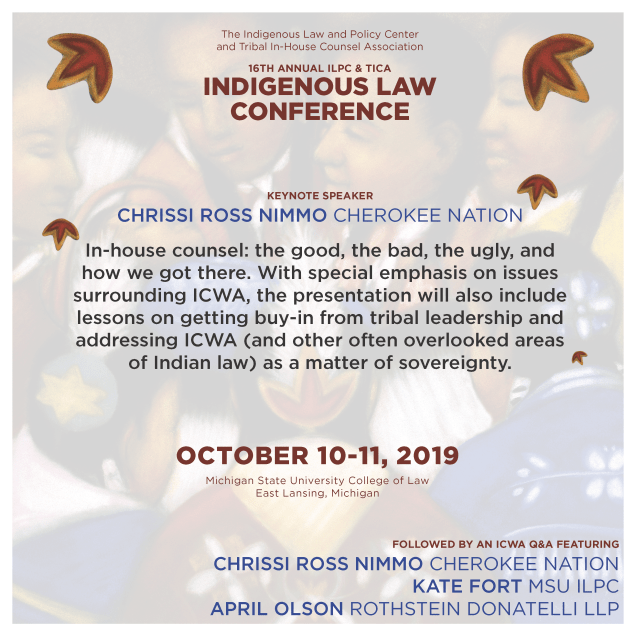
If you would like to sponsor this presentation or others, please contact Tribal In-House Counsel Association President Doreen McPaul at dmcpaul@nndoj.org.
For information about the agenda, sponsorships, and registration visit the event page.
Here:
Question presented:
Do states waive their authority under section 401 of the Clean Water Act if they do not approve or deny a certification request within one year, even when an applicant withdraws and resubmits the request before that one year ends?
Lower court materials here.
UPDATE — cert stage briefs:
Here is the unpublished opinion in State v. Ziegler (Minn. Ct. App.):
 Turtle Talk
You must be logged in to post a comment.