Oglala Sioux Tribe Suit against Army Corps

Here is the complaint in Oglala Sioux Tribe v. United States Army Corps of Engineers (D.D.C.):

Complaint

An excerpt:

This is a complaint for declaratory and injunctive relief to stop the construction and operation of the Dakota Access Pipeline (DAPL) until the Defendant United States Army Corps of Engineers (Corps) completes an environmental impact statement (EIS) that fully analyzes the impacts of the DAPL to the Tribe’s Treaty rights and rights in the Mni Wiconi Project as required by the National Environmental Policy Act (NEPA) and the Mineral Leasing Act (MLA).

Standing Rock Denounces Army Easement Announcement, Vows Court Challenge

Download(PDF): Press Release

Next steps for Tribe and allies:

  • The Tribe will challenge any easement decision on the grounds that the EIS was
    wrongfully terminated. The Tribe will demand a fair, accurate and lawful environmental impact statement to identify true risks to its treaty rights, including its water supply and sacred places.
  • The Tribe has asked the court for DAPL to disclose its oil spill and risk assessment
    records for full transparency and review by the public.
  • If DAPL is successful in constructing and operating the pipeline, the Tribe will seek to
    shut the pipeline operations down.
  • A Native Nations march on Washington is scheduled for March 10. The Standing Rock
    Sioux Tribe and tribes across the country invite allies in America and from around the
    world to join the march.

Tenth Circuit Rejects Bivens Suits against Federal Officers in “Operation Cerebus”

Here is the opinion in Estate of Redd v. Love.

Briefs:

Appellant Brief

US Brief

Reply

Lower court materials here.

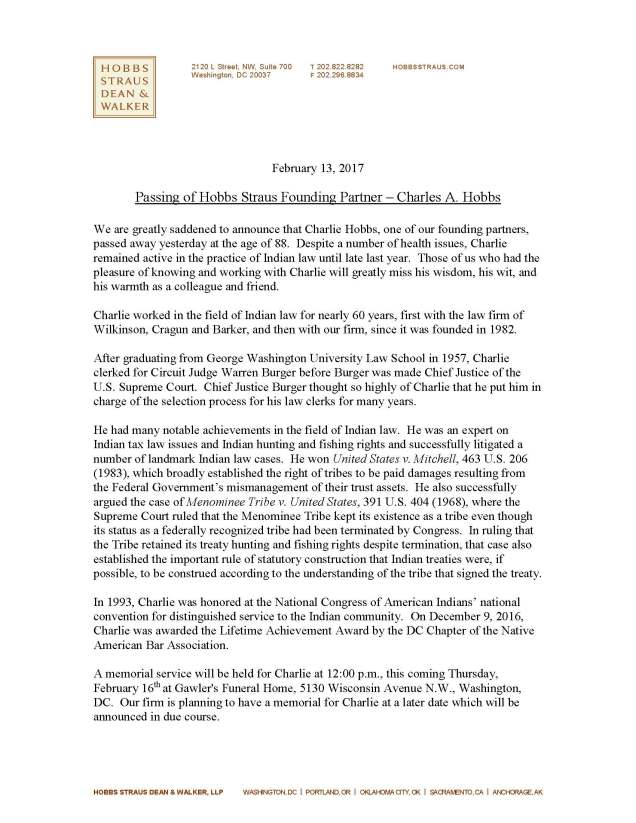
Charlie Hobbs Passes On

Here is the announcement from Hobbs Straus:

Charlie Hobbs Passing Announcement

charlie-hobbs-passing-announcement

Montana Indian Law Program — Summer 2017

Here (PDF):

2017-summer-indian-law-card-8-5x5-5_page_12017-summer-indian-law-card-8-5x5-5_page_2

Federal Court Suppresses Key Evidence Procured in Stop of Non-Indian by Tribal Police

Here are the materials in United States v. Cooley (D. Mont.):

34 Motion to Suppress

41 Response

46 Reply

48 DCT Order

An excerpt:

Normally, under Bressi, Officer Saylor would be required to determine whether Cooley was non–Indian shortly after seizing him. 575 F.3d at 896. However, Officer Saylor determined Cooley was non–Indian when Cooley initially rolled his window down. Because Cooley was non–Indian, Officer Saylor had the authority to detain Cooley only if it was “apparent” Cooley had violated state or federal law. Bressi, 575 F.3d at 896. Officer Saylor’s observations up to that point fell considerably below an “apparent” state or federal law violation. When Officer Saylor seized Cooley, he had observed bloodshot and watery eyes, no odor of alcohol, possible but unconfirmed slurred speech, two semi-automatic rifles, wads of cash in Cooley’s pocket, and answers to questions that seemed untruthful to him. Officer Saylor had also heard Cooley explain that he pulled over because he was tired—an occurrence Officer Saylor acknowledged was common on Highway 212—and that the vehicle did not belong to him but instead to a Thomas Spang or Thomas Shoulderblade, one of whom Officer Saylor suspected of drug activity and one of whom was a former probation officer. None of Cooley’s actions, whether taken individually or cumulatively, establish an obvious state or federal law violation. The Court holds Officer Saylor exceeded the scope of his authority when he detained Cooley. All evidence obtained subsequent to Cooley’s seizure is suppressed because it is “fruit of the poisonous tree.” United States v. Ramirez–Sandoval, 872 F.2d 1392, 1395 (9th Cir. 1989) (citing Nardone v. United States, 308 U.S. 338, 341 (1939)).

NYU Law Review Seeking Submissions from Indian Law Scholars

A message from the editorial board:

NYU Law Review is seeking submissions from Indian law scholars.

1. Print Articles.

As always, our Articles Department is seeking submissions covering diverse subject-matters, especially including general issues in Indian law that would be accessible to a generalist audience. Article submissions must have a minimum of 10,000 words and be submitted on Scholastica. In addition to submission on Scholastica, you may also forward any submission directly to our Senior Articles Editor, Simon Williams, at sjw446@nyu.edu. The Department is accepting unsolicited articles through the end of March, 2016.

2. Online Essays and Comments.

Our Online Department is similarly interested in submissions in Indian law. The Online Department is focused on publishing content addressing timely legal issues, such as current controversies and debates. Online submissions have a maximum word limit of 10,000 words and may be submitted directly to our Senior Online Editor, Marcelo Triana, at mt3497@nyu.edu or via Scholastica. More information on our submission policy can be found on our website, www.nyulawreview.org.

Pascua Yaqui Tiwahe Coordinator Opening

Download(PDF): Job Announcement

The Tiwahe Family Advocacy Coordinator is responsible for the planning, development, implementation, continuation, monitoring, and improvement of the Tiwahe Project under the Office of the Attorney General. The Tiwahe Project’s goal is to strengthen American Indian and Native American (Al/AN) communities and families through a tribally driven and culturally relevant service model with an emphasis on intervention and prevention services. The incumbent will be responsible for coordinating project goals and objectives of the BIA’s Tiwahe project with local tribal, federal, state partners and service providers. This individual will also be responsible for working alongside the BIA and the National Tiwahe Coordinator.

Responsibility and Requirements:

Provide project oversight and coordination on the Tribal Tiwahe Project, including but not limited to serving as primary point of contact for the Tribe.

Under the direction of the Attorney General, will coordinate project goals and objectives including other key tribal service programs including the Office of the Attorney General, Office of the Prosecutor, Department of Health, Department of Housing, Tribal Courts, Social Services, Law Enforcement, Department of Education, Job Placement and Training/477 Program and/or other Tribal programs.


National Indian Law Library Bulletin (2/10/2017)

Here:

The National Indian Law Library added new content to the Indian Law Bulletins on 2/10/17.

U.S. Supreme Court Bulletin
http://www.narf.org/nill/bulletins/sct/2016-2017update.html
Read the latest Tribal Supreme Court Project update published on 2/7/17.

U.S. Federal Courts Bulletin
http://www.narf.org/nill/bulletins/federal/2017.html
United States v. Cooley (Indian Civil Rights Act; Tribal Criminal Jurisdiction)

Tribal Courts Bulletin
http://www.narf.org/nill/bulletins/tribal/2016.html
Guertin v. Mashantucket Pequot Tribal Nation  (Jurisdiction)
In re T. J. M. (Child Support)
Navajo Nation v. Tso (Criminal Law – Judicial Abuse of Office)
Martinez v. Colville Confederated Tribes (Domestic Violence; Sentencing)

State Courts Bulletin
http://www.narf.org/nill/bulletins/state/2017.html
Quinault Indian Nation v. Imperium Terminal Services, LLC (Ocean Resources Management Act – Oil Terminal Permits)

News Bulletin
http://www.narf.org/nill/bulletins/news/currentnews.html
Read the latest news about the shift in momentum for the Dakota Access Pipeline project and a court settlement that protects religious rights for Hawaiian prisoners.

U.S. Regulatory Bulletin
http://www.narf.org/nill/bulletins/regulatory/2017.html
The Department of the Interior, Bureau of Indian Affairs, publishes notices regarding tribal consultation meetings on water infrastructure improvements.

Law Review & Bar Journal Bulletin
http://www.narf.org/nill/bulletins/lawreviews/2017.html
Here are the articles featured this week:
Complexity’s shadow: American Indian property, sovereignty, and the future.
Building relations: Alaska Natives, ANCSA and the federal government.
Sovereignty and subsistence: Native self-government and rights to hunt, fish, and gather after ANCSA.
ANCSA Section 7(I): $40 million per word and counting.
Issuing new stock in ANCSA corporations.
Look back to go forward.
A tribal advocate’s critique of proposed ANCSA amendments: perpetuating a broken corporate assimilationist policy.
Protection of Alaska Native customary and traditional hunting and fishing rights through Title VIII of ANILCA.
The benefits of a benefit corporation statute for Alaska Native corporations.
A business entity by any other name: corporation, community and kinship.
Standing Rock and the erosion of tribal rights.
An argument in support of tax-free per-cap distribution payments derived from Native American nations gaming sources.

U.S. Legislation Bulletin
http://www.narf.org/nill/bulletins/legislation/115_uslegislation.html
The following were added:
S.302: A bill to enhance tribal road safety, and for other purposes.
S.Res.40: A resolution designating the week beginning on February 5, 2017, as “National Tribal Colleges and Universities Week”.
S.254: A bill to amend the Native American Programs Act of 1974 to provide flexibility and reauthorization to ensure the survival and continuing vitality of Native American languages.
S.343: A bill to repeal certain obsolete laws relating to Indians.
H.R.986: To clarify the rights of Indians and Indian tribes on Indian lands under the National Labor Relations Act.
S.304: A bill to amend the Indian Health Care Improvement Act to allow the Indian Health Service to cover the cost of a copayment of an Indian or Alaska Native veteran receiving medical care or services from the Department of Veterans Affairs, and for other purposes.
H.R.981: To prohibit any hiring freeze from affecting the Indian Health Service.
S.249: A bill to provide that the pueblo of Santa Clara may lease for 99 years certain restricted land, and for other purposes.
S.269: A bill to provide for the conveyance of certain property to the Tanana Tribal Council located in Tanana, Alaska, and to the Bristol Bay Area Health Corporation located in Dillingham, Alaska, and for other purposes.
H.R.984: To extend Federal recognition to the Chickahominy Indian Tribe, the Chickahominy Indian Tribe-Eastern Division, the Upper Mattaponi Tribe, the Rappahannock Tribe, Inc., the Monacan Indian Nation, and the Nansemond Indian Tribe.
Federal Court Orders Exhaustion in Claims involving Interpretation of Navajo Insurance Law

Here are the materials in Progressive Advanced Insurance Company v. Worker (D. Ariz.):

11 Motion to Dismiss

15 Response

16 Reply

17 DCT Order

An excerpt:

The Court determines that the tribal courts of the Navajo Nation have a colorable or plausible claim to jurisdiction over this matter. See Elliott, 566 F.3d at 848. Like the insurer in Stump, Progressive issued an insurance policy that listed a tribal member as a named insured and covered vehicles that were kept on tribal lands. Unlike the insurer in Stump, however, Progressive never mailed anything to an address on tribal lands. To the extent that factor is dispositive, it may be that the tribal court lacks jurisdiction. But this is a question that must be answered first by the tribal courts of the Navajo Nation. See LaPlante, 480 U.S. at 16 (explaining that the tribal court should have “‘the first opportunity to evaluate the factual and legal bases for the challenge’ to its jurisdiction”). An analysis of the Todecheene decision does not change this conclusion. In that case, the Ninth Circuit ultimately determined that it was not clear that the tribal courts plainly lacked jurisdiction. Todecheene, 488 F.3d at 1216. This Court reaches the same conclusion here.