Here:
Oral argument audio here.
Lower court materials here.
Prior CA9 opinion and materials here.
Here (PDF):
We learned the terrifically sad news that Barbara Lane, the legendary and heroic anthropologist that served as the lead expert witness in the United States v. Washington trial that led to the Boldt decision passed away late last year. 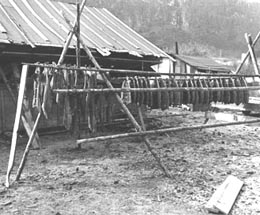
In her honor, we dug up a rare copy of a short article she published in the now-defunct American Indian Journal that summarized some of her written testimony. Here:
Background of Treaty Making in Western Washington
And, of course, the Boldt decision itself:
UPDATE — we have her obituary now:
Barbara Lane, one of the foremost experts in First Nations anthropology and Native American rights, passed away on December 31, 2013 in Arlington, Washington. Dr. Lane produced exceptional expert reports and testimony in more than 40 court cases, many of which were pivotal in determining the rights of native peoples to access and use natural resources. The United States federal courts that ruled on treaty fishing rights in the Northwest relied heavily on her testimony. Her work was instrumental for the Quinault and other Washington Tribes in numerous treaty fishing rights cases related to the 1974 Boldt Decision (U.S. vs Washington) and for the Quinault in Mitchell vs U.S. in 1977. The United States Supreme Court referenced her findings in affirming the key decision on Northwest treaty rights. (I.e. the “Boldt” Decision.) She also served as an expert witness in cases involving fisheries and land claims of Canadian First Nations. Her work was well known and respected by Indigenous Peoples, the academic community, and legal circles. She was retained as the U.S. Federal Court of Oregon expert in U.S. v. Oregon in 1991.
Barbara was a member of the Society for Applied Anthropology, the Canadian Sociological and Anthropological Association, and the American Ethnological Society. During her illustrious career, she held many research, editorial and administrative positions. Although she authored numerous publications, she often preferred to do her work without seeking public recognition.
She received an A.B. and M.A. from the University of Michigan in the late 1940’s and earned a PhD from the University of Washington in 1953. Barbara held faculty positions at the Universities of Washington, Hawaii, Pittsburg, British Columbia, Victoria and Western Washington University. In 2006, Barbara was awarded an honorary Doctor of Law Degree from the University of Victoria for her expertise and contributions to First Nations anthropology and rights.
Her career took her to far reaches of the world, including Postdoctoral Study at the Australian National University from 1953-1954 and work with Coast Salish peoples, India, and Vanuatu. Much of her early work was done in professional partnership with her Husband, Robert who predeceased her.
As Director for the Quinault Indian Bicentennial Project from 1976-1977, she provided guidance and direction for creating an historical record for the people and culture of the Quinault Nation. This work led to the publication of the Handbook on Legislation and Litigation Affecting the Quinault Reservation and established an invaluable core of records for the Quinault Historical Foundation (now called the Quinault Cultural Center).
Her home and office was located in Victoria, British Columbia for many years. Barbara is survived by a son, two daughters and one grandchild.
Here are the materials in United States v. Washington subproceeding 05-4 (W.D. Wash.):
193 Swinomish Motion for Partial Summary J
Subp 05-4 Dkt 242 Order Suquamish-1
Materials on subproceeding 05-3 are here.
Here are the materials in United States v. Washington subproceeding 09-1 (W.D. Wash.):
Here are the materials in United States v. Washington, subproceeding 11-02 (W.D. Wash.):
Here are the materials in Koniag, Inc. v. Kanam (D. Alaska):
Here is a complaint filed by Kurt Kanam against the parties in United States v. Washington in the “Karluk Tribal Court” from last fall:
This isn’t a post on the merits of the Freedmen case, but instead a rumination about the import of U.S.–tribal treaty rights in tribal courts. Generally, do treaty rights have legal import in tribal court?
My reading of the Nash case (here) is that anyone claiming to assert treaty rights against an Indian tribe who was a party to the treaty may be foreclosed from bringing those claims without the presence of the United States (the other party to the treaty) as a party to the litigation. If that reading has broad implications for Indian treaties, then no treaty right could effectively be litigated in tribal court without the presence of the United States. An odd result, to be sure.
This isn’t a purely academic question. A few years back, the Ninth Circuit wondered why it was still deciding treaty rights subproceedings in United States v. Washington that don’t involve either the United States or Washington, or really any of the underlying issues about the treaty right. Many of the cases are intertribal conflicts. There may be an intertribal court for the Puget Sound treaty tribes someday, all without the presence of the United States. And properly so.
This all suggests the United States doesn’t need to be a party to treaty rights litigation in every case.
 Turtle Talk
You must be logged in to post a comment.