Here from Neshnawbe News, Nov./Dec. 1973:
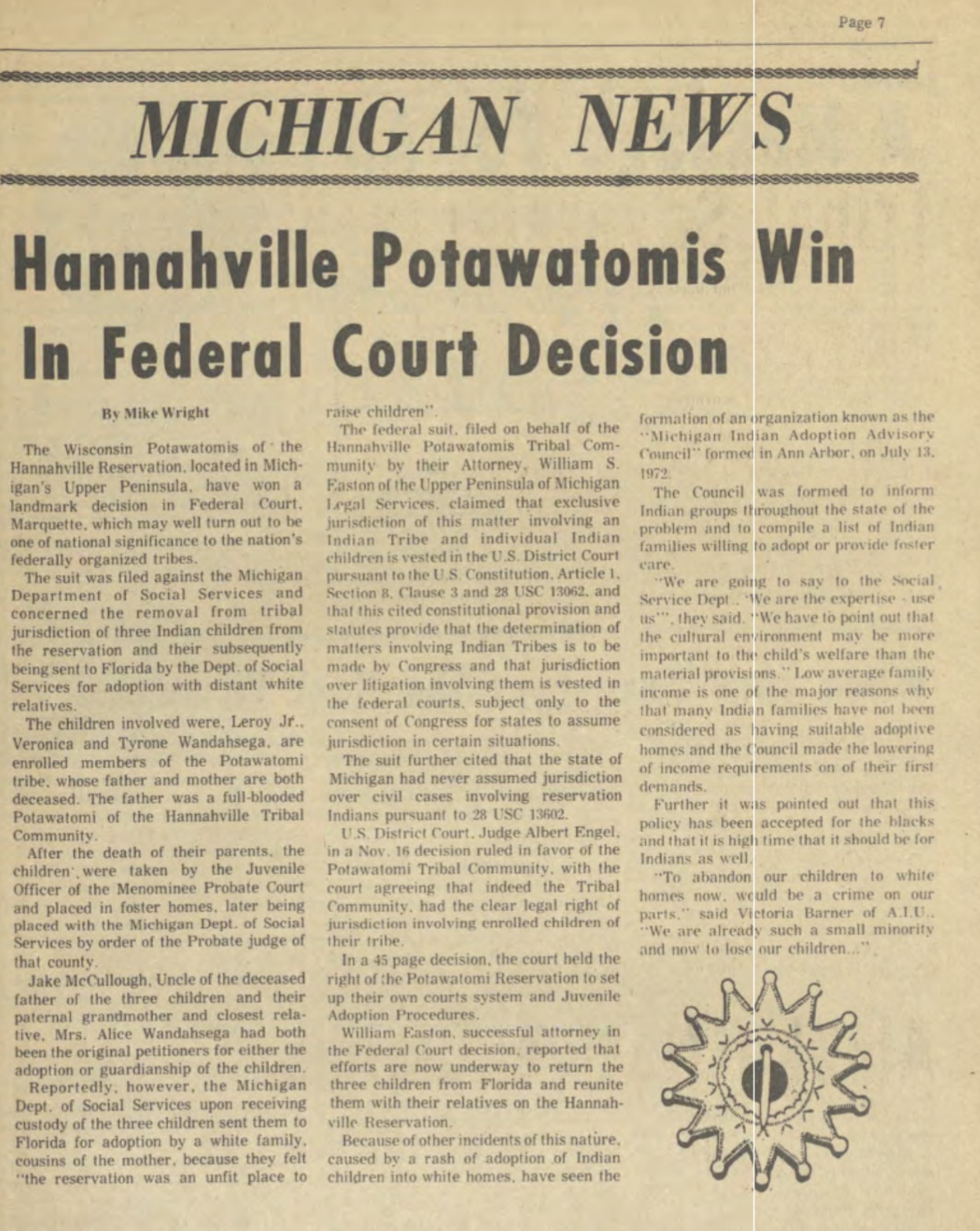
Here is the decision.
Here:
A ZOOM CLE Program, this Wednesday, December 18, 2024 from 9 am to noon, focusing on jurisdiction in Oklahoma’s Indian Country, focusing on cases spanning from U.S. v. Ramsey in 1926 to the recent Hooper & O’Brien Cases authorizing state jurisdiction over Indians in Indian country under novel and unprecedented theories
3 hours of Oklahoma Continuing Legal Education credit applied for, including 1 hour of ethics.
Presented by the Oklahoma Indian Bar Association (“OIBA”)
Email to OklahomaIndianBarAssociation@yahoo.com for more information. Contact Arvo Mikkanen via text at 405/420-9912 with any questions.
Online registration deadline is 12/18/24 at 9:00 am.
REGISTRANTS WILL RECEIVE A ZOOM LINK BY EMAIL ON THE DAY OF THE SEMINAR 12/18/24. DO NOT ASK FOR LINK BEFORE THAT TIME. LINK WILL BE SENT ONLY TO THE EMAIL ADDRESS YOU PROVIDE WHEN YOU REGISTER.
A DROPBOX WILL BE SET UP AND EMAILED TO YOU FOR YOU TO DOWNLOAD THE WRITTEN MATERIALS
Registration is $ 75.
Current paid 2024 & 2025 OIBA members with paid membership are entitled to $15 discount and can register for $60.
Elected Tribal Leader / Tribal Employee Registration is $ 30.
Student registrations are $20.
Attorneys: 3 Oklahoma Continuing Legal Education (“CLE”) Credits Applied for, including 1 hour of ethics. If you wish for credits for other states, that is your responsibility to submit to your own state bar for approval.
If you are not an Oklahoma bar member, please enter 00000 in the registration form.
AGENDA
9:00 am – 10:00 am – Arvo Mikkanen (Kiowa/Comanche), Attorney & Former Tribal Judge
OIBA President Mikkanen will discuss the recognition of Indian country post statehood in the Osage murder trials, the re-establishment of tribal and federal jurisdiction under the Littlechief and Ahboah cases, and the constructs for analysis provided in the Bracker and Castro-Huerta cases. Ethics for practicing attorneys in the Indian law field will also be discussed throughout.
10:00 am – 11:00 pm – Patti Palmer Ghezzi, Attorney & Trial/Appellate Consultant
Ms. Ghezzi will discuss the critical cases litigated and decided involving Oklahoma’s Indian country after Littlechief, leading up to the Murphy and McGirt cases which recognized the continuing boundaries of the Muscogee Nation Reservation.
11:00 am – 12:00 pm – Jeri Wisner (Muscogee), Attorney General – Muscogee Nation
AG Wisner will discuss the City of Tulsa’s attempts to undermine the McGirt decision which re-established Indian country in eastern Oklahoma within the boundaries of the Muscogee Nation reservation through the recent Hooper and O’Brien cases. The focus will be on assertions that the state has criminal jurisdiction over Indians within Indian country, under a variety of novel theories.

From The Nishnawbe News [Northern Michigan University], May 1972:

From Nishnawbe News [NMU], Summer 1972:

Here are the materials in Ratcliffe v. Yocha Dehe Wintun Nation (E.D. Cal.):
Kekek Jason Stark has published “Exercising the Right of Self-Rule: Tribal Constitutions and Tribal Customary Law” in the Mitchell Hamline Law Review. PDF
Here is an excerpt:
In the context of the development and implementation of Tribal constitutions, Tribal Nations must ask themselves whether the federal government was playing a trick on Tribal Nations by imposing the Indian Reorganization Act (IRA) and its corresponding constitutions and Anglo-American governing principles upon Indian country. Are these documents and corresponding governing principles actually “shit,” dressed up as “smart berries” under the guise of making Tribal Nations “wise” in the image of Anglo-American law? Ninety years after the enactment of the IRA, it is time Tribal Nations become wise and return to traditional constitutional principles based on Tribal customary law and unwritten, ancient Tribal constitutions.
As always with KJS, highly recommended.
Here is the opinion in In re J.O.
Excerpt:
¶14 Rather than answer that question, COCA took a detour. Relying primarily on a United States Supreme Court case, COCA determined that, if Parker never had a relationship with Child, the requirements of ICWA Sections 1912(d) and (f) would not apply. As the trial court never made a specific finding regarding the nature of Parker’s relationship with Child, COCA ordered the trial court on remand to make that finding. COCA then concluded if there was no relationship the State would not have to make the necessary showings under ICWA. Parker petitioned for certiorari, arguing that COCA misapplied federal and Oklahoma law regarding ICWA. We agree.
¶15 The ICWA Section 1912 requirements are intended to respect and preserve the tribes’ interest in the custody and care of its children, and the detrimental impact to a child of placement outside its culture, in addition to and independent of any parental custodial interest. Holyfield, 490 U.S. at 49-50. Oklahoma adopted the Oklahoma ICWA (OICWA) to clarify state policies and procedures used to implement the federal statutory scheme. After Holyfield, the Legislature amended the OICWA policy statement to recognize that “Indian tribes and nations have a valid governmental interest in Indian children regardless of whether or not said children are in the physical or legal custody of an Indian parent or Indian custodian at the time state proceedings are initiated.” 10 O.S. § 40.1. And the OICWA applies “to all state voluntary and involuntary child custody court proceedings involving Indian children, regardless of whether or not the children involved are in the physical or legal custody of an Indian parent or Indian custodian at the time state proceedings are initiated.” 10 O.S. § 40.3(B). We presume that the Legislature was aware of the previous statutory language and intended these amendments to change the statutes accordingly. In the Matter of Baby Boy L., 2004 OK 93, ¶ 18, 103 P.3d 1099, 1105-06. Thus, under OICWA, whether a parent has a relationship with the child is not determinative of the tribe’s independent interest.
¶16 This Court reinforced this policy in Baby Boy L. There, the non-Indian mother refused father’s attempts to be active in the baby’s life and sought a non-Indian adoption outside the reservation. Indian father objected to the adoption, and the tribe intervened, moving to dismiss the adoption and seeking ICWA compliance. The trial court applied a doctrine called the “existing Indian family exception.” This doctrine, applied in a minority of states, requires that for ICWA to apply a child must be living in an Indian home, or already have a primarily Indian cultural heritage, or are otherwise somehow culturally “Indian”, rather than applying the federal ICWA definitions of Indian children. This Court, interpreting the OICWA amended language, concluded that through the amendments the Legislature had explicitly repudiated the “existing Indian family” exception to ICWA, and that exception could not be applied under Oklahoma law. Baby Boy L., 2004 OK 93, ¶ 18, 103 P.3d at 1105-06.


 Turtle Talk
You must be logged in to post a comment.