Here.
Lee v. Tam Oral Argument Transcript
Here.
Here.
Here. [PDF for when the Trump Administration deletes this report.] Update 10/27/17 — aaaaand it’s gone.
An excerpt:
This Report serves several functions. First, it provides information about the existing Federal statutory, regulatory, and policy framework governing both Tribal consultation and Federal decision-making on infrastructure and related projects. Second, it serves as a record of Tribal input on this topic, summarizing both written and oral comments received during the consultations, listening session, and written comment period. Third, in order to improve both consultation and infrastructure permitting processes, this Report recommends that agencies undertake a thorough review of their consultation policies and practices, and that consultation policies be provided to the WHCNAA and made publicly available (if they are not already). The Report provides an initial Federal response to Tribal comments and recommendations along with a set of principles that should inform Tribal consultation. Finally, the Report highlights best practices gleaned from what Tribes identified as successful Tribal consultations and makes recommendations for further research, administrative, regulatory, or legislative action.
Here (PDF):
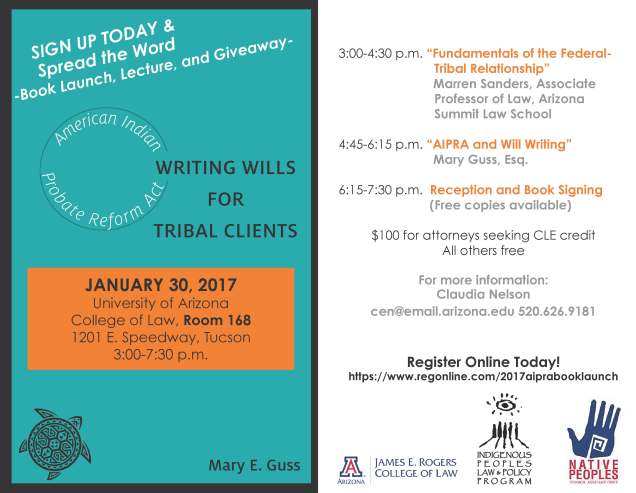
On Monday, January 30, 2017, Arizona Law will host a conference and book launch, featuring presentations by IPLP graduates Marren Sanders and Mary Guss, followed by a reception and book signing, with free copies available of the new publication “AIPRA — Writing Wills for Tribal Clients.”
Here:
cayibia_ap1-14-17-116123107-0001
Press release:
Cayuga Nation Traditional Government Appeals BIA Decision
Agency Violates Own Rules to Interfere in Cayuga Affairs
January 16, 2017 – Seneca Falls, NY—The Cayuga Nation’s traditional government – the Council of Chiefs and Clan Mothers – on Friday appealed the December 15, 2016 Bureau of Indian Affairs (BIA) decision declaring a group organized by Clint Halftown to be the government of the Cayuga Nation. The decision by BIA Eastern Regional Director Bruce Maytubby would strip the Clan Mothers of their longstanding role in the Nation’s government, a role Clint Halftown has previously supported. It would put in place a mail-in survey process to substitute for the traditional processes by which Haudenosaunee Nations like the Cayuga Nation have always chosen their leaders.
“Far from being a neutral decision-maker, Maytubby prejudged the viability of the campaign of support process and secretly colluded with the Halftown faction while excluding Nation leaders then-recognized by the United States,” the appeal says. “Mr. Maytubby reversed existing federal policy on supporting mail-in surveys as a means of Cayuga governance without providing any evidence whatsoever – much less substantial evidence – to justify such a reversal.”
The appeal highlights secret communications and meetings between Mr. Maytubby and the Halftown group and points out Mr. Maytubby’s own admission that the mail-in survey process would violate federal law on tribal elections.
“This arbitrary and capricious decision and the backroom dealings that preceded it sets dangerous precedent for federal interference in the affairs of sovereign Indigenous Nations,” explained attorney Joseph Heath, who represents the Nation’s traditional leaders, many of whom have been recognized by the BIA and acknowledged as leaders by the Halftown group for more than a decade. “This violates not only Haudenosaunee law but also federal law protecting Indian nations’ right to self-governance, and their right to self-determination under Article 3 of the United Nations’ Declaration on the Rights of Indigenous Peoples.”
Sachem Samuel George of the Cayuga Nation noted, “Centuries of bad policies by the United States and its Bureau of Indian Affairs have resulted in the challenges our people face today. We have survived genocide, being forced from our lands, having our children taken from us. In recent decades, the United States’ policies have improved in their acknowledgement of the sovereignty of Indigenous Nations, giving us the freedom to create a better future for our people. Maytubby’s decision, on the other hand, is a return to the dark ages of Indian Affairs.”
###
Here:
The Tohono O’odham Nation Office of Attorney General is seeking a Chief Prosecutor for the Office of the Prosecutor. Applicants must have at least six years of relevant experience, including three years of supervisory experience, and be licensed in Arizona. To apply, please send a cover letter, resume, and three writing samples to Laura Berglan, Acting Attorney General, via email at laura.berglan@tonation-nsn.gov.
Here is the opinion in Shopbell v. State of Washington Dept. of Fish and Wildlife:
We posted materials on this case here.
Kevin Washburn has posted “What the Future Holds: The Changing Landscape of Federal Indian Policy,” forthcoming in the Harvard Law Review Forum.
The abstract:
Since first described by Chief Justice John Marshall, the United Stated has been deemed to have a moral and legal “trust responsibility” to the American Indian tribal nations who gave way so that the United States could exist. For nearly two centuries, the trust responsibility reflected a paternalistic view toward Indian tribes. As the United States has developed a more enlightened policy characterized by greater respect for “tribal self-governance,” tribal governments have experienced a renaissance. Instead of federal paternalism, federal policy has moved away from federal control and toward tribal empowerment. As a result, the trust responsibility’s paternalistic features have come to seem anachronistic, and the trust responsibility can be described today by a new set of norms. The evolution, however, is not complete. Some of the old paternalistic features continue to animate federal Indian law and serve as obstacles to tribal self-governance. Moreover, as tribal governments exercise greater powers, they are subject to new scrutiny. Perhaps ironically, even some Native Americans have sought to reinstate federal oversight of tribal nations. The shifting norms of federal policy have produced new conflicts and will require a new reckoning about the federal role as old norms clash with new.
 Turtle Talk
You must be logged in to post a comment.