Here.
Culverts case background materials here.
Here is the complaint in Cavazos v. Zinke (D.D.C.):
The plaintiffs are represented by Gerald Torres, Michael Sliger, and Hope Babcock.
News coverage: “Expelled Tribe Members Say Feds Did Nothing to Protect Their Rights”
Update:
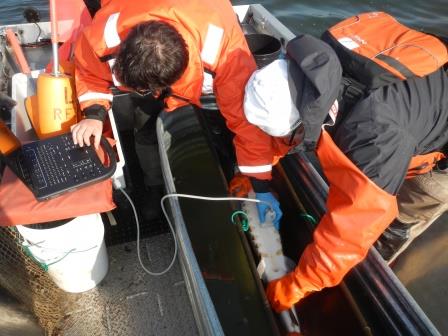
On Thursday 4/12/18, the Little River Band of Odawa Indians Natural Resources Department staff, led by Corey Jerome – Sturgeon Biologist, have recaptured a Lake Sturgeon from Manistee Lake that was raised and released in 2008 from our sturgeon Streamside Rearing Facility at Rainbow Bend on the Manistee River. This is the first released sturgeon that has been documented returning into the Manistee River system from our rearing facility and is thought to be on its way up the Manistee River to spawn this spring. Corey Jerome was able to confirm the identity of this sturgeon by using the unique identification number scanned from the PIT-Tag in the fish, this tag was implanted into this sturgeon before its release in 2008. The sturgeon was released on September 20, 2008 and was 7.3 in., 0.05 lbs. and is now 10 years old and 45.27 in., 28 lbs. To our knowledge this is the first documented lake sturgeon from a Streamside Rearing Facility to return to its natal stream within the Great Lakes. Corey Jerome began in the spring of 2017, and has continued in 2018 to look for adult lake sturgeon returning to the Manistee River from our Streamside Rearing Facility. It is our plan to continue these efforts to look for returning sturgeon in the Manistee River that have been released from our Streamside Rearing Facility to evaluate the success of our efforts. (Pictures Attached; Corey Jerome holding the returning sturgeon; Corey Jerome and Josh Beaulaurier taking ultrasound images to determine the sex of the sturgeon.)
Here:

Here:
2018-04-13 Doc 335 NN Mot Leave Intervene
2018-04-13 Doc 335-1 NN Memo in Support of Mot for Leave to Amend
2018-04-13 Doc 335-2 EX 1 – NN Proposed Third Amended Complaint
On remand from the Ninth Circuit, the Nation moves the district court for leave to file its third amended complaint, which restates the Nation’s claims for breach of trust (dismissal of the Nation’s NEPA claims was upheld). The appeals court gave short shrift to the argument by the US, adopted by the district court, that sovereign immunity barred the breach of trust claim, clarifying (consistent with the majority of circuits) that section 702 of the APA, as amended, is a broad waiver of that immunity for claims not seeking money damages.
While continuing to assert that the Secretary as water master for the mainstream of the Colorado River in the Lower Basin breached his fiduciary duties, including the duty of protection explicitly undertaken in the 1849 Treaty of Peace, in management decisions that failed to account for the needs and unquantified rights of the Navajo Nation for homeland purposes, the proposed amended complaint now focuses more particularly on the federal defendants’ historic failure to correct an omission in the Decree in Arizona v. California, omitting lands above Lake Mead, and inducing reliance on limited water supplies by others with rights junior to the Navajo Nation to the detriment of the Nation.
Here:


The Aoki Center for Critical Race and Nation Studies at King Hall, UC Davis Law School, is celebrating the launch of the Aoki Center Tribal Justice Project on Thursday, April 12, at noon in the courtyard of the law school. A collaborative effort with California tribal judges, lawyers, and leaders, the Tribal Justice Project seeks to enhance the capacity and sovereignty of tribes in California by providing culturally appropriate training for tribal judges and court personnel and establishing an intertribal appellate court at the law school.
By targeting the needs of tribes in California and other Public Law 280 states, the Project will be the first of its kind to fill a critical educational gap. In contrast to most other states, California and five other states are governed by Public Law 280, a federal law that allows the state to assume concurrent jurisdiction in certain criminal and civil matters over Indians on certain tribal lands. Historically this law has created significant challenges for tribes in California and other Public Law 280 states that wish to establish their own tribal courts. Training will be provided in areas accessible to tribes throughout the state and at King Hall. The first training is scheduled at the Yurok Tribe, California’s largest tribe, in late June.
The Aoki Center hopes that the variety of curricular offerings in Federal Indian Law and Tribal Justice as well as extra-curricular programs and opportunities for service to tribes will encourage more Native students to become lawyers and to attract students to King Hall who are interested in providing legal services to California tribes.
Hon. Christine Williams, a member of the Yurok Tribe and the Chair of the California Tribal Judges Association, is the Director of the Aoki Center Tribal Justice Project. Certified in Indian law, Judge Williams has spent her legal career focused on representing Tribes in a broad spectrum of legal matters such as tribal court development, Indian child welfare and cultural resource protection. She currently serves as the Chief Judge for the Shingle Springs Band of Miwok Indians in El Dorado County. Previously, she assisted in the formation of and development of the Northern California Intertribal Court System, a consortium court serving four tribes in Mendocino County, California, where she also served as its Chief Judge. Judge Williams has a long history of providing training and education on various areas of Indian law and Indian Child Welfare law and history. She serves as an appointee to the Tribal Court State Court Forum.
Jennifer R. Leal, a descendant of the Washoe and Mono Lake Paiute communities from northern California, is the Project’s Program Administrator. She brings to the project extensive experience in the areas of tribal relations, tribal court administration and judicial education. Previously, Ms. Leal worked for the National Judicial College – National Tribal Judicial Center in Reno, Nevada as the Program Manager. Therein she utilized her prior role as the Tribal Court Administrator for the Washoe Tribe of Nevada & California – Washoe Tribal Court in Gardnerville, Nevada to inform her work. While working at a national level, she developed distance-learning curricula and facilitated discussions on problem solving tribal court administration challenges. Ms. Leal also contributed to the early idea and design of the Judicial Council of California’s Court Toolkit for Tribal/State/Federal Administrators and Clerks. She became faculty in 2013 and provided education on court administration to Alaska tribal court administrators and clerks using David Kolb’s Learning Style Inventory for adult learners. Since leaving the National Tribal Judicial Center and retuning to California, Ms. Leal served as the Executive Assistant to the Morongo Band of Mission Indians’ Tribal Chairman, Robert Martin, who was also Chairman in 1987 and represented the Tribe during the landmark U.S. Supreme Court case California v. Cabazon Band of Mission Indians and Morongo Band of Mission Indians. Ms. Leal earned both her Bachelor of Arts and Master of Arts degrees in American Indian Studies from UCLA. Her graduate research concentrated on history and law and primarily focused on tribal courts.
Professor Mary Louise Frampton, Director of the Aoki Center for Critical Race and Nation Studies at King Hall, will provide oversight and faculty support for the Tribal Justice Project. Professor Frampton introduced a new course in Tribal Justice in Fall 2017 in consultation with Judge Williams. That course added to the curricular offerings at King Hall by the preeminent Federal Indian Law scholar, Professor Katherine Florey. She is particularly interested in the extraterritorial application of law, theories of jurisdiction, and the powers of tribal courts.
This Project was created with support from the Yurok Tribe of Northern California and the Bureau of Indian Affairs.
https://law.ucdavis.edu/centers/critical-race/tribal-justice/
Here.
Here:
Final FLOW letter to MPSC and DEQ
Excerpt:
Dear Chairwoman Talberg and MPSC Commissioners Cadwell, Rittenhouse, Saari, and Eubanks, Director Grether, Mr. Graf, and Mr. Matousek:
It is the consensus view of federal and state agencies, experts, and interested parties, including Enbridge, that a failure of Line 5 along its length, but particularly under the Straits of Mackinac and the St. Clair River, would result in catastrophic economic and environmental harm.
FLOW’s attached comments request a comprehensive evaluation of feasible and prudent alternatives to Line 5 in its entirety, including, but not limited to Line 5 near, in, across or under the public trust bottomlands and/or waters of the Straits of Mackinac, and Line 5 near, in, across, or under the St. Clair River at Marysville, and across the other 245 public trust water crossings in the state. For the reasons described in the letter, the Department of Environmental Quality (“DEQ”), Michigan Public Service Commission (“MPSC”), and State of Michigan have a legally and state constitutionally required duty to conduct such a comprehensive analysis of the feasible and prudent alternatives to Line 5 in its entirety, including both the Straits and St. Clair River.
On behalf of FLOW, our supporters, and the people of Michigan, we ask you to implement this request immediately.
Here is the opinion in Pedersen v. Arctic Slope Regional Corp.:
From the NYTs, here.
 Turtle Talk
You must be logged in to post a comment.