Here are the materials in Temple v. Her Many Horses (D. S.D.):
Author: Matthew L.M. Fletcher
Eighth Circuit Affirms Indian Country Assault Convictions
Here is the opinion in United States v. Rainbow.
An excerpt:
Christopher Rainbow (Christopher) and Jordan Rainbow (Jordan) were found guilty of assault with a dangerous weapon and assault resulting in serious bodily injury, both in violation of 18 U.S.C. §§ 2, 113, and 1153. On appeal, they argue that the district court erred in admitting into evidence certifications of Indian blood and 1 in denying their requests to instruct the jury on lesser-included offenses. Jordan also argues that the district court erred in asking certain questions of a doctor who treated the victim and that the evidence isinsufficient to support his convictions. We affirm
Check Out Stephen Pevar’s Interview with the Filmmaker of “Johnny Cash’s Bitter Tears”
Navajo Nation Prevails in Voting Rights Case against San Juan County
Here is the order in Navajo Nation v. San Juan County (D. Utah):
An excerpt:
The County’s redistricting decisions predominated by racial classifications violate the Equal Protection Clause because they are not narrowly tailored to serve a compelling governmental interest and cannot survive strict scrutiny. On this basis, Navajo Nation is entitled to summary judgment on its first claim for relief. San Juan County’s motion for summary judgment is denied on the merits to the extent that it addresses the Equal Protection claim asserted in the first claim for relief, and denied as moot to the extent it addresses any other theory that could support Navajo Nation’s first claim. Because San Juan County Commission District Three violates the Equal Protection Clause, the districts in the County must be redrawn.
Briefs here.
NILL Indian Law Bulletin 2/18/16
| The National Indian Law Library added new content to the Indian Law Bulletins on 2/18/16.
U.S. Supreme Court Bulletin U.S. Federal Trial Courts Bulletin News Bulletin Law Review & Bar Journal Bulletin |
NABA-AZ Annual Golf Tourney

Nez Perce Tribe Seeks Chief Judge
Nez Perce Tribe seeks applicants for CHIEF JUDGE HR-15-122. This 4-yr. contract position requires a wide range of legal and administrative skills, handling all phases of civil and criminal litigation, drafting orders, opinions, etc., and assuring effective operation of the Tribal Court. Requires 3 yrs. experience as a judge, tribal court judicial experience preferred. Requires thorough knowledge of Indian law, a Juris Doctorate from an accredited law school and membership in good standing in any state bar. A complete application includes a NPT application including current resume and contact information for 4 work-related references including 2 judges. Application form and information and full position announcement is at www.nezpercetribe.org. or contact Robert Kipp at 208-843-7332. Tribal preference applies. Open until filled.
Enterprise Rancheria Prevails in IGRA Good Faith Negotiations Suit against California
Here are the materials in Estom Yumeka Maidu Tribe of the Enterprise Rancheria v. State of California (E.D. Cal.):
14-1 Tribe Motion for Judgment on the Pleadings
New from Fletcher: Federal Indian Law Hornbook

Matthew L.M. Fletcher (that’s me) just published “Federal Indian Law” as part of the West Academic hornbook series. Here’s the blurb:
Fletcher’s Hornbook on Federal Indian Law is a deep survey of the history and substantive law governing the relations between the three American sovereigns, federal, state, and tribal. Interwoven are issues of federalism, administrative law, constitutional rights, and international relations. This hornbook includes original research and novel analysis of foundational Supreme Court decisions and critical federal statutory schemes – the stories beyond the stories. In addition to delving into the origins and histories of cases and statutes, the hornbook analyzes modern Indian rights settlements, the international and comparative frontiers of Indian law, and the future of the field.
If you want a preview of the table of contents and the index, see here (PDF).
New on the TT Bookshelf: John Low’s New Book on the Pokagon Band and the City of Chicago
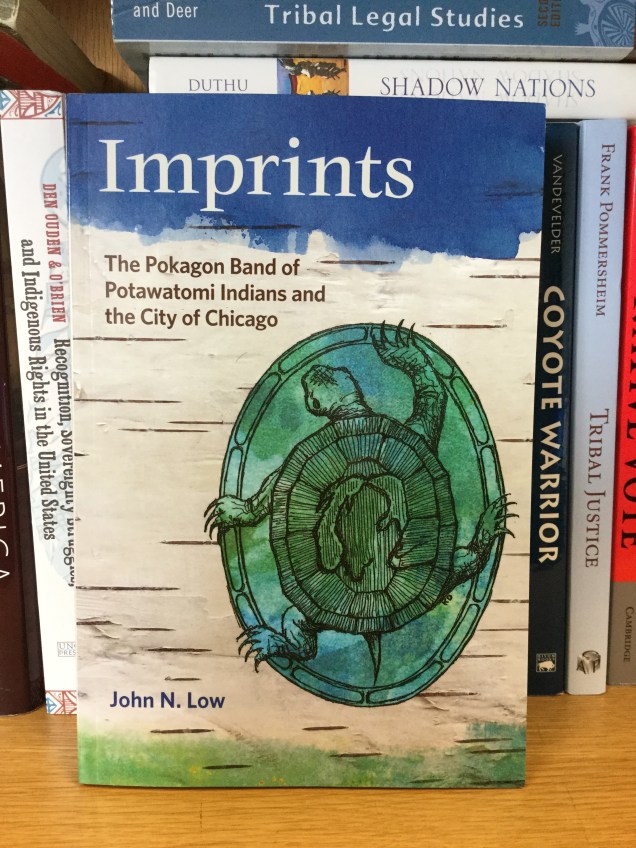
John Low has published “Imprints: The Pokagon Band of Potawatomi Indians and the City of Chicago” with Michigan State University Press (book page here).
From the website:
Imprints: The Pokagon Band of Potawatomi Indians and the City of Chicago
The Pokagon Band of Potawatomi Indians has been a part of Chicago since its founding. In very public expressions of indigeneity, they have refused to hide in plain sight or assimilate. Instead, throughout the city’s history, the Pokagon Potawatomi Indians have openly and aggressively expressed their refusal to be marginalized or forgotten—and in doing so, they have contributed to the fabric and history of the city.Imprints: The Pokagon Band of Potawatomi Indians and the City of Chicago examines the ways some Pokagon Potawatomi tribal members have maintained a distinct Native identity, their rejection of assimilation into the mainstream, and their desire for inclusion in the larger contemporary society without forfeiting their “Indianness.” Mindful that contact is never a one-way street, Low also examines the ways in which experiences in Chicago have influenced the Pokagon Potawatomi. Imprints continues the recent scholarship on the urban Indian experience before as well as after World War II.
 Turtle Talk
You must be logged in to post a comment.