Download complaint and exhibits in the matter of Friends of Toppenish Creek v. IHS (W.D. Wash.) here.
Environmental
Elizabeth Kronk Warner on Tribal Environmental Ethics as an Alternative Ethical Paradigm
Elizabeth Kronk Warner has posted “Looking to the Third Sovereign: Tribal Environmental Ethics as an Alternative Ethical Paradigm.”
Here is the abstract:
As evidenced by the Paris COP 21, the world has decided that the time has come to address climate change. As policy makers around the world consider the best methods of controlling greenhouse gas emissions and mitigating the impacts of climate change, they may also be increasingly reconsidering the ethical paradigm(s) used to tackle modern environmental challenges, such as climate change. Therefore, now is the ideal time to reconsider the environmental ethics underlying environmental policy making. In the United States, a national, comprehensive plan to both mitigate the effects of and adapt to those effects that cannot be mitigated has yet to be developed. Given such federal malaise, policy makers will need to look elsewhere to find examples of alternative ethical paradigms, but not necessarily outside of the exterior boundaries of the United States. They can look to the third sovereign — Indian tribal governments. Tribes are actively innovating in this field, as they are implementing tribal environmental ethics into law designed to address the impacts of climate change. This article, therefore, considers what role, if any, can tribal environmental ethics play in the re-examination and consideration of American environmental ethics? The answer — quite a substantial role. Tribes must straddle two worlds — a traditional one and one dominated by Western culture and values. As a result of this dichotomy, tribes are necessarily experts at adaptation and innovation. To demonstrate the value of looking to tribal environmental ethics when considering alternative ethical paradigms for the United States, this article begins by discussing the link between environmental ethics and policy making. With this understanding in place, the article then examines the importance of environmental ethics to tribes. This Part considers factors that may motivate tribes to adopt environmental ethics alternative to American environmental ethics, and also uses legal ethics as an example of the necessity, in some instances, for the development of an alternative ethical paradigm, such as one separate from the model ethical code presented by the American Bar Association. Finally, the article concludes with a discussion of how tribes are serving as laboratories of environmental ethical innovation. The Part begins with an introduction to some ethical paradigms other than anthropocentrism, such as animism and Deep Ecology. The purpose of this introduction is to demonstrate how tribal environmental ethics might parallel some of these alternative ethical frameworks, but also to show that tribal environmental ethics can be different. With this introduction in place, the Part argues that tribes have the capacity for innovation, and then provides explicit examples of where tribes have departed from American environmental ethics. Ultimately, given the significance of emerging environmental challenges, such as climate change, the article concludes that, if policy makers decide on the necessity of an ethical paradigm other than anthropocentrism, tribal environmental ethics provide a compelling alternative, and, tribes, as the third sovereign in the United States, demonstrate how such an alternative environmental ethic may be codified into environmental laws.
MSU NALSA Climate Change Panel
Whitney Gravelle and Kyle Whyte

Chris Caldwell
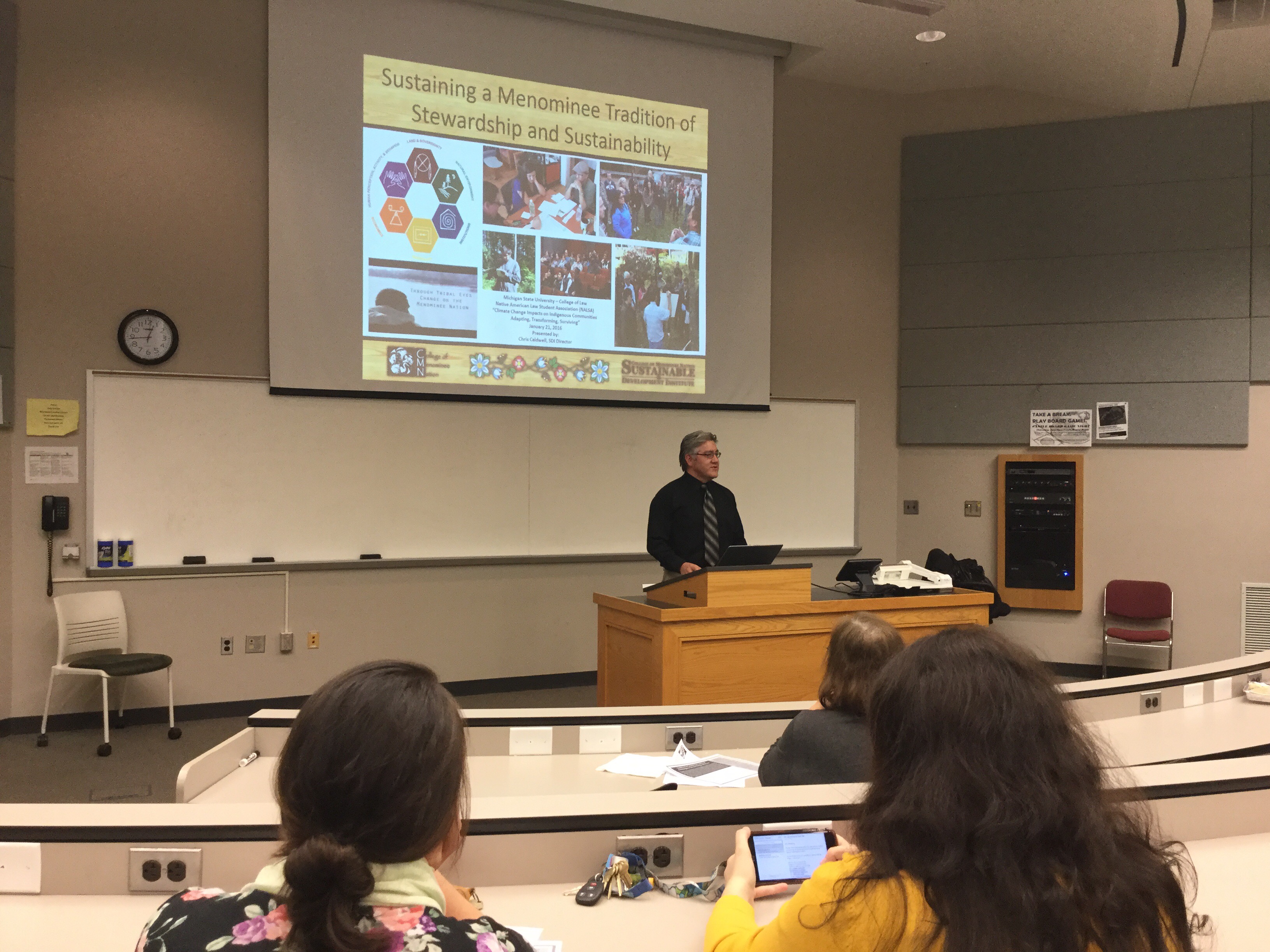
Michigan State NALSA Event — Jan. 21, 2016

Ninth Circuit Briefs in Havasupai Tribe v. Provencio
Ninth Circuit Briefs in Hopi Tribe v. EPA
Navajo Blame EPA Inaction for Suicides
From The Daily Beast:
“For most Americans, the third week of December is about wrapping up Christmas shopping and prepping for a whirlwind of family gatherings. But for the leaders of the Navajo Nation, it’s about something much heavier: suicide prevention.”
Article is HERE.
Indian Law Profs Comments on EPA’s Proposed Water Quality Standards for Washington State
Law Professor Comments Submitted on EPA Proposed Rule
Law Professor Comments regarding the Environmental Protection Agency’s (EPA) proposed Revision of Certain Water Quality Criteria Applicable to the State of Washington, Docket ID No. EPA-HQ-OW-2015-0174, published at 80 Fed. Reg. 55063 (Sept. 14, 2015):
Water quality standards (WQS) for Washington2 impact the rights, resources, and health and well-being of numerous tribes in the region. In fact, when the waters that support fish are allowed to be contaminated, tribes’ interests are profoundly affected and tribal people disproportionately among the most exposed. This context is significant, because it constrains rulemaking in important ways. Among other things, the adequacy of WQS for Washington must be considered in view of legal protections for tribes’ fishing rights, including treaties and other instruments.
New Carla Fredericks Scholarship on Tribal Energy
Carla Fredericks has posted “Plenary Energy,” forthcoming in the West Virginia Law Review, on SSRN.
Here is the abstract:
An incompatible relationship exists between the federal trust responsibility over Indian tribes and tribal sovereignty, the conflicting nature of which has been exacerbated by numerous judicial confirmations of the unbridled congressional plenary power over all tribal affairs. Nowhere is there more conflict between the trust responsibility and sovereignty than within the context of mineral resource development on tribal lands. The evolution of the regulatory framework of Indian mineral development can be viewed as a continuum, with maximum trust obligation and minimum tribal sovereignty on one extreme, and an inversion of these two variables on the other. There currently exists pending legislation that would amend the 2005 Energy Policy Act in a manner that would allow tribes greater autonomy in developing their mineral resources without necessarily compromising the trust relationship. But, as this article suggests in using the Keystone XL Pipeline as a case study, tribes should not rely on Congress to act in the interest of tribal sovereignty unless they can attach this interest to a strong political impetus. Invoking both the United Nations Declaration on the Rights of Indigenous People and Convention No. 169 of the International Labour Organization, this article contends that attaining a understanding of American Indian rights as fundamental through an international human rights framework can help untangle the web of conflicting doctrines that very much defines American Indian law today, opening the door to a paradigm shift in the domestic relationship between tribes and the federal government that would allow tribes to attain economic self-sufficiency through their own assets.
 Turtle Talk
You must be logged in to post a comment.