Article on Allotment-Era Literature and Cases on Tribal Jurisdiction and Reservation Diminishment

My article. “How Allotment-Era Literature Can Inform Current Controversies on Tribal Jurisdiction and Reservation Diminishment” was recently published in volume 82 of the University of Toronto Quarterly, in a special issue on law and literature.

I looked at non-Native authored and Native-authored literature of the time, specifically in South Dakota and surrounding states and territories, to see whether it helped illuminate the injustices that were being perpetrated on tribes through the allotment process and the takings of surplus lands. The idea was that this literature might have, like the news articles I looked at in “Unjustifiable Expectations: Laying to Rest the Ghosts of Allotment-Era Settlers,” put purchasers on notice that tribal lands were being taken unjustly. Most of the non-Native literature I looked at was not that helpful, but a work by historian/poet Doane Robinson was an exception. On the Native side, Zitkala-Sa’s short stories proved to be the most helpful, but the works I looked at by Luther Standing Bear and Charles Eastman were also somewhat helpful.

Unfortunately, the article isn’t available on Lexis or Westlaw, but it is on Muse, if you have access to that. A sightly older version is on my ssrn page.

New Scholarship by Ann Piccard: “Death by Boarding School”

Ann Piccard has published Death by Boarding School: “The Last Acceptable Racism” and the United States’ Genocide of Native Americans, 49 Gonz. L. Rev. 137 (2014).

A summary:

There is a special kind of racism in this country against Native Americans, and it is the “last acceptable racism.” The author of that poignantly accurate description of most Americans’ attitudes towards Native Americans, who is both a Native American and a Jew, noted,

Not that long ago, white administrators of Indian boarding schools told our children that the “Indian in you shall die.” This kind of treatment and forced thinking has a lasting generational effect. It can be difficult to break through that type of programming.  Many of our people, however, have shaken off these forced ideological shackles to speak the truth and demand long overdue respect. Our voice is getting louder.

Our words are being said with more frequency and emphasis. But people need to hear us. Societal racism should no longer be an ad hoc affair, which is routinely accepted when directed against a certain group. It should be universally condemned. Perpetuating past wrongs and dehumanizing concepts hurts everyone.

This last acceptable racism is rarely mentioned in the U.S. However, one day in a very small town in northern Minnesota, in an area that has been economically depressed ever since the decline of the taconite and iron ore mining industry several decades ago, I watched two Native American men park a pickup truck in front of the local pawn shop.

I could tell the young men were Native Americans only because of the Bois Forte Band license plate on their truck; other than that, they looked, sounded, and acted like most of the other men in that rural north woods town. Upon reflection, of course, I realized that their skin was slightly darker than most residents of the town; I also began to notice that I did not see dark-skinned people working or shopping in any of the town’s stores. My eye was untrained, a fact that I attribute to my upbringing in the Deep South,6 where I was in a small minority of white children who were raised by our parents to see and to protest (and refuse to accept) the prevailing racism toward African-Americans. The subtle differences in appearances between the Native Americans and the “whites” in Minnesota had gone unnoticed by my Southern eyes. But as we watched the young men take their chain saws into the pawnshop that day, my husband remarked that men in northern Minnesota who hock their chain saws must be in pretty bad shape, because how could they survive, let alone make a living, without such tools?

New Scholarship on Land Appropriation from Indigenous Peoples and Energy Resources

The Energy Law Journal has published “Land in the Second Decade: The Evolution of Indigenous Property Rights and the Energy Industry in the United States and Brazil” by Danielle C. Davis.


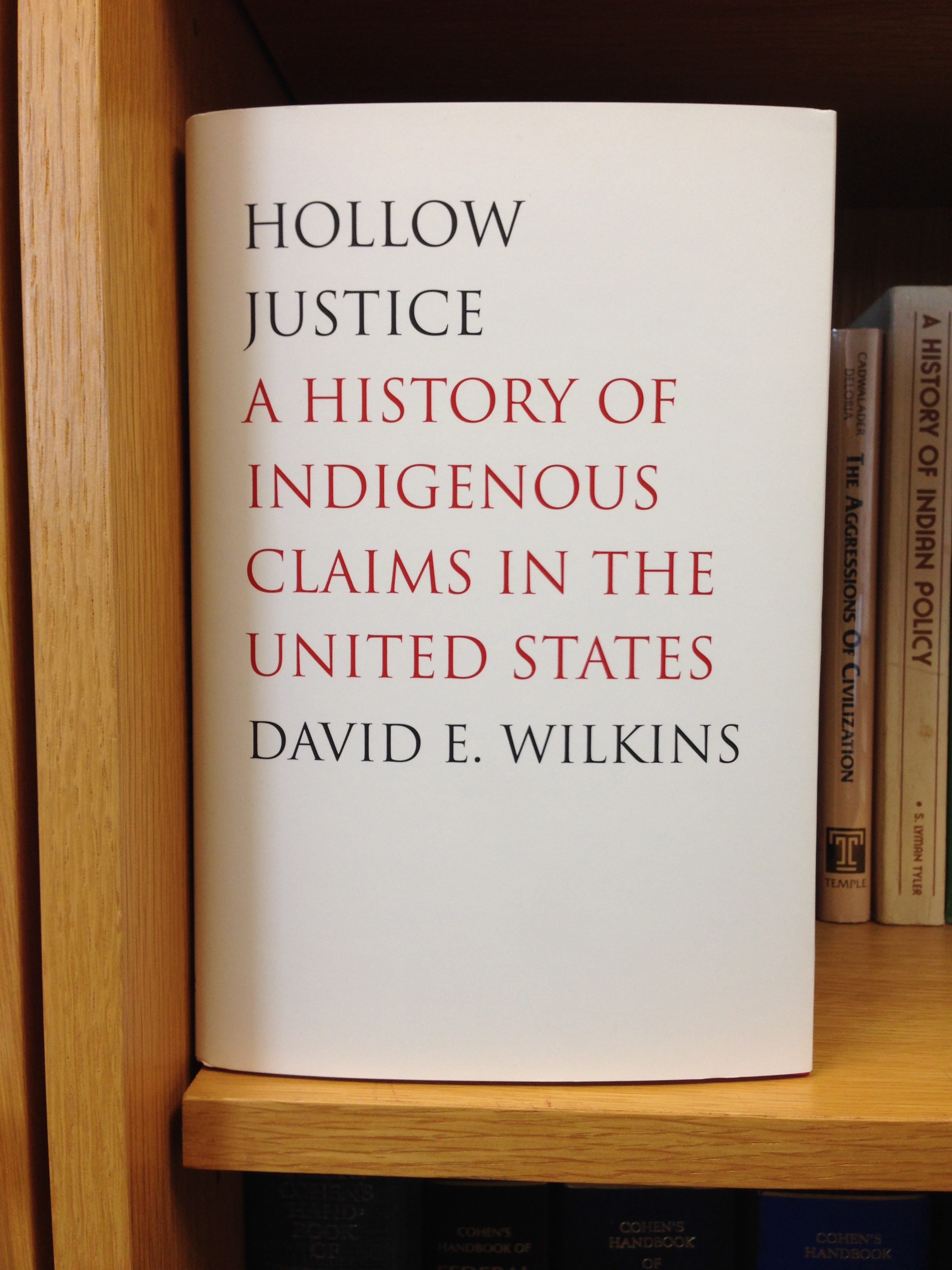
Recommended Winter Break Reading — David Wilkins’ “Hollow Justice”

Good stuff. Here:

Hollow Justice

Fletcher Paper on the Seminole Tribe and the Origins of Indian Gaming

At the invitation of Alex Pearl and the FIU Law Review to write a symposium piece on Florida Indian history and law, a challenge for me since I know very little about it, I came up with “The Seminole Tribe and the Origins of Indian Gaming.” Assuming the law review finds it publishable, it will appear in the FIU Law Review alongside the work of luminaries like Siegfriend Weissner and Sarah Krakoff.

Here is the abstract:

The Seminole Tribe of Florida has played perhaps the most important role in the origins and development of Indian gaming in the United States of any single tribe. The tribe opened the first tribally owned high stakes bingo hall in 1979. The tribe in 1981 was involved in one of the earliest lower court decisions forming the basis of the legal theory excluding most states from the regulation of high stakes bingo, a theory that Congress largely codified in the Indian Gaming Regulatory Act (IGRA) years later. The tribe was a party to the Supreme Court decision in 1996 that radically altered the bargaining power between tribes and states over the negotiation and regulation of casino-style gaming under IGRA. And more recently, the tribe has been a leading participant in negotiations and litigation over the regulatory landscape of Indian gaming after the 1996 decision. The Tribe is one of the most successful Indian gaming tribes in the nation.

This paper traces that history, but also offers thoughts on how the culture and traditional governance structures of the Seminole Tribe played a part in its leadership role in the arena of Indian gaming.

Ann Tweedy on the Madison County v. Oneida Indian Nation II Cert Petition

Here, from the Faculty Lounge. An excerpt:

In the Counties’ brief in support of the petition for certiorari, they claim that a holding in the Tribe’s favor on the disestablishment question would contravene the “justifiable expectations” of non-Indians in the area, who have come to expect to be exposed to little if any tribal presence or power.   As I explained in a recent article, the Supreme Court routinely makes similar assumptions in favor of non-Indian residents and past land purchasers in tribal jurisdiction and reservation diminishment cases.  See generally Ann E. Tweedy, “Unjustifiable Expectations:  Laying to Rest Allotment-Era Settlers,” 36 Seattle U. L. Rev. 129 (2012).  There are numerous problems with this type of assumption, however, and it can be hoped that the Solicitor General will raise some of them in his response.

The Oneida settlement in this matter is bogged down; see here and here.

In related news, former Oneida chairman Jake Thompson passed away last month: “Jake Thompson, who started Oneida land claim, dies.”

Kirsten Carlson’s “Priceless Property”

Kirsten Matoy Carlson recently published “Priceless Property” in the Georgia State Law Review.

Here is the abstract:

In 2011, the poorest American Indians in the United States refused to accept over one billion dollars from the United States government. They reiterated their long-held belief that money–even $ 1.3 billion–could not compensate them for the taking of their beloved Black Hills. A closer look at the formation of the Sioux claim to the Black Hills helps us to understand why the Sioux Nation has repeatedly rejected compensation for land taken by the United States over 100 years ago. This article seeks to understand why the Sioux view the Black Hills as priceless property by studying the formation of the Black Hills claim. It constructs a new, richer approach to understanding dispute formation by combining narrative analysis with the sociolegal framework for explaining dispute formation. The article argues that narratives enrich the naming, claiming, and blaming stages of dispute creation. It illustrates the usefulness of this new approach through a case study of the Black Hills claim. It uses the autobiographical work of an ordinary Sioux woman to provide a narrative lens to the creation of the Sioux claim to the Black Hills. American Indian Stories by Zitkala-Sa presents a narrative of Sioux life around the time of the claim’s emergence. By contextualizing and humanizing the claim, my analysis provides insights into why the Sioux claim to the Black Hills emerged into a legal dispute and helps to explain why the Black Hills remain priceless property to the Sioux Nation today. The article concludes with a suggestion for successful resolution of the Black Hills claim based on acceptance of the Black Hills as priceless property to the Sioux Nation.

20131023-070414.jpg

Colette Routel on Bounties on Dakota Men During the US-Dakota War

Highly recommended paper.

Colette Routel has posted “Minnesota Bounties on Dakota Men During the US-Dakota War” on SSRN. Here is the abstract:

The U.S.-Dakota War was one of the formative events in Minnesota history, and despite the passage of time, it still stirs up powerful emotions among descendants of the Dakota and white settlers who experienced this tragedy. Hundreds of people lost their lives in just over a month of fighting in 1862. By the time the year was over, thirty-eight Dakota men had been hanged in the largest mass execution in United States history. Not long afterwards, the United States abrogated its treaties with the Dakota, confiscated their reservations along the Minnesota River, and forced most of the Dakota to remove westward.

While dozens of books and articles have been written about these events, scholars have largely ignored an important legal development that occurred in Minnesota during the following summer. The Minnesota Adjutant General, at the direction of Minnesota Governors Alexander Ramsey and Henry Swift, issued a series of orders offering rewards for the killing of Dakota men found within the State. The first order authorized the creation of a corps of volunteer scouts that would scour the “Big Woods” in search of Dakota men. They were to be paid not only a daily wage, but an additional $25 for each scalp they were able to provide the Adjutant General’s Office. Subsequent orders permitted individual citizens who were not part of the volunteer corps to claim up to $200 for proof that they had killed a Dakota. These bounty orders remained in effect until at least 1868, when their constitutionality was finally questioned by the Minnesota Supreme Court in State v. Gut.

Minnesota was not the only state that placed a bounty on their Indian inhabitants. Around the same time, a bounty system was enacted by the Territory of Arizona, and one was also implemented by private citizens and local governments within the State of California. Like the bounty system in Minnesota, these programs were creatures of state and territorial law, but they were implicitly and explicitly approved by the federal government. In fact, they could be viewed as part of a much broader extermination program that was at the heart of federal Indian policy during this time period.

This article uses primary historical sources to describe the events leading up to the enactment of a bounty system in Minnesota, its creation, and subsequent on-the-ground implementation. In an attempt to avoid the pitfalls of “presentism,” the legality of this bounty system is analyzed according to the laws in effect in 1863, when it was created. This article concludes that the Minnesota bounty system was illegal from its inception, as it was contrary not only the international law of war, but also the Lieber Code, which was issued by the U.S. Secretary of War in April 1863, and used to govern the conduct of Union soldiers during the ongoing Civil War.

A CLOSER LOOK AT GAMING COMPACT NEGOTIATIONS IN MICHIGAN PART I: The history of Michigan’s first gaming compacts

The Bay Mills Indian Community’s pending Supreme Court case has sucked a lot of the oxygen out of the room here in Michigan.  And it has definitely overshadowed an impending showdown between the State of Michigan and seven six* tribes over the negotiation of new Class III gaming compacts.

The negotiation of new tribal-state gaming compacts here in Michigan will offer a unique case study in how the Indian Gaming Regulatory Act’s compact provisions affect the negotiation of “second generation” gaming compacts – compacts that follow, rather than extend, a tribe’s previous compact.

We’re going to take a closer look at these negotiations in upcoming posts.  But, first, it is important to understand how the current agreements – approved in 1993 – came into effect. WARNING: Marathon Blog Post.

THE HISTORY

As in other parts of the country, a number of Michigan tribes were already operating Class III gaming when IGRA was enacted in 1988.  In enacting IGRA, Congress required tribes to negotiate a gaming compact with states to engage in Class III gaming – even for those tribes that were already operating such games.  Congress also required states to negotiate these agreements in “good faith.”

Six Michigan tribes sought to negotiate Class III gaming compacts with the State of Michigan almost immediately after IGRA’s enactment.  Then-Governor Jim Blanchard refused to negotiate over Class III slot machines, and ultimately refused to enter into a compact.

In 1990, those six tribes filed a lawsuit against the State of Michigan in the U.S. District Court for the Western District of Michigan, alleging that the State violated IGRA’s requirement to negotiate in good faith, and seeking a declaratory judgment that Class III slot machines would be permissible to include in the Compact.

In 1992 – 4 years before the Supreme Court’s decision in Seminole –  the Western District of Michigan ruled in that lawsuit (Sault Ste. Marie Tribe v. Engler) that the Tribes’ lawsuit was barred by sovereign immunity. 

After an unsuccessful appeal, the Tribes amended their lawsuit to name then-Governor John Engler as the defendant in an Ex parte Young action.  That case – Sault Ste. Marie Tribe of Chippewa Indians, et al. v. Engler – ended through a negotiated settlement agreement.  That agreement was entered by the U.S. District Court for the Western District of Michigan as a Consent Judgment in 1993.  That Consent Judgment included several key provisions that will impact ongoing compact negotiations:

  • The seven tribes that were party to the litigation agreed to pay 8% of the net win from electronic games of chance to the State of Michigan’s “Strategic Fund” – provided that the Tribes “collectively enjoy the exclusive right to operate electronic games of chance in the State of Michigan.” (Sections 6 and 7 of the 1993 Stipulation)
  • The Tribes also agreed to pay 2% of the net win from electronic games to “any local units of state government in the immediate vicinity of each tribal casino.”  Importantly, the Tribes were permitted to determine which local units of government would receive the payments (Section 8 of the 1993 Stipulation).
  • Section 5 of the Consent Judgment expressly states that the Tribes are only obligated to make revenue sharing payments to the state “only so long as there is a binding Class III compact in effect between each tribe and the State of Michigan…and then only so long as the tribes collectively enjoy the exclusive right to operate” electronic games of chance in Michigan.
  • Section 8 of the Consent Judgment states that both the Stipulation and the Consent Judgment may be modified or rescinded “only in the above captioned case, and only by the mutual written consent of all parties and with the Court’s concurrence.”

Concurrent with the Western District of Michigan’s entry of the Consent Judgment, the seven Tribes and the State of Michigan entered into separate Class III gaming compacts that were identical to one another.  Those gaming compacts were approved by the Department of the Interior in 1993.

Each of those compacts stated that they would remain in effect “for a term of twenty (20) years from the date it becomes effective[.]”  In other words, they would remain in effect until November 2013.

But those compacts also included language that has created some…(ahem) room for interpretation:

[12(B)]  At least one year prior to the expiration of twenty (20) years after the Compact becomes effective, and thereafter at least one year prior to the expiration of each subsequent five (5) year period, either party may serve written notice on the other of its right to renegotiate this Compact.

Continue reading

California COA Decides ICWA-Related Appeal Involving Cherokee/Choctaw Freedmen Descendants

The opinion in In re D.N. is here.

An excerpt:

The “by blood” requirement in the Choctaw Nation‟s Constitution, as well as others, has been interpreted as excluding the descendants of freedmen. (Allen v. Tribal Council (2006) 9 Okla. Trib. 255.) The exclusion of the descendants of former slaves of the Five Civilized Tribes is a matter of ongoing controversy. (See, e.g., Cherokee Nation v. Nash (N.D.Okla. 2010) 724 F.Supp.2d 1159.) It cannot be addressed in this dependency proceeding since membership criteria are the tribe‟s prerogative, and its determination of a child‟s eligibility for membership is conclusive for purposes of ICWA. (44 Fed.Reg. 67584, 67586 (Nov. 26, 1979); § 224.3, subd. (e)(1); In re Jack C., III (2011) 192 Cal.App.4th 967, 978.)