Here:
Oral argument will be May 16, 2016: Oral Argument Order
Lower court materials here.
MSU ILPC & Indian Law Clinic students presented at the Jackson Community Forum: Impact of Land Treaties.

As a side note–this event, hosted at the Jackson District Library and open to the public, was very well attended. The questions we received were all thoughtful, curious, and kind. Our students did well and felt welcomed. This event came out of a project volunteers in the city did around the 200 anniversary of 1815 survey of Michigan–which happened because of the Treaty of Detroit. Instead of ending there, the organizers decided they needed to know more about treaties and how they work today. Because the event went so well, the librarians are planning to have more events on other issues involving Native communities in Michigan.
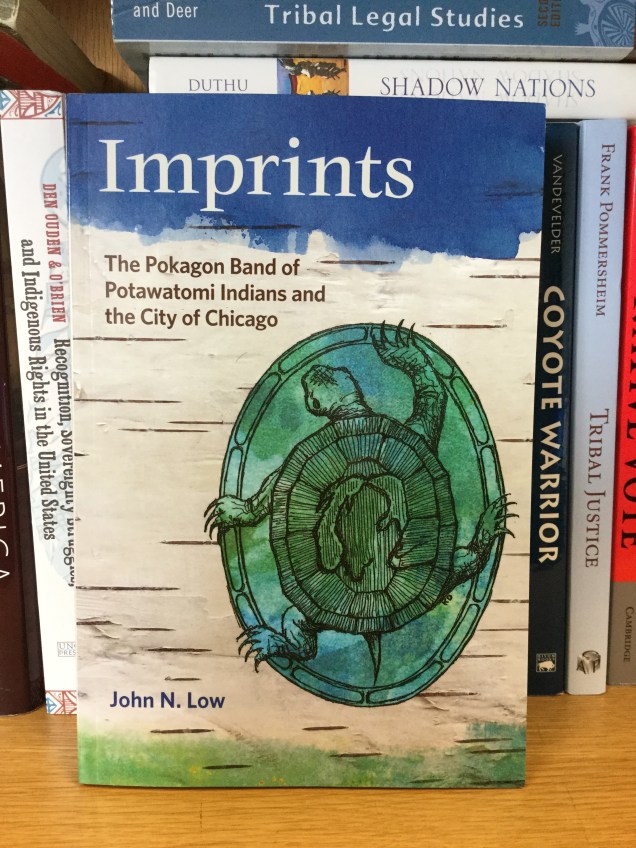
John Low has published “Imprints: The Pokagon Band of Potawatomi Indians and the City of Chicago” with Michigan State University Press (book page here).
From the website:
Imprints: The Pokagon Band of Potawatomi Indians and the City of Chicago
The Pokagon Band of Potawatomi Indians has been a part of Chicago since its founding. In very public expressions of indigeneity, they have refused to hide in plain sight or assimilate. Instead, throughout the city’s history, the Pokagon Potawatomi Indians have openly and aggressively expressed their refusal to be marginalized or forgotten—and in doing so, they have contributed to the fabric and history of the city.Imprints: The Pokagon Band of Potawatomi Indians and the City of Chicago examines the ways some Pokagon Potawatomi tribal members have maintained a distinct Native identity, their rejection of assimilation into the mainstream, and their desire for inclusion in the larger contemporary society without forfeiting their “Indianness.” Mindful that contact is never a one-way street, Low also examines the ways in which experiences in Chicago have influenced the Pokagon Potawatomi. Imprints continues the recent scholarship on the urban Indian experience before as well as after World War II.
TRIBAL COUNCIL SEEKS LETTERS OF INTEREST TO SERVE ON THE BOARD OF DIRECTORS OF WASÉYABEK DEVELOPMENT COMPANY, LLC.
The Tribal Council is soliciting letters of interest and statements of qualifications from NHBP Tribal Members and other qualified persons interested in being appointed to fill a vacant position on the Board of Directors of Waséyabek Development Company.
Waséyabek Development Company was created in May 2011 as a limited liability company, wholly-owned by the Nottawaseppi Huron Band, which is organized under the NHBP Limited Liability Code. Waséyabek Development Company will serve as the vehicle through which business diversification strategies by the Tribal government will be planned and managed.
There are two (2) positions on the Board with approximate four (4) year terms of office commencing July 1, 2016 and ending June 30, 2020.
MISSION AND PURPOSE OF WASEYABEK DEVELOPMENT COMPANY/ROLE OF BOARD OF DIRECTORS
As stated in its Articles of Organization and Operating Agreement, the mission and purpose of Waséyabek Development Company is to:
The day-to-day business activities of Waséyabek Development Company will be managed by a Chief Executive Officer hired by Waséyabek and by the individual business managers hired for specific businesses authorized. During FY 2016, the Board of Directors will be continuing work to develop key strategic and organizational documents for the Company, including business development and investment criteria, financial management and reporting structures/procedures, compensation plans and personnel policies for enterprise employees, and other organizational documents.
The Board will oversee the hiring of a Chief Executive Officer and other business/financial consultants to be retained by Waséyabek to develop overall business plans, investment criteria and strategies for the Nottawaseppi Huron Band to further the mission and purposes of the Company. Funding for the activities of Waséyabek Development Company will come from appropriations approved by the Tribal Council, the amount of which will be guided by Revenue Allocation Plan.
The Waséyabek Board of Directors will be responsible for maintaining regular reporting and accountability to both the Tribal Council and the Membership at large through the development of appropriate financial reporting and other communication procedures.
REQUIRED QUALIFICATIONS FOR APPOINTMENT
In accordance with the Operating Agreement for Waséyabek Development Company, at least one of the vacant Board position must be filled by a person who is an enrolled member of NHBP or other person entitled to preference (spouses/parents of NHBP Members or other Native Americans) under the NHBP Indian Preference in Employment Code. It is the Tribal Council’s desire to fill this position with a qualified person who is an enrolled member of NHBP.
All persons appointed to Board must possess the following qualifications (as verified by an extensive background investigation and interview) to be considered for appointment.
provided, however, that not less than one (1) Board members shall be a financial professional (i.e. Certified Public Accountant, Financial Analyst or Management Accountant) or experience as business operations (i.e. CEO, COO, General Manager); and
Persons who are proven subject matter experts in business who have understanding and demonstrated high-level (management) understanding and experience managing business operations and/or the financial or marketing initiatives associated with growing businesses are preferred. Persons with such experience in technology (including hospitality support), energy, manufacturing and/or construction industries are especially encouraged to apply.
TERM OF OFFICE/COMPENSATION
Term: The individuals appointed with serve a four (4) year term of office (July 1, 2016-June 30, 2020).
Compensation: Members of the Board of Directors will receive a monthly stipend of $2,000 for attendance at meetings and participation in conference calls/planning activities to be undertaken by the Board. Board Members will also be eligible for reimbursement of travel and other expenses incurred in furtherance of Company activities in accordance with a Budget to be developed for Waséyabek Development Company.
STATEMENTS OF INTEREST/RESUMES SHOULD BE SENT TO THE FOLLOWING ADDRESS NO LATER THAN MARCH 31, 2016:
NHBP TRIBAL COUNCIL
ATTN: WASÉYABEK DEVELOPMENT COMPANY BOARD OF DIRECTORS
1485 MNO-BMADZEWEN WAY
FULTON, MI 49052
Here:
Saginaw Cert Petition and Appendix- Filed
Questions presented:
For more than sixty years, the National Labor Relations Board correctly declined to exercise jurisdiction over tribal operations on tribal lands. But in recent years, the Board has belatedly asserted the extraordinary power to regulate the on-reservation activities of sovereign Indian tribes, precipitating a three-way circuit split in the process. Nothing in the text of the National Labor Relations Act changed in that interval; it contains no language granting the Board authority over Indian tribes. Nor has the language of various Indian treaties, like those between the Saginaw Chippewa Indian Tribe and the United States, changed; they continue to recognize the Tribe’s authority to exclude non-members. And despite the Board’s complete lack of expertise in Indian law, the Board now dictates that some tribal operations are subject to the NLRA and others are not based on its evaluation of the centrality of certain functions to tribal sovereignty and subtle differences in treaty language.
This case presents two questions, both of which have divided the courts of appeals:
(1) Does the National Labor Relations Act abrogate the inherent sovereignty of Indian tribes and thus apply to tribal operations on Indian lands?
(2) Does the National Labor Relations Act abrogate the treaty-protected rights of Indian tribes to make their own laws and establish the rules under which they permit outsiders to enter Indian lands?
Lower court materials here.
Here:
Little River Petition and Appendix COMBINED
Question presented:
Whether the National Labor Relations Board exceeded its authority by ordering an Indian tribe not to enforce a tribal labor law that governs the organizing and collective bargaining activities of tribal government employees working on tribal trust lands.
Lower court materials here.
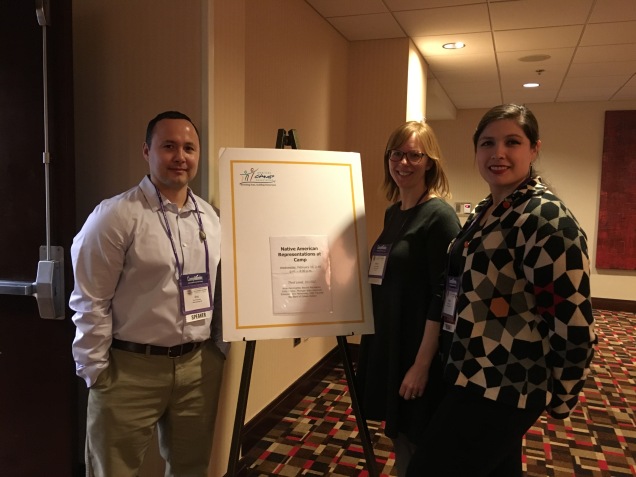
Eric Hemenway, Anne Henningfeld, and Emily Proctor outside their well-attended panel.
Here:
Here.
 Turtle Talk
You must be logged in to post a comment.