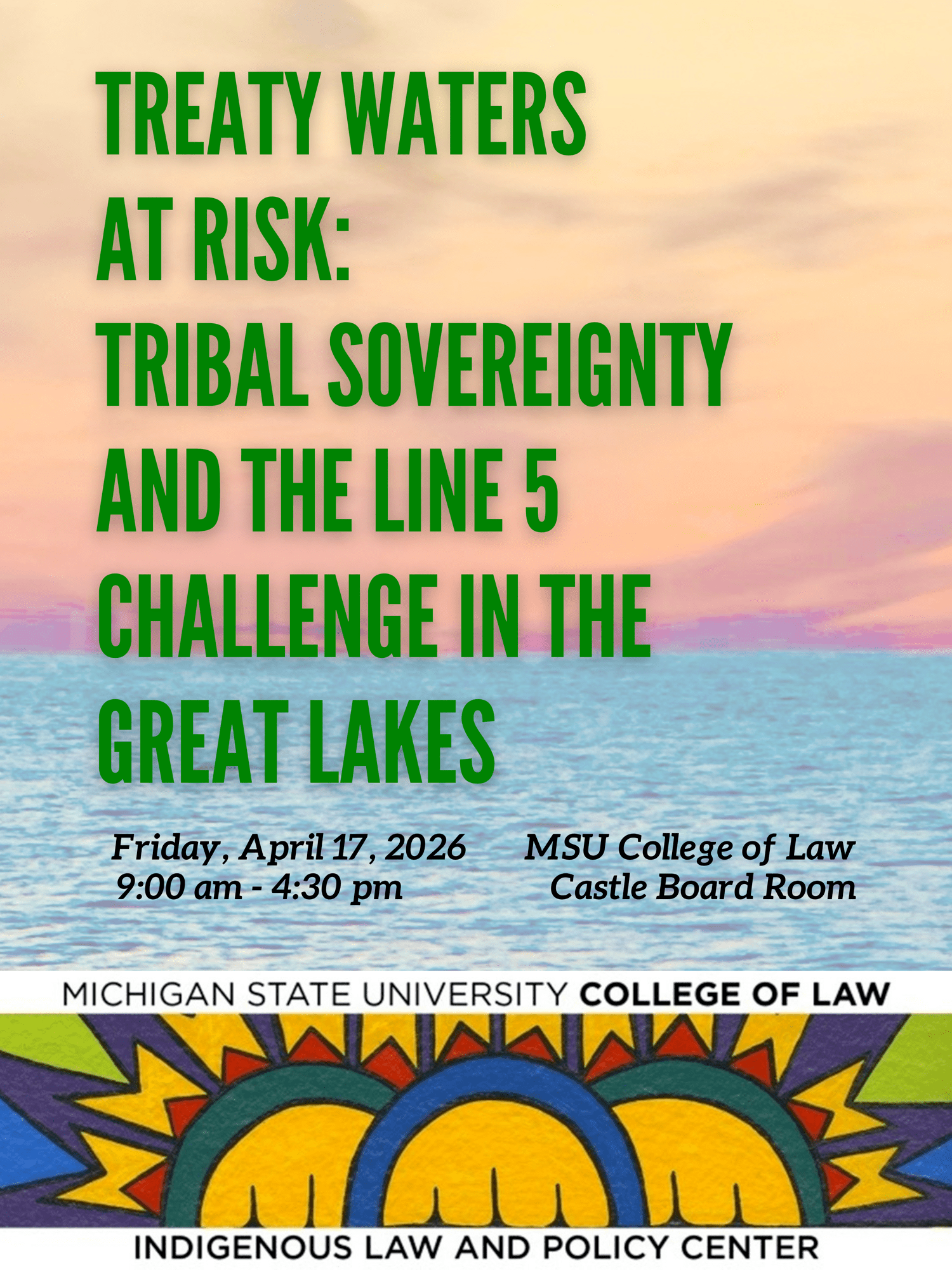
Join us at MSU Law for Treaty Waters at Risk: Tribal Sovereignty and the Line 5 Challenge in the Great Lakes, a one-day conference on Friday, April 17, 2026, examining the legal and environmental stakes of energy infrastructure in treaty-protected waters.
Featuring a keynote by Whitney Gravelle, MSU Law and ILPC alumna and President of the Bay Mills Indian Community, the program brings together leading voices to discuss treaty rights, co-management, and the ongoing Line 5 conflicts at Bad River and the Straits of Mackinac.
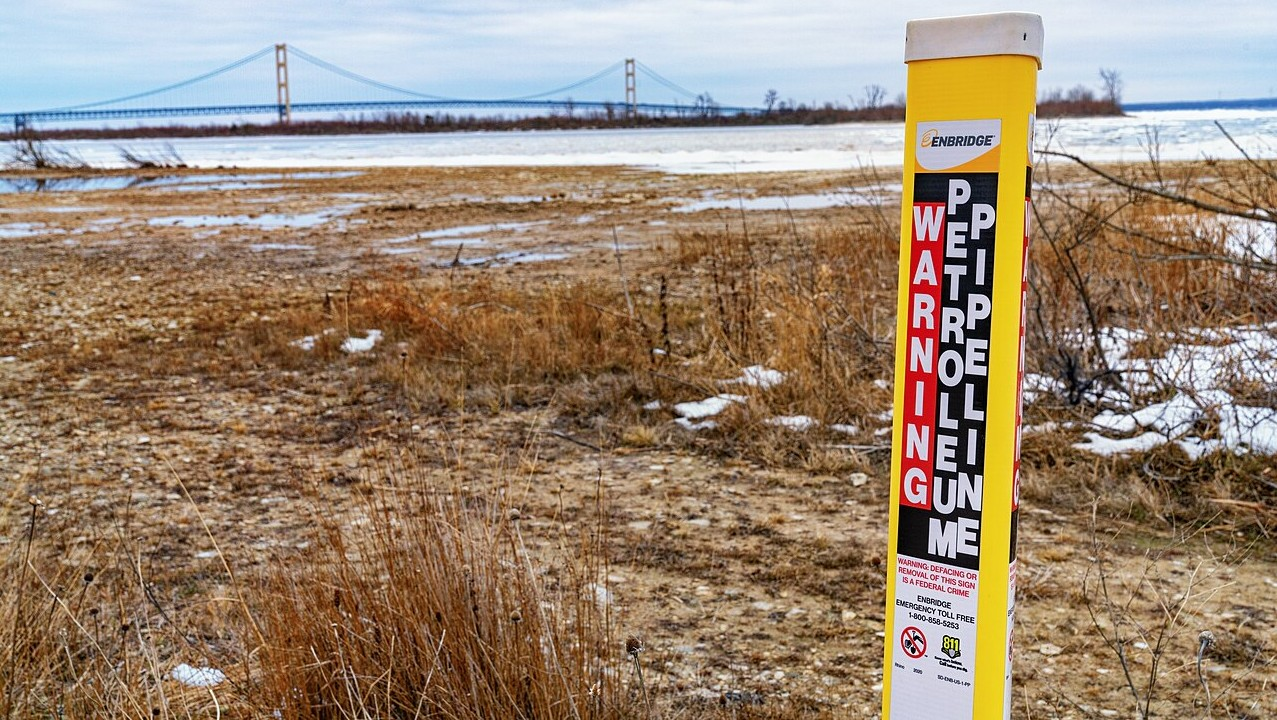
Tribes in Michigan oppose Enbridge the Line 5 oil pipeline replacement plan, arguing the environmental risks to their traditional waters far outweigh any benefits. The proposal to replace the 70-year-old pipeline that currently runs through Michigan and Wisconsin has faced many legal challenges over the years. Now, the U.S. Supreme Court will decide whether the state or federal government should have say over how the project proceeds. The decision could set a precedent on how much power tribes and states have in regulating fossil fuel development. We’ll speak with tribal leaders, Native legal scholars, and others about what’s next for the ongoing Line 5 pipeline legal battle.
GUESTS
Wenona Singel (Little Traverse Bay Bands of Odawa), associate professor of law at Michigan State University College of Law and associate director of the Indigenous Law and Policy Center
Join us April 9-11, 2026, for Living with Treaties: The 1817 Project, the University of Michigan, and the Western Expansion of the United States. This conference will explore the role of treaties in the development of both the University of Michigan and the state of Michigan, while considering how their effects continue to resonate locally, regionally, and nationally today for an Indigenous present and future.
The conference will bring together members of Anishinaabe Tribal communities; U-M faculty, staff, and students; K-12 educators; scholars; tribal historians; and community activists for roundtable discussions, panels, and workshops that aim to inform and connect with non-specialist audiences.
Conference sessions will focus on key themes that include the role of treaties in the founding and development of the University of Michigan, such as the 1817 Treaty of Fort Meigs; the ongoing impact of 19th-century treaty agreements on tribal communities in the region; and the ways in which these treaties continue to shape contemporary Native activism and legal efforts. Discussions will also explore the broader histories of colonization and Indigenous dispossession across what is now the state of Michigan and the Midwest region of the U.S, with an eye to how local and regional histories provide valuable insights into broader national patterns.
The conference is free and open to all, and will be livestreamed and recorded. Registration is encouraged but not required. We will send out reminder emails and event updates when you register.
The Living with Treaties: The 1817 Project, the University of Michigan, and the Western Expansion of the United States Conference is part of The 1817 Project: Land, Culture, Memory, and Repair, one of the major research initiatives of the University of Michigan’s Inclusive History Project. Led by Eric Hemenway, Bethany Hughes, and Michael Witgen, The 1817 Project is a multi-disciplinary examination of the foundational land transfer by the Ojibwe, Odawa, and Boodewaadamii nations in the 1817 Treaty of Fort Meigs (also known as the Treaty of the Maumee Rapids), which was part of the University of Michigan’s 1817 origins in Detroit and subsequent relocation to Ann Arbor, as well the university’s ongoing connections to Indigenous land and contemporary issues of Native American student experience. Learn more about The 1817 Project.
The Living with Treaties: The 1817 Project, the University of Michigan, and the Western Expansion of the United States Conference is presented by the Inclusive History Project in partnership with the Eisenberg Institute for Historical Studies (EIHS) and with the support of the Bentley Historical Library, Clements Library, the Department of American Culture, the Department of History, the Native American Student Association, the Native American Studies Program, Rackham Graduate School, Penny W. Stamps School of Art & Design, and the University of Michigan Museum of Art (UMMA).
The conference logo was designed by Eva Oldman.
For questions or more information, contact inclusivehistory@umich.edu.
The relationship between the United States federal government, the states, and Native Nations has long been at the core of federal Indian law. From the earliest decades of its jurisprudence, for example, the United States Supreme Court struggled in its efforts to analyze and define the rights, authorities, and interactions of Native Nations within and in relation to the evolving structure of constitutional federalism. Treaties between the United States and Native Nations were central to those decisions and provided a necessary, constitutional check against state interests intent on eliminating sovereign Native Nations. Those constitutional and structural implications thus go well beyond federal Indian law and provide important—but often overlooked—insight into the health and stability of fundamental aspects of our legal system as a whole and, therefore, the rule of law itself. Here in Washington, the Washington State Supreme Court developed its own approach to analyzing and interpreting treaty rights, which, for much of the first half of the twentieth century, largely ignored or dismissed treaties and rights reserved thereunder in favor of state interests. More recently, however, the state’s highest court has embarked on an effort to reassess and reckon with its role in perpetrating and perpetuating historical injustices. That effort has resulted in a series of decisions reconsidering the Court’s own treaty-related jurisprudence and, therefore, offers a timely and critically important opportunity to consider the potential and promise of this work. In the spirit of the 125th anniversary of the founding of the University of Washington School of Law and the centennial volume of Washington Law Review, this Article considers the fundamental issues posed by treaty-related questions and aims to draw lessons from the Washington State Supreme Court’s recent efforts to address historical injustices that might inform other, similar efforts across the country. Situating that assessment within the context of treaty rights and the sovereignty of Native Nations illustrates the power of this work to catalyze a deeper and broader reckoning with crucial questions of justice and the rule of law.
On November 19, 2025, the Klamath Tribes filed a motion to amend their petition in the Circuit Court of Klamath County. The amended petition seeks to reverse recent illegal orders that replaced a long-time administrative law judge in the Klamath Basin Adjudication (KBA) on the heels of a secret deal cut between the Oregon State Office of Administrative Hearings and certain water users in the Upper Klamath Basin. Here is the amended petition:
The KBA is a several-decades-old lawsuit pending in the Circuit Court of Klamath County. It is quantifying the federal reserved water rights of the Klamath Tribes in the Klamath River Basin. The KBA involves administrative hearings conducted by the Office of Administrative Hearings, which made initial determinations on the Tribes’ water rights claims. Extensive proceedings were conducted at the Office from 2006 to 2012, and the Klamath County Circuit Court recently returned cases there for additional proceedings.

 Turtle Talk
You must be logged in to post a comment.