Here are the materials in Wildearth Guardians v. United States Fish & Wildlife Service (D. Mont.):
treaty rights
Ninth Circuit Briefs in Skokomish Indian Tribe v. Forsman
Here:
Lower court materials here.
Op Ed by Washington State Rep. J.T. Wilcox on Culverts Case
Here.
Today’s Supreme Court order list
Here. Highlights are that there has been no decision on cert. in the Culverts case and that the Wampanoag’s First Circuit gaming win will remain in place.
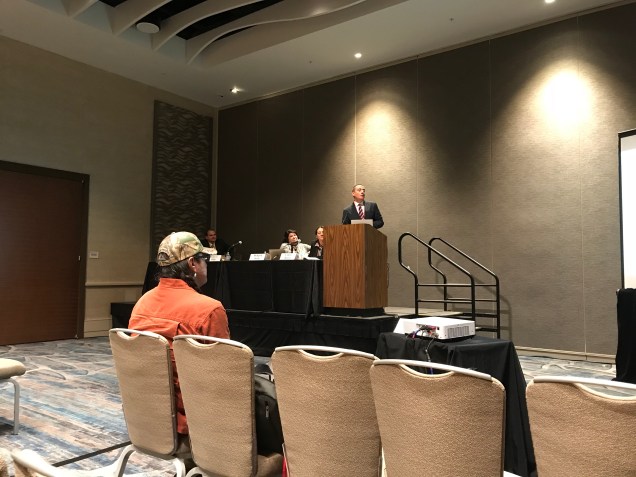
AALS Indian Nations Panel on 1868 Treaties
John LaVelle, Michalyn Steele, Colette Routel, and Monte Mills
Colville Member Prevails in B.C.’s High Court on Right to Hunt in Canada
Here’s a news article. Mr. Desautel prevailed as a descendant of the Sinixt Tribe. Decision is here.
Michigan Tribal Response to Michigan’s Line 5 Deeply Flawed Report
Quileute & Quinault response to request for rehearing/rehearing en banc in ocean U&A case
Here is Quileute & Quinault’s response, addressing issues such as whether the Stevens treaties must be read together, the meaning of “fish” and whether U&As are species-specific, the proper use of the canons of construction, and what we know of the treaty negotiations at issue here.
Previous coverage here.
Ninth Circuit Rules in Favor of Lummi over Klallam Tribes in U&A Litigation
Here is the opinion in Lower Elwha Klallam Tribe v. Lummi Nation.
From the syllabus:
The panel reversed the district court’s summary judgment in favor of the Lower Elwha Klallam Indian Tribe, and held that the disputed waters west of Whidbey Island, Washington were included in the Lummi Nation’s right of taking fish at usual and accustomed grounds and stations (“U & A”) under the 1855 Treaty of Point Elliot.
In United States v. Washington, 384 F. Supp. 312 (W.D. Wash. 1974), Judge Boldt developed a framework for determining U & As for Indian signatories to the Treaty. In Finding of Fact 46, Judge Boldt stated that the U & A for the Lummi Indians “included the marine areas of Northern Puget Sound from the Fraser River south to the present
environs of Seattle.”To determine whether the waters west of Whidbey Island were included in the Lummi’s U & A, the panel followed a two-step procedure. At step one, the panel held that Fact 46 was ambiguous because it did not clearly include or exclude the disputed waters. At step two, the panel examined the record before Judge Boldt to clarify his intent, and concluded that the district court erred in excluding the disputed waters
from the Lummi’s U & A. The panel held that the district court improperly imposed a heightened standard in holding that logic or linguistics needed to “compel the conclusion” that contested waters be included in a U & A.
Briefs here.
 Turtle Talk
You must be logged in to post a comment.