Gila River Indian Community and San Carlos Apache Tribe Win Water Rights Dispute

Here are the materials in Gila River Indian Community v. Schoebroek (D. Ariz.):

78 Gila River MSJ

85 Schoebroek Opposition

87 Schoebroek MSJ Claim Preclusion

89 Schoebroek MSJ on Jurisdiction

100 Gila River Reply ISO 78

101 Gila River Opposition to 87

103 Gila River Opposition to 89

107 Reply ISO 87

108 Reply ISO 89

111 Schoebroek MTD San Carlos Complaint

112 San Carlos Apache Complaint in Intervention

116 Tribes Motion for Sanctions

117 San Carlos Opposition

118 Reply ISO 111

119 Opposition to 116

120 Reply ISO 116

137 DCT Order

Prior post here.

Washington COA Rejects Tribal Employee Immunity Defense, But Rejects Liability on the Merits [DV Wrongful Death @ Tulalip]

Here are the available materials in Pitoitua v. Gaube (Wash. Ct. App.):

New Mexico Federal Court [Browning, J.] Holds State Courts Do Not Possess Jurisdiction over Tort Claims Brought against Tribal Gaming but Federal Courts Have No Jurisdiction to Do Anything About It

Here are the materials in Pueblo of Pojoaque v. Biedsheid (D.N.M.):

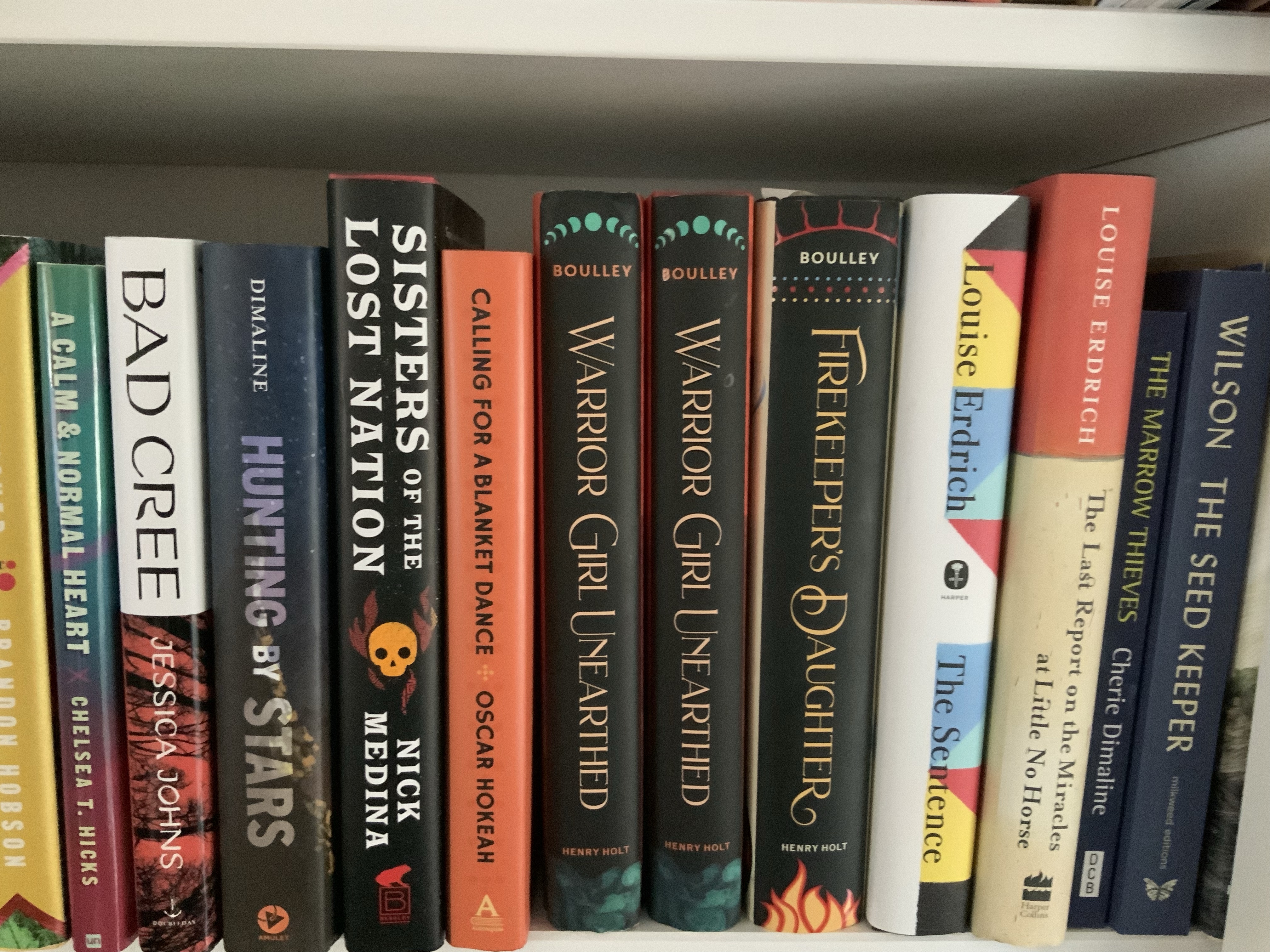
Native America Calling Show on Angeline Boulley’s “Warrior Girl Unearthed”

Here.

Part of the canon at the MEOW residence

Mass. Federal Court Quashes Subpoena of Former Tribal Lending Affiliate [tribal sovereign immunity]

Here are the materials in In re Subpoena of Kenney (D. Mass.):

3 Motion to Quash Subpoena

13 Response

18 Reply

39 Magistrate Order

Split Tenth Circuit Vacates Major Crimes Act Murder Conviction and Orders New Trial on Self-Defense

Here is the opinion in United States v. Britt.

Briefs:

Britt Brief

US brief

Reply

University of Tulsa Hiring Indian Law

Come be inspired living on Tulsa time, a place of rich contradictions and potential. THE UNIVERSITY OF TULSA COLLEGE OF LAW invites applications from both entry-level and experienced faculty for a tenured or tenure-track position researching and teaching in Indian Law to begin in August 2024; preference is for candidates with superior academic records and who demonstrate excellence in scholarship and a strong potential to excel as scholars.

Tulsa Oklahoma is located on the traditional tribal lands of the Muscogee Creek Nation, the Cherokee Nation, and the Osage Nation, and offers a rich opportunity to hear from Tribal leaders as your scholarship develops.  The faculty at the University of Tulsa is committed to strong scholarship as a core value that influences excellent teaching.   The University offers candidates an opportunity to work closely with local tribes to solve local problems and have their scholarship shape conversations across 38 federally recognized tribes in Oklahoma.

For consideration, applications must be submitted via the website: https://universitytulsa.peopleadmin.com/

Interested candidates should submit a Letter of Interest, CV, and research agenda. We value diverse experiences and backgrounds, including diversity of race, ethnicity, gender, age, religion, language, abilities/disabilities, sexual orientation, gender identity, socioeconomic status, and geographic region. For questions, please contact Professor Marc Roark Chair, Appointments Committee, marc-roark@utulsa.edu

The University of Tulsa is an affirmative action/equal opportunity employer and encourages qualified candidates across all group demographics to apply. The University does not discriminate on the basis of personal status or group characteristic including, but not limited to race, color, religion, national or ethnic origin, age, sex, disability, veteran status, sexual orientation, gender identity or expression, genetic information, ancestry, or marital status. The University of Tulsa is an Equal Opportunity Employer including Disability/ Veteran.

The University of Tulsa acknowledges the land it sits upon is the traditional lands of the Osage, Caddo, and Wichita Tribal Nations, and currently resides within the Muscogee Creek Nation.  The University also acknowledges its role as a former Presbyterian School for Indian Girls seeking to create programs that reconcile the need for acknowledgement and responsibility.
Arizona State NDN Law Students Win National Writing Prizes + Publish in the ASU Law Journal

Here is the news item on the prizes. And here are the articles:

Noah Goldberg published “Indian Embryos as ‘Indian Children’?” in the Arizona State Law Journal (PDF). Here is an excerpt:

This Comment argues that ICWA protections should apply to human embryos in all states that reject pure property regimes for embryo disposition. Otherwise, personhood regimes would serve as an end-run around ICWA.34 Once personhood regimes treat embryos as persons or create rules implementing family law before the birth of a child, inevitable tensions arise with ICWA. Not applying ICWA protections to these regimes would undermine the spirit of ICWA and create an unacceptable legal loophole to circumvent the rights of tribes, Indian parents, and Indian children. However, ICWA would not have to apply at the embryo-disposition stage in states that adopt pure property regimes because future parental rights are not determined at the dissolution stage. Part II surveys ICWA, its purpose, and its protections. Part III explores the current state of embryo-disposition laws and focuses on the newly passed Arizona personhood disposition regime. Part IV analyzes how ICWA should interact with personhood regime states and examines the risks that personhood states pose to tribes, Indian families, and the spirit of ICWA. Part V concludes that the best way forward is to reject personhood regimes in favor of pure property regimes or stringently impose ICWA protections at the embryo-disposition stage in personhood states whenever substantive family law is adjudicated.

Claire Newfeld has published “Indian Boarding School Deaths and the Federal Tort Claims Act: A Route to a Remedy” in the Arizona State Law Journal (PDF).

An excerpt:

With such somber results expected from the American investigation, tribes deserve a remedy that will make them as close to whole as possible. There are several potential remedies that tribes and families can pursue, such as filing a lawsuit or lobbying for relief in Congress. The United States must listen to Native communities in determining what remedy will provide the most opportunity for healing and reparation. This Comment will attempt to contribute to that dialogue by arguing that, should the affected parties seek relief through litigation, they possess valid wrongful-death or negligence causes of action14 under the Federal Tort Claims Act (“FTCA” or “Act”).

Choctaw Nation VAWA Training

VAWA Training hosted by Choctaw Nation of Oklahoma

November 15-16, 2023  

A tuition free event hosted in-person at the Choctaw Casinos & Resorts, Durant, OK

Visit the training website to register and view agenda information as it arises

Tribal and First Nations of the United States and Canada file Early Warning Measure and Urgent Action Procedure Request to CERD

The undersigned Tribal and First Nations submitted a petition to the Committee on the Elimination of Racial Discrimination to urge the Committee to examine the Government of Canada’s compliance with its obligations under the Convention on the Elimination of All Forms of Racial Discrimination.

The Convention requires Canada to prevent and rectify discriminatory practices direct and indirect – committed by Canadian corporations at home and abroad.

Previous UPR Filing – Line 5

Representatives of fifty-one Tribal and First Nations located in what is now the United States and Canada submitted a report to the United Nations Human Rights Council calling on the Government of Canada to stop violating the human rights of Indigenous peoples through its support for Enbridge’s Line 5 crude oil pipeline. The groups submitted the report for consideration under Canada’s upcoming Universal Periodic Review (UPR). As a U.N. member state, Canada’s human rights record is periodically scrutinized by U.N. member States through the UPR at the Human Rights Council. Canada will be reviewed during the 44th session of the UPR Working Group, which will take place from November 6 through 17 this year, and it will be Canada’s fourth review.