Here are the materials in Hawk v. Burr (E.D. Wis.):
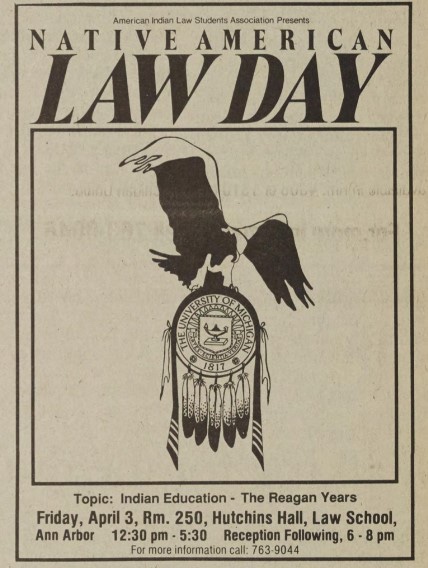
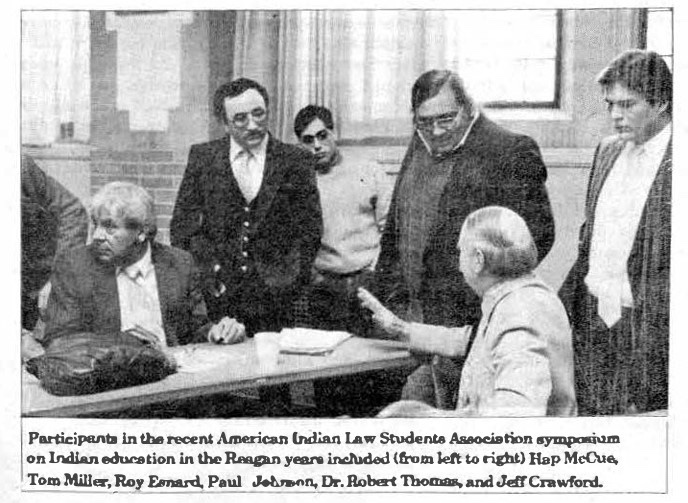
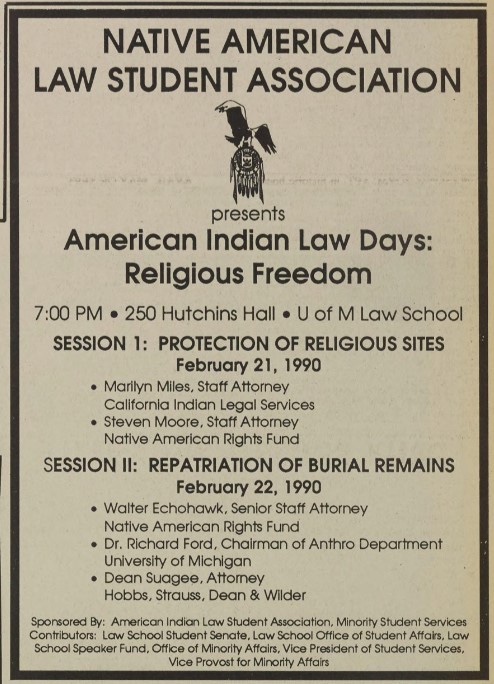
A Look Into the U of M NALSA’s Past




City of Nome to Pay $750K + Apologize for Failure to Investigate Sexual Assault against Native Woman
Here is the settlement agreement in Hardy v. City of Nome:
Here is an opinion piece by the plaintiff, “I fought for justice for 5 years after I was sexually assaulted. The work isn’t finished.“
Washington Federal Court Orders Insurance Company to Exhaust Tribal Court Remedies
Here are the materials in Allstate Insurance Co. v. Cornelson (W.D. Wash.):

Hugh Theut Appointed Incoming Editor-in-Chief of Michigan State Law Review
Here:

As the 2021-22 academic year draws to a close, the passing of the torch is happening among many student organizations and leadership groups at the College of Law.
Michigan State Law Review, the law school’s flagship journal, begins the process each spring by hosting elections to determine a new executive board for the coming year. The result of the recent vote appointed rising 3L Hugh Theut, ’23, as the new Editor-in-Chief (EIC) of Law Review.
“Getting on Law Review is such a big accomplishment to me,” Theut explained, “and then to go through the elections process and make it to EIC, I think it’s very humbling.”
Theut joined Law Review with the goal of adding strong legal writing skills to his learned ability for advocacy. He studied political science at the University of Iowa, where he also minored in rhetoric and persuasion. His minor allowed Theut the opportunity to engage in public speaking and serve as an advocate, ultimately motivating him to pursue a law degree. He comes from a family of practicing attorneys, so the idea was always on the table, but Theut explained that “by the time I got to undergrad, I found a niche for (the law) and enjoyed it.”
Originally from Michigan’s Upper Peninsula and a citizen of the Mackinac Bands of Chippewa and Ottawa Indians, Theut returned to his home state after receiving his bachelor’s degree. He chose to continue his education at MSU Law, “I thought it was a great law school coming in, and now I feel as though I made the right decision,” he said. Continuing, Theut said, “The school has provided me with every opportunity to succeed, including a summer associate position with Kerr Russell I landed through the school’s on campus interview process.”
Outgoing Editor-in-Chief, Brandon Cross, ’22, has supported Theut during the leadership transition. “He’s been super helpful, bringing me up to speed,” Theut said. “His advice was to work closely with Professor David Blankfein-Tabachnick, stay on the ball, and don’t get behind. Be ready for anything.”
Professor Blankfein-Tabachnick serves as Michigan State Law Review’s faculty advisor, and he celebrated Theut’s appointment: “Becoming Editor-in-Chief of the Michigan State Law Review is among the highest honors a student at our Law College might achieve. Hugh is an extraordinarily bright and tremendously capable person. As a student, he has been an absolute star.”
“Hugh will continue the excellence that has been the journal’s marquee, building on the superb work of previous EIC’s. Most recently, Brandon Cross, whose tireless and outstanding work and commitment to the journal has been just astonishing,” he added. “We all owe Bran and his team a huge thank you and look forward to working with Hugh and his incoming team as they take on the leadership of one of Michigan State University’s many crown jewels.”
As Theut prepares to take on more responsibility in his new role with Law Review, he is excited for what the year ahead will bring.
“I look forward to working with Professor Blankfein-Tabachnick. I think he’s phenomenal. I had him for Tax last semester, and he was great,” Theut said. “I also talked to the previous Editor-in-Chief before Bran, Kylee Nemetz, and she had a lot of great things to say about the position. … I just feel incredibly lucky.”
Sault Tribe En Banc Petition in Trust Land Acquisition Case
Here is the petition in Sault Ste. Marie Tribe of Chippewa Indians v. Haaland:
Panel stage materials here.
Tenth Circuit Briefs in Monster Tech. Group v. Eller [Iowa Tribe]

Jurisdiction Case out of Alaska Supreme Court [ICWA]
These kind of cases feel like they are coming in a rapid speed right now–this is the third one I am aware of that have been/will be decided this spring. The issue is the attempted interference by foster parents in a transfer to tribal court proceeding, usually by trying to achieve party status.
Having considered the parties’ briefing — and assuming without deciding both that J.P. and S.P. were granted intervenor-party status in the superior court and that such a grant of intervenor-party status would have been appropriate4 — we dismiss this appeal as moot. “If the party bringing the action would not be entitled to any relief even if it prevails, there is no ‘case or controversy’ for us to decide,” and the action is therefore moot.5 As explained in our order of July 9, 2021, even if we were to rule that the superior court erred in transferring jurisdiction, we lack the authority to order the court of the Sun’aq Tribe, a separate sovereign, to transfer jurisdiction of the child’s proceeding back to state court.6 And we lack authority to directly review the tribal court’s placement order.7
The Court cites my all time favorite transfer case–In re M.M. from 2007. Not only is that decision a complete endorsement of tribal jurisdiction, it also explains concurrent jurisdiction (especially useful when you are operating in a PL280 state), which is not the power to have simultaneous jurisdiction, but the power to chose between two jurisdictions.
When we speak of “concurrent jurisdiction,” we refer to a situation in which two (or perhaps more) different courts are authorized to exercise jurisdiction over the same subject matter, such that a litigant may choose to proceed in either forum.FN13 As the Minnesota Supreme Court explained in a case involving an Indian tribe, “[c]oncurrent jurisdiction describes a situation where two or more tribunals are authorized to hear and dispose of a matter *915 and the choice of which tribunal is up to the person bringing the matter to court.” (Gavle, supra, 555 N.W.2d at p. 290.) Contrary to Minor’s apparent belief, that two courts have concurrent jurisdiction does not mean that both courts may simultaneously entertain actions involving the very same subject matter and parties.
D.C. Federal Court Awards $15M+ to Navajo Nation for Judicial Costs under PL638
Here are the materials in Navajo Nation v. United States (D.D.C.):

White Earth Ojibwe Appellate Court Dismissed Manoomin Suit against Minnesota DNR
Here is the order in Minnesota Dept. of Natural Resources v. Manoomin dated March 10, 2022:
Prior post here.
 Turtle Talk
You must be logged in to post a comment.