WSBA Indian Law Section’s CLE will be May 10 in Seattle. A pdf of the agenda is here: ILS CLE Agenda – 2019 To register, click here.
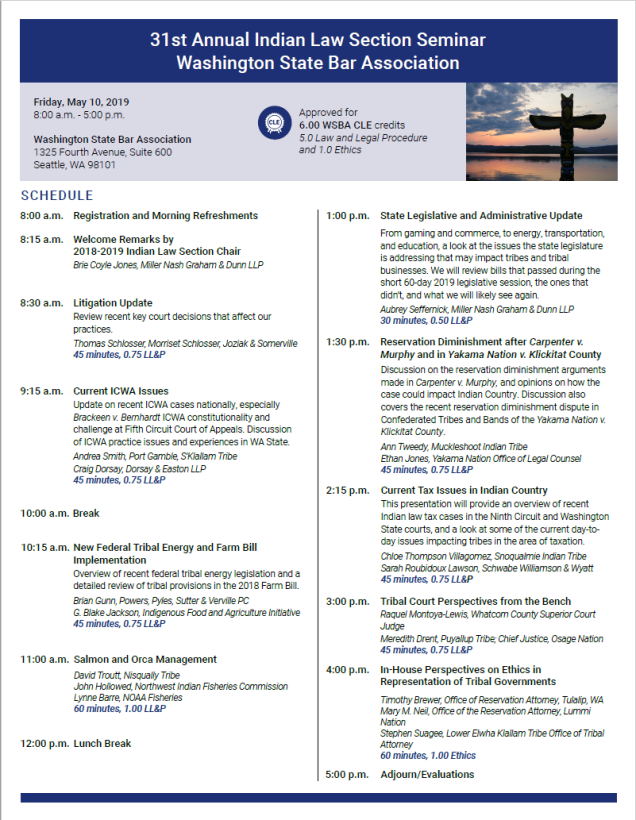
WSBA Indian Law Section’s CLE will be May 10 in Seattle. A pdf of the agenda is here: ILS CLE Agenda – 2019 To register, click here.
This is otherwise known as the Goldwater litigation, the second federal case filed back in 2015 in Arizona.
Documents are here
The Tribe requested transfer and the child’s attorney objected. The trial court did not allow testimony regarding bonding and attachment from the child’s doctor. The Supreme Court held
With or without the 2016 regulations, though, circuit courts need the benefit of a sufficiently developed record to assist in the good cause determination. See A.O., 2017 S.D. 30, ¶ 13, 896 N.W.2d at 656; In re M.C., 504 N.W.2d 598, 601 (S.D. 1993). In both A.O. and M.C., we held that the circuit court should have conducted an evidentiary hearing before determining the motion to transfer jurisdiction. In the absence of a developed record, we are unable to conduct meaningful appellate review concerning the merits of the parties’ claims.
[¶17.] As it relates to this case, we conclude that the circuit court abused its discretion when it granted the Tribe’s motion to transfer without hearing the testimony of the child’s physician who was present in the courtroom. Relying upon the impromptu offer of proof by Child’s counsel, the court determined that Dr.
Whitney’s testimony was categorically irrelevant. We disagree.
The Court reversed and remanded for an evidentiary hearing.
Although ICWA does not explicitly recognize “permanent guardianships,” a comparison of Arizona’s statute for permanent guardianship and ICWA’s definition for a “foster care placement” shows that ICWA applies in permanent guardianships.
***
Section 1912(e)’s plain language states that no foster care placement, which includes permanent guardianships, may be ordered without expert-witness testimony on whether a parent’s or an Indian-relative custodian’s continued custody of a child will likely result in serious emotional or physical damage to the child. Therefore, a court must hear expert-witness testimony before ordering a permanent guardianship. The record shows that R.Y. was subject to ICWA and a guardianship proceeding took place. Thus, ICWA required the juvenile court to hear expert-witness testimony on whether Mother’s or the Indian-relative custodian’s continued custody of R.Y. would likely result in serious emotional or physical damage to R.Y.
This is a very important point–I get so many questions about the issue of guardianships used to avoid ICWA requirements and about the follow-up about whether a state-initiated proceeding can turn into a fully voluntary one:
Natasha S. also argues that Mother had converted the involuntary dependency into a voluntary matter when Mother petitioned to appoint Natasha S. as guardian, thereby eliminating the need for expert-witness testimony. But all of the proceedings, including the guardianship, arose out of a state dependency action that the Department had initiated. Thus, despite Mother’s motion, this was still an involuntary dependency action and required expert-witness testimony. Moreover, expert-witness testimony is required in voluntary child custody proceedings governed by ICWA. 25 U.S.C. §§ 1903(1)(i), 1912(e); 25 C.F.R. § 23.103(a)(1)
Here:
The National Indian Law Library added new content to the Indian Law Bulletins on 4/18/19.
U.S. Supreme Court Bulletin
http://www.narf.org/nill/bulletins/sct/2018-2019update.html
Petition for certiorari was filed in this case on 4/10/19:
Allergan, Inc. v. Teva Pharmaceuticals USA, Inc. (Patents)
Federal Courts Bulletin
https://www.narf.org/nill/bulletins/federal/2019.html
United States v. Jones (Sentencing)
Cain v. Salish Kootenai College, Inc. (Tribal Colleges – Arm-of-the-Tribe)
Yselta Del Sur Pueblo v. City of El Paso (Tribal Real Property)
State Courts Bulletin
https://www.narf.org/nill/bulletins/state/2019.html
Mitchell v. Preston (Indian Child Welfare Act – Transfer to Tribal Court)
In Re.: A.G. A Minor Child (Indian Child Welfare Act – Transfer to Tribal Court)
Law Review & Bar Journal Bulletin (contact us if you need help finding a copy of an article)
https://www.narf.org/nill/bulletins/lawreviews/2019.html
News Bulletin
https://www.narf.org/nill/bulletins/news/currentnews.html
In the Land & Water section, we feature articles about consideration from Congress on tribal water rights issues.
U.S. Legislation Bulletin
https://www.narf.org/nill/bulletins/legislation/116_uslegislation.html
The following bills were added:
Here (PDF):
Here are the materials in El Paso Natural Gas Co. LLC v. United States (D. Ariz.):
Prior posts here.
Some notes.
It’s a federal requirement to inquire about a child’s tribal citizenship regardless of state law. There are eight states with comprehensive state ICWA laws (the article is missing California and Wisconsin), and that doesn’t count states that have incorporated the regulations into law (Louisiana) or have other elements of ICWA in their laws.
I know the lawyer he is referring to–s/he did not drive 300 miles for every hearing, but when no one would call the tribe back or answer the phone for a hearing s/he sure did.
ICWA is a remedial statute designed to change state practice, not tribal.
It might be worth mentioning that Michigan has twelve federally recognized tribes, and while the total population of Native children might be small, we are still putting Native children in foster care at disproportionate rates–that said, it’s difficult to tell given the issues with our data collection.
And finally, if you are wondering what ICWA/MIFPA inquiry looks like in Wayne County, here is a colloquy from an unpublished case four years ago:
The Court: All right, the petition is authorized. The children have been
placed with relatives. What else? I guess— is that it? Did anyone ever ask
is there any . . . American Indian heritage in this family? American Indian
heritage?
Ms. Safran (attorney for respondent [parent]): Do you have any Indian heritage in your family?
The Court: Cherokee, Chippewa.
Ms. Safran: There might be some grand— on the grandmother’s side,
what was it? Some time— some type; attenuated.
Ms. Trott (attorney for petitioner [state]): Ms. Topp was told no at the
other—
Ms. Safran: Well, we didn’t have all the parties.
Ms. Topp (case worker): I talked to [respondent], as well, in the police station[,] and I was told no.
Ms. Safran: She doesn’t think—
The Court: You don’t have any kind— are you sure it’s American, or, any
idea what we’re talking about? I mean, what kind of Indian? Cherokees,
Chippewa? I mean, there’s a whole bunch.
Unidentified speaker: I don’t— I don’t know; I can ask.
The Court: And . . . what relative? Grandma? Great-grandma?
Ms. Safran: Your Honor, can we get a date because . . . they want me in
[Judge] Slavens[’ courtroom] and I can’t believe it.
The Court: You’ve got to wait just one second. All right, you can investigate and see. That’s pretty distant; great-grandma is pretty far back. So, I’m
not gonna demand that we send notice.
Ms. Trott: This is on the paternal side? Or maternal? Of which father?
The Court: On the mother’s side or father? It better be a maternal because
right now— all right. You have the right to have this heard by a referee as
to all the children . . . or by a judge with or without a jury, and, of course,
continued right to an attorney at all hearings. We’re setting this for trial?
Ms. Trott: Yes.
In re Harrell, No. 316067, 2014 WL 465718, at *6-7 (Mich. Ct. App. Feb. 4, 2014)

Maurisa Bell grew up on the Wind River Reservation in Riverton, Wyoming. She is an enrolled member of the Eastern Shoshone Tribe and was also raised around her Northern Arapaho family. In 2015, she graduated from Montana State University in Bozeman, MT and completed the Pre-Law Summer Institute program during the summer of 2016. While in law school, Maurisa served as Vice President and Treasurer for the MSU-NALSA, an Area representative for National-NALSA, and volunteered as a student mentor for the Indigenous Law and Policy Center.
She spent her summers in Washington, D.C. working for the Department of Justice’s Office of Tribal Justice; the National Indian Gaming Commission; and Dentons, US LLP in their Native American Law and Policy practice group. She is a dedicated and driven leader who, in just a few weeks, will graduate from the Michigan State University College of Law.
Maurisa will work for Dentons upon graduation, pursuing her passion in helping tribes and tribal communities.
Congratulations, Maurisa!
Forthcoming in the Montana Law Review’s Browning Symposium issue, available at SSRN here.
An excerpt:
Many of my first memories revolve around my grandmother Laura Mamagona’s apartment in Grand Rapids, Michigan. She shared the apartment with my uncle Crockett, who was a college student. Her apartment was the upstairs room of an old house on the side of a hill on College Street. My memories are mostly of domestic activities. Cooking. Sweeping. Sitting around. Playing with trains. Leafing through Crockett’s Sports Illustrated magazine collection. Laura worked the night shift at the veteran’s hospital across from Riverside Park. Early on weekday mornings, June, my mother, would drop me off at Laura’s place in her VW bug, the first car I remember. I had my own crib at Laura’s, one I can remember escaping pretty easily. Often, Laura would sleep most of the morning while I puttered around the house. Sometimes, Crockett would be there. Family lore tells that once, June dropped me off earlier than usual and Laura had worked a little late, so I was probably there alone for a short while. I heard the story so often growing up that I can seemingly remember that day, too. This was in the mid-1970s, before Congress enacted the Indian Child Welfare Act.
Recently, my wife Wenona Singel discovered documents about Laura’s childhood home life in the National Archives in Chicago. Wenona was there to research family boarding school histories. Laura’s name as a young woman, Laura Stevens, was listed alongside several of her brothers and sisters as former students at Mount Pleasant Indian Industrial Boarding School. They were all born with the Pokagon surname, but Laura’s dad, Peter Stevens, changed their names, thinking it would help the family blend in with white America. Laura never attended the boarding school, and instead spent those years in quarantine in a hospital in Kalamazoo. We think she tested positive for tuberculosis at the boarding school intake and was diverted to quarantine. While Laura was there in the hospital during several of her early teen years, her biological mother walked on. Laura had younger brothers and sisters in her family home in Allegan County, Michigan. So, Peter—who was single then—drove to Kalamazoo and took Laura home. As a young woman, but the oldest sibling left in the house, Laura was forced to replace her mom. The archive documents contain reports by social workers who visited the house, we think, on somewhat random occasions. They were spot checks, of sorts, by the State of Michigan, to see how this Indian family with no mother in the home was coming along. The social workers detailed every aspect of the Stevens’ home in the reports. They noted how many Bibles were in the house and where they were placed. They noted how many portraits of Jesus Christ there were and the location each was hung. They reported Laura’s younger siblings were all dressed for company and quietly studying. They focused especially on teenaged Laura. There she was, sweeping the kitchen. There she was, cooking dinner. There she was, folding clothes. The social workers were impressed. Well, they were barely impressed. Laura was, after all, still an Indian. Reading the reports, one can’t help but think that young Laura Stevens was the only thing stopping the State from taking Peter Stevens’s kids away from him. Imagine if she had been out shopping on the day of the spot visit. The little Stevens kids would have been home alone, dishes in the sink and dirty clothes on the floor. Laura might have come home from shopping, and then later Peter from work, to find a home stripped of its children. However, this never came to be. Perhaps out of sheer luck, Laura was always home when the social workers showed up.
And:
The Fifth Amendment of the United States Constitution is a truly fateful provision for Indian people. On occasion, Wenona and I teach at the Pre-Law Summer Institute (PLSI) for American Indians. It’s an eight week program that serves a little bit like a summer boot camp for Indian people who are planning to matriculate to law schools in the fall. Wenona teaches Property and I teach Indian Law. Compared with the regular law school survey-the-field course in Federal Indian Law, the short class I teach at PLSI is even more truncated. I can only assign a cross-section of the “greatest hits” of Indian law Supreme Court decisions because I don’t have time to conduct a full survey. I also try to assign cases where tribal interests prevailed. It turns out tribal interests and Indian people prevail more than not when the Fifth Amendment is in play. However, there are cases where tribal interests painfully and dramatically suffer under the Supreme Court’s interpretation of the Fifth Amendment.
 Turtle Talk
You must be logged in to post a comment.