Federal Court Rules Cherokee Freedmen Retain Treaty Rights

Here is the opinion in Cherokee Nation v. Nash (D.D.C.).

More details tomorrow.

An excerpt:

The Court finds it confounding that the Cherokee Nation historically had no qualms about regarding freedmen as Cherokee “property” yet continues, even after 150 years, to balk when confronted with the legal imperative to treat them as Cherokee people. While the Cherokee Nation might persist in its design to perpetuate a moral injustice, this Court will not be complicit in the perpetuation of a legal injustice.  

Briefs here. Case tag here.

Federal Court Dismisses Kialegee Tribal Town v. Dillinger for Lack of Federal Question

Here are the materials in Kialegee Tribal Town v. Dellinger (N.D. Okla.):

2 Complaint

4 Motion for PI

8 DCT Order

an excerpt:

The Court finds that it lacks subject matter jurisdiction over this case because plaintiffs have not shown in their complaint that the Court would be required to resolve a substantial and disputed question of federal law. Plaintiffs’ complaint identifies an issue of federal law concerning the enforcement of IGRA by an Indian tribe, but plaintiffs have not adequately alleged facts supporting even an inference that the MCN was seeking to enforce IGRA. Dellinger’s letter strongly supports the conclusion that the MCN was seeking to enforce its own laws when it took possession of the Bruner allotment. The law is clearly established that federal courts lack the authority to resolve disputes over tribal law, and such disputes fall exclusively within the jurisdiction of tribal courts. Attorney’s Process & Investigation Servs., Inc. v. Sac & Fox Tribe of Mississippi in Iowa, 609 F.3d 927, 943 (8th Cir. 2010); Wheeler v. United States Dep’t of Interior, Bureau of Indian Affairs, 811 F.2d 549, 551-52 (10th Cir. 1987). The Court lacks jurisdiction to hear matters solely concerning the interpretation of tribal law, and plaintiffs must litigate their case in tribal court to the extent that plaintiffs’ contest the enforcement of tribal gaming laws. As the parties seeking to invoke the jurisdiction of this court, plaintiffs bear the burden to establish that “federal law creates the cause of action or that the plaintiff’s right to relief necessarily depends on resolution of a substantial question of federal law.” Franchise Tax Bd. of State of California, 463 U.S. at 27-28. Plaintiffs have failed to meet their burden, and this case should be dismissed.

Alaska v. Ross Cert Stage Materials (ESA Seal Listing)

Here:

Cert Petition

AFN Amicus Brief

Fed Cert Opp

Alaska Reply

Newly Posted Tribal Justice Recorded Webinars: Healing to Wellness, Trauma Informed Justice Systems, and Peace Circles

The National American Indian Court Judges Association (NAICJA) in collaboration with the National Council of Juvenile and Family Court Judges (NCJFCJ) have joined together to develop a free tribal justice webinar series! Working closely with partners, the Tribal Law and Policy Institute (TLPI) on the Healing to Wellness webinars and the Native American Rights Fund’s Indigenous Peacemaking Initiative (IPI) for the Peace Circles webinar. See naicja.org for more information on upcoming training and the NAICJA National Tribal Judicial and Court Personnel Conference.

Tribal Justice Webinar – Planning a Healing to Wellness Court: Inspiration and Vision (8/22/17)

Tribal Healing to Wellness Courts bring together community-healing resources with the tribal justice process, using a team approach to achieve the physical and spiritual healing of the participant and the well-being of the community. This webinar will walk participants through the visioning and foundation planning process to begin the development and implementation of a Healing to Wellness Court. Focus will be given to the key partners needed, as well as primary components that should eventually be reflected in your policies and procedures. You’ll hear firsthand from seasoned tribal judges who will share reflections, tips, and lessons learned about their experience with developing their own Healing to Wellness Court.

Tribal Justice Webinar – Trauma-Informed Court Systems: A Webinar for Tribal Communities (7/27/17)

Research continues to clarify how traumatic experiences negatively impact the way traumatized people interact with the world. When an individual becomes court-involved it is highly likely that they have experienced some level of trauma. If the court system is not trauma-informed they can be re-traumatized, often triggering harmful reactions. Tribal communities have the challenge of addressing the traumatic experiences of individuals while at the same time dealing with the after effects of historical and intergenerational traumatic patterns that have affected entire communities. However, tribes also have strengths found in their traditional teachings that provide inspiration for strategies to address trauma in all its forms. This webinar will explain what is meant by the phrase trauma-informed courts, provide data about challenges facing tribes around the country, discuss how trauma looks in the court setting, and then provide practical ideas about how to incorporate both traditional values and research-based strategies to make tribal court systems not only trauma-informed but trauma-responsive.

Tribal Justice Webinar – Healing to Wellness Courts Key Components and Standards (5/25/17)

The Tribal Key Components form the foundation of all tribal drug courts. The Adult Drug Court Standards represent the latest research-based best practices for what works within the drug court setting. Applicants for Wellness Court federal funding are now being asked to abide by both documents. This webinar overviews both the key components and the Standards, and discuss how they inter-relate. This webinar is designed for those less familiar with the Wellness Court model and those seeking to use these documents to apply for federal funding and/or integrate into their own Wellness Court.

Tribal Justice Webinar – Peace Circles: A Virtual Circle on Peacemaking (4/26/17)

Peacemaking is not alternative dispute resolution to Native communities – it is the original, traditional way our communities managed to work through disputes for centuries before tribal courts were created. Because of natural limitations inherent in tribal courts, there is increasing interest in the continuation and revitalization of those traditional ways.

This webinar explains how tribal traditions may hold a solution to some problems that have proven especially difficult in tribal court, provide some examples of how other tribes have had success, and explain how this movement is part of a bigger picture, even internationally, of how indigenous communities are using their own wisdom to solve their problems. Speakers include well known and seasoned Peacemakers including NARF Indigenous Peacemaking Initiative staff and advisory committee members.
Town of Vernon v. United States Cert Stage Materials

Here:

Cert Petition

Questions presented:

1. Whether a tribe that opted out of the Indian Reorganization Act can have its status under the Act revived under the Indian Land Consolidation Act, 25 U.S.C. § 2202, even though the United States did not hold land in trust for that tribe at the time the tribe sought a land-in-trust acquisition.

2. Whether the land-in-trust provision of the Indian Reorganization Act, 25 U.S.C. § 5108, exceeds Congress’ authority under the Indian Commerce Clause, Art. I, § S, cl. 3.

3. Whether § 5108’s standardless delegation of authority to acquire land “for Indians” is an unconstitutional delegation of legislative power.

4. Whether the federal government’s control over state land must be categorically exclusive for the Enclave Clause, Art. I, § 8, cl. 17, to prohibit the removal of that land from state jurisdiction.

US Cert Opp Brief

Federal Court Dismisses Section 1983 Action against Sandia Pueblo Police

Here is the order in Crist v. Nix (D.N.M.):

28 DCT Order

An excerpt:

Last, Crist also names the Sandia Pueblo Police Department as a Defendant. The Sandia Pueblo Police Department is not a “person” within the meaning of 42 U.S.C. § 1983. There is no remedy against the Sandia Pueblo Police Department under § 1983 and the Complaint fails to state a claim for relief against the Sandia Pueblo Police Department Will v. Michigan Dep’t of State Police, 491 U.S. 58, 63–64 (1989). In addition, although the Court does not reach the question, an issue exists as to whether Sandia Pueblo Tribal police officers act under color of state law and are subject to liability under § 1983. Compare Burrell v. Armijo, 456 F.3d 1159, 1174 (10th Cir. 2006) (tribal officers act under color of tribal law, not state law) and Evans v. McKay, 869 F.2d 1341, 1348–49 (9th Cir. 1989) (tribal officials acting in concert with state officials act under color of state law).

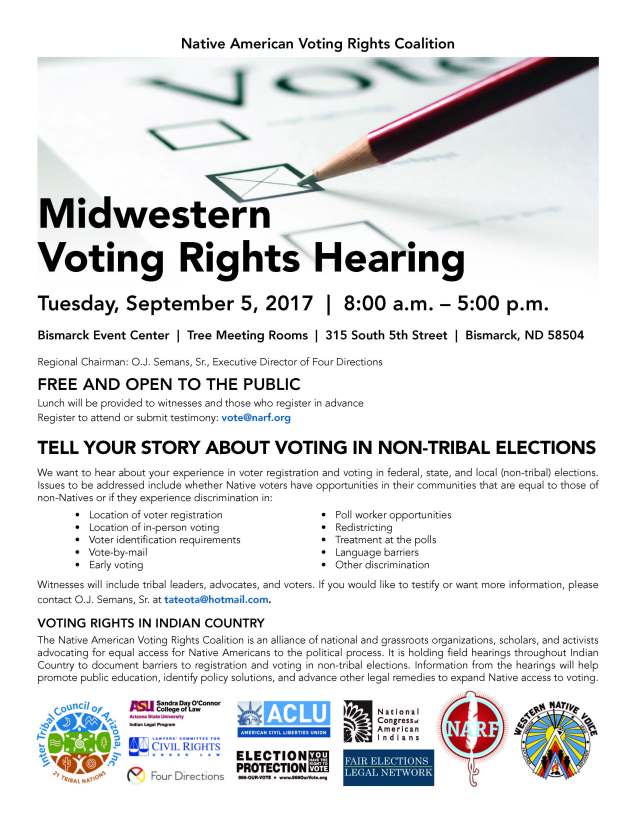
Native American Voting Rights Coalition: Midwestern Voting Rights Hearing (9/5/2017)

Here (PDF):

NAVRC ND Hearing_Sept 2017

Ninth Circuit Affirms Dismissal of Counterclaims against Quinault Tribe

Here are the materials in Quinault Indian Nation v. Pearson.

Opinion

Opening Brief

Answer Brief

Reply

The court’s syllabus:

In an action brought by the Quinault Indian Nation alleging a scheme to defraud the Nation of cigarette taxes, the panel affirmed the district court’s dismissal of counterclaims as barred by the Nation’s sovereign immunity. 

The panel held that if brought in a separate suit against the Nation, the counterclaims would be barred by sovereign immunity. Asserting the claims as counterclaims did  not change the sovereign-immunity analysis. The panel concluded that the Nation did not waive its sovereign immunity because it filed the underlying suit but took no further action that unequivocally waived its immunity to the counterclaims, and the counterclaims did not qualify as claims for recoupment.

Eighth Circuit Affirms Major Crimes Act Conviction over Dissent on Right to Counsel in Tribal Court (Rosebud Sioux)

Here are the materials in United States v. Long:

Opinion

Long Brief

US Brief

Reply

An excerpt from the dissent:

A misdemeanant like Michael Long is forbidden to possess a firearm only if he was “represented by counsel in the case” in which he sustained the misdemeanor conviction, or if he “waived the right to counsel in the case.” 18 U.S.C. § 921(a)(33)(B)(i)(I). It is undisputed that Long did not waive the right to counsel and that he was not represented by a lawyer in the case. The court concludes, however, that because Long was represented in the case by a nonlawyer, dubbed a “lay counsel” by the Rosebud Sioux Tribe, he was “represented by counsel in the case.” I believe that this conclusion is inconsistent with the meaning of the word “counsel” in the statute, so I would reverse Long’s conviction for possession of a firearm as a prohibited person.

Materials in Cherokee Nation Trust Breach Claims against Interior

Here are the materials so far in Cherokee Nation v. Dept. of Interior (W.D. Okla.):

1 Complaint

51-1 Motion to Dismiss

55 Cherokee Motion to Strike Exhibits

58 US Response to Motion to Strike

59 Cherokee Reply in Support of Motion to Strike

63 Cherokee Response to Motion to Dismiss