EPA publishes Revised Interpretation of Clean Water Act TAS Provision

On May 16, the EPA published a final revised interpretation of the Clean Water Act’s TAS provision in the Clean Water Act, concluding that the Treatment as State provision includes an express delegation of authority by Congress to Indian tribes to administer regulatory programs over their entire reservations, subject to section 518(e)’s eligibility requirements.  This revised interpretation eases the burden for tribes applying for TAS status under the Act, removing the hurdle of having to demonstrate inherent regulatory authority under the Montana test in order to apply for TAS status.  The revised interpretation is likely to reduce the time and resources required to obtain EPA approval of TAS applications, particularly for tribes with lands owned by non-Indians within their reservation boundaries.

The Final Interpretive Rule published in the Federal Register is here.

The EPA’s Response to Public Comments on the Revised Interpretation here.

Continue reading

Fletcher & Singel on the Historical Basis for the Trust Relationship between the US and Indian Children

Fletcher & Singel have posted “Indian Children and the Federal Tribal Trust Relationship” on SSRN.

Here is the abstract:

This article develops the history of the role of Indian children in the formation of the federal-tribal trust relationship and comes as constitutional challenges to the Indian Child Welfare Act (ICWA) are now pending. We conclude the historical record demonstrates the core of the federal-tribal trust relationship is the welfare of Indian children and their relationship to Indian nations. The challenges to ICWA are based on legally and historically false assumptions about federal and state powers in relation to Indian children and the federal government’s trust relationship with Indian children.

Indian children have been a focus of federal Indian affairs at least since the Framing of the Constitution. The Founding Generation initially used Indian children as military and diplomatic pawns, and later undertook a duty of protection to Indian nations and, especially, Indian children. Dozens of Indian treaties memorialize and implement the federal government’s duty to Indian children. Sadly, the United States then catastrophically distorted that duty of protection by deviating from its constitution-based obligations well into the 20th century. It was during this Coercive Period that federal Indian law and policy largely became unmoored from the constitution.

The modern duty of protection, now characterized as a federal general trust relationship, is manifested in federal statutes such as ICWA and various self-determination acts that return self-governance to tribes and acknowledge the United States’ duty of protection to Indian children. The federal duty of protection of internal tribal sovereignty, which has been strongly linked to the welfare of Indian children since the Founding, is now as closely realized as it ever has been throughout American history. In the Self-Determination Era, modern federal laws, including ICWA, constitute a return of federal Indian law and policy to constitutional fidelity.

Indian Law Job Announcements

I added a new page that provides an overview for finding Indian law job announcements on Turtle Talk and elsewhere on the internet.  To access it, click on “Indian Law Job Announcements” in the black bar immediately below our Turtle Talk banner at the top of the webpage.  The page offers advice for first and second year law students seeking summer clerkships as well as third year law students and law graduates seeking permanent employment.


Manitoba Path to Reconciliation Act

Bill text here

New Article by Lorinda Riley on the Role of Politics in Federal Recognition

Lorinda Riley has published “When a Tribal Entity Becomes a Nation: The Role of Politics in the Shifting Federal Recognition Regulations,” in the American Indian Law Review.

Here is a description excerpted from the article’s introduction:

This article explores how each presidential administration has both shaped and bent the federal recognition regulations to fulfill its political priorities. By merging a quantitative analysis of each administration’s federal recognition record and the political realities that each administration faced, this study provides a rare inquiry into the political nature of the recognition process. First, this article examines the regulatory history of federal recognition, including a detailed discussion of various versions of the regulation and accompanying guidance published by the Department of the Interior (DOI). Then the article provides an overview of how politics play into the regulatory process and the implementation of regulation. Finally, the article re-visits each administration’s actions related to federal recognition, and considers how each administration has utilized these regulations to serve its own political priorities.


Invitation to Connecting with Lawyers Networking Reception on January 28, 2016

Happy New Year! We want to personally invite you and your colleagues to MSU COL’s Connecting with Lawyers Networking Reception on Thursday, January 28, 2016, at the Kellogg Hotel and Conference Center, from 6:00pm-8:00pm. Come connect with current students and recent graduates. In addition to connecting with our students, you will have the opportunity to meet judges and other members of the bar. During the program, we will highlight different practice areas and geographic locations, and have giveaways every half hour. Complimentary hors d’oeuvres and beverages will be provided.

You can RSVP for the event, by completing this google form, https://docs.google.com/a/msu.edu/forms/d/1Ob57E4WVRWott-4f2KxFR-hDbOCFoFNe32SsoJB2kRs/viewform. If you have any questions about the event, you can contact the Career Services Office at career@law.msu.edu or (517) 432-6830. Please forward this message to your contacts and students.

A Look at the New California Law Banning Public Schools from using the term Redskins

As widely reported here, here, and here, California is now the first state in the nation to enact legislation forbidding all public schools from using the term Redskins for school or team names, mascots, or nicknames.

From the L.A. Times:

As of Jan. 1, 2017, all public schools will be barred from using the term “Redskin,” which many Native Americans consider a racial slur. The measure by Assemblyman Luis Alejo (D-Watsonville) will allow schools that use materials that contain the term, such as uniforms, to phase out their use to alleviate cost concerns. The new law will affect four California high schools in Merced, Calaveras, Tulare and Madera counties.

The legislation, called the California Racial Mascots Act, was approved by the Governor on October 11.  It includes the following findings:

(a) The use of racially derogatory or discriminatory school or athletic team names, mascots, or nicknames in California public schools is antithetical to the California school mission of providing an equal education to all.
(b) Certain athletic team names, mascots, and nicknames that have been used and remain in use by other teams, including school teams, in other parts of the nation are discriminatory in singling out the Native American community for the derision to which mascots or nicknames are often subjected.
(c) Many individuals and organizations interested and experienced in human relations, including the United States Commission on Civil Rights, have concluded that the use of Native American images and names in school sports is a barrier to equality and understanding, and that all residents of the United States would benefit from the discontinuance of their use.
(d) No individual or school has a cognizable interest in retaining a racially derogatory or discriminatory school or athletic team name, mascot, or nickname.

The legislation provides that, “[B]eginning January 1, 2017, all public schools are prohibited from using the term Redskins for school or athletic team names, mascots, or nicknames.”  It also includes provisions that ameliorate the financial impact that this new law might otherwise cause for schools that use the term Redskins.  It allow schools to continue to use uniforms or materials bearing the term Redskins after January 1, 2017 as long as the school selects a new school or athletic team name, mascot, or nickname, and the school does not purchase new uniforms or other materials such as yearbooks, newspapers, marquees, signs or other fixtures that bear the term.  The targeted schools will essentially be able to slowly progress toward elimination of the use of word Redskins on team uniforms and materials as they purchase new uniforms and equipment in the ordinary course of replacing these items.

Although California is the first state to use legislation to ban public school use of Redskins, it is not the first state to adopt a state-wide measure that phases out use of the term. In 2012, the Oregon State Board of Education adopted a resolution and final rule that prohibits the use of any Native American mascot by a public school on or after July 1, 2017.  For those interested in the findings and sources relied upon the Oregon Board of Education in reaching its decision to adopt the rule, the Board’s final report on the use of Native American mascots is available here.  Some may also be interested in a 2014 report on Native American mascots in schools produced by the Center for American Progress, which is available here.

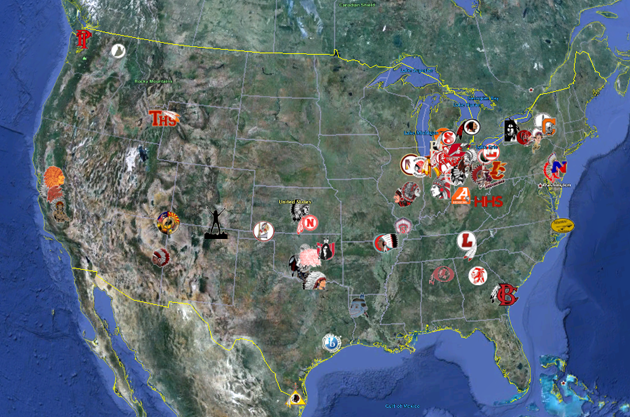
California and Oregon aside, there remain 21 states representing 58 high schools in the U.S. that use Redskins as a team name or mascot.  These schools are marked on the map below.  Many more schools throughout the U.S. use other Indian mascots, such as Indians, Warriors, Braves, and Chieftans.
Map of high schools that use the Redskins name

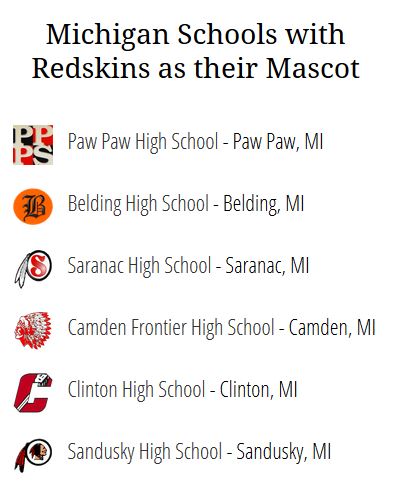
Interestingly, the area of lower Michigan, Indiana, Ohio, and Pennsylvania have the highest concentration public high schools using the name Redskins, constituting nearly half of the schools on the map.  This “Redskins Belt” includes six Michigan high schools, identified on the list and map below.

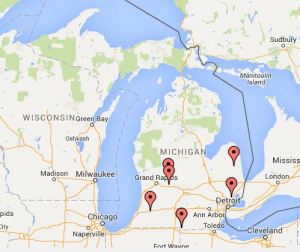
List of Michigan high schools that use Redskins as a name or mascot   Map of Michigan public high schools using Redskins name

Past efforts to ban the use of Native American mascots throughout the state of Michigan have been unsuccessful.  In 2013, the Michigan Department of Civil Rights filed a complaint with the U.S. Department of Education Office for Civil Rights on behalf of all present and future students who self-identify as American Indians, alleging that thirty-five schools in Michigan engage in the continued use of American Indian mascots, names, nicknames, logos, and other imagery, creating a hostile environment and denying equal rights to all current and future American Indian students.  The complaint was dismissed because, in an effort to protect students from a possible backlash at their schools, the Michigan Dept. of Civil Rights offered empirical studies that supported the psychological harm experienced by American Indian students in lieu of specific examples of race-based incidents and the identity of students and individuals who suffered specific harm because of the alleged discrimination.  The US Dept. of Education Office for Civil Rights concluded that these omissions rendered the complaint insufficient to support an inference that racial discrimination had occurred or was occurring.

For states like Michigan with public schools that continue to use Indian mascots, the strategies pursued in California and Oregon provide new examples of pathways to successfully banning Indian mascots. One thing is clear, however.  Any state that takes seriously 1) its commitment to ensure that students are not subjected to unlawful discrimination in public schools on the basis of race or color and 2) its obligation to provide an educational environment that is not hostile and that promotes educational attainment for all,  should closely examine the effect of and potential prohibition of the use of Indian mascots in schools.
Congrats, Whitney Gravelle and Alayna Farris! 2015 Summer Clerks’ work recognized by NARF

Alayna Farris, Whitney Gravelle, and John Echohawk recognize the donation from the Confederated Tribes of Siletz

At the Indigenous Law & Policy Center, we’re very proud of the work of current and past MSU College of Law Students. This week, Whitney Gravelle (MSU COL ’16, Anishinaabe from the Bay Mills Indian Community) was featured in an update from NARF.  Whitney and her summer clerk colleague, Alayna Farris from the University of Arkansas School of Law, worked on several matters, including the revision and updating of A Compilation of Federal and State Education Laws regarding Native Language in Curriculum and Certification of Teachers in Native Languages.   Their work at NARF this summer was made possible by a grant from the Confederated Tribes of Siletz Indians and the Siletz Tribal Charitable Contribution Fund.

More information is available here.

Although the deadline for the NARF Summer 2016 Clerkship program has passed,  interested first year law students should research this excellent opportunity and prepare to apply in the early fall of 2016 for the Summer 2017 Clerkship program.

Whitney Gravelle at NARF

Resources for Lawyers and Law Students with ADHD

A conservative estimate of 44,000 lawyers have ADHD/ADD, the majority of which are diagnosed. Lynn Phillip’s article in the ABA’s GPSolo Magazine outlines some of the major warning signs for lawyers.

In lawyers, one of the most obvious manifestations of the condition is their ongoing attempts to “get organized”—which always end in only short-term success, if any. They report falling behind in their work or being fearful they missed something important, and frequently they feel that they are not living up to their potential. By this point in their lives, many lawyers have learned to work around the manifestations of their ADHD symptoms. They struggle to stay focused on boring tasks, have trouble managing their time, and often start projects enthusiastically but quickly lose their excitement and, with it, the desire to finish the project. They are usually aware of being facile and quickly grasping and building on concepts, but planning for the eventual goal is a problem. They often have low self-esteem because of their inability to be consistent, stay focused, and curb impulses, and frequently they struggle with relationships—partly because they miss or misunderstand the social cues people give one another. They question why things that seem easy for others can be such problems for them.

This does not mean lawyers with ADHD are not extremely successful in practice. Here is one lawyer’s story of living with ADHD.

The World Health Organization has created a short self-diagnostic test, which can help in determining whether taking the time for a professional evaluation would be worthwhile.

Lawyer Assistance Programs are a great first resource for lawyers and law students with ADHD. State LAPs are often able to provide short-term counseling, referrals to doctors and counselors, and additional resources.

Law students with diagnosed, or undiagnosed, ADHD experience an especially difficult time staying organized, focusing on reading assignments, and ensuring deadlines are met throughout the semester. Students with an ADHD diagnosis should ensure they are working with their law school’s student services office to obtain any necessary exam or classroom accommodations needed.

The Harvard University Bureau of Study Counsel in the Center for Academic and Personal Development has developed many resources for students with ADHD, including short guides on Remembering What You Read, the Fundamentals of Time and Task Management, Practices in Managing Time, and Strategies for Focus and Concentration.

MGM Resorts Sues Connecticut over New Tribal Gaming Act

The complaint, filed in federal district court in Connecticut on August 4, is here: 273548545-MGM-v-Malloy Complaint.

The state law, signed by the Governor on June 19, 2015, is here.

From the complaint:

MGM seeks to have the Act declared invalid and enjoined on two principle bases:

a. The Act violates the Equal Protection Clause because it is a race-based set-aside in favor of the two Preferred Tribes at the expense of all other tribes, races, and entities; and

b. The Act violates the dormant Commerce Clause because it discriminates on its face in favor of the two in-state Preferred Tribes at the expense of out-of-state competitors, all of whom are barred from attempting to develop a casino gaming facility in Connecticut.