“The MITW is a program enacted by Public Act 174 of 1976, which waives the tuition costs for eligible Native Americans in public community colleges or universities within Michigan. Up until 1995, the MITW was fully funded so that public state institutions will be reimbursed by the State of Michigan for tuition for Native American students who fulfilled the requirements. In 1995, then Michigan Governor John Engler sought to eliminate the program, but the state legislature overrode the governor’s decision with inadquate funding.
Tribal leaders have fought since the mid-1990s to have the program fully funded. After her election last November, Governor Whitmer made a commitment to tribal leaders she would put the MITW in her budget. She did so when she submitted her budget in February and the state legislature kept the line item to fund MITW in the budget.”
Research
Muscogee Primary Election Results Vacated
Here is the opinion in In re Tiger (Muscogee (Creek) Supreme Court):
doc.-3-order-and-opinion-100219-2.pdf
News coverage here.
ILPC/TICA Panel -Ethics In and Out of Indian Country
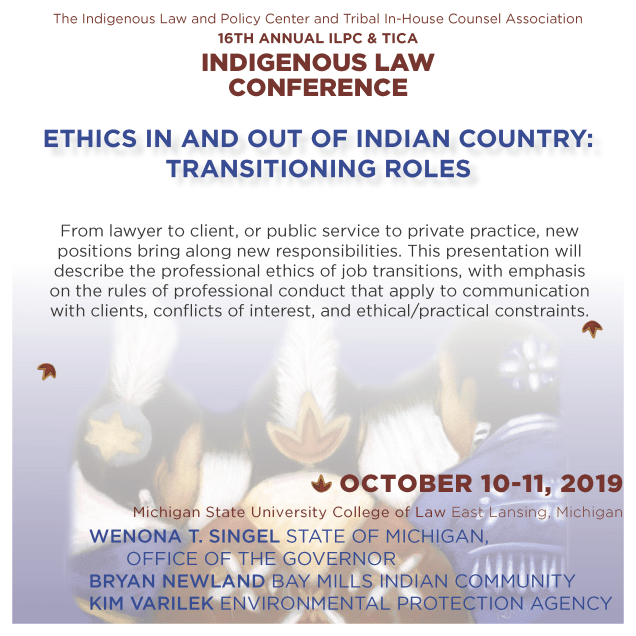
You can register to join us in person or via webcast for the ILPC/TICA 16th Annual Indigenous Law Conference at the MSU College of Law
For information about the agenda, sponsorships, and registration visit the event page.
The Ethics In and Out of Indian Country: Transitioning Roles panel will fulfill Ethics CLE credits and is sponsored by Rey-Bear McLaughlin, LLP.

Ninth Circuit Confirms Pineoleville Pomo Nation’s Officials Face Potential Individual Liability under RICO
Here is the unpublished opinion in JW Gaming Development LLC v. James.
Materials here.
Ninth Circuit Affirms U&A Boundaries in U.S. v. Washington Subproceeding 09-01 [Makah versus Quinault & Quileute]
Here are the materials in Makah Indian Tribe v. Quileute Indian Tribe (CA9):
Quileute & Quinault Opening Brief
State of Washington and Klallam Tribes Brief
Lower court materials in United States v. Washington (W.D. Wash.) (subproceeding 09-01):
442 Quileute Motion for Reconsideration
447 State Motion — Scrivener’s Error
456 State Response to Motions for Reconsideration
Governor Whitmer Appoints Whitney Gravelle to Michigan Women’s Commission
“Whitney B. Gravelle, of Brimley, is the tribal attorney for the Bay Mills Indian Community and the former chief judge of the Bay Mills Tribal Court. Ms. Gravelle is active in the tribal community mentoring indigenous youth through the Boys & Girls Club Tribal Youth Program. She earned her Juris Doctor degree from the Michigan State University College of Law. Ms. Gravelle is appointed to succeed Nicole DeMarco, whose term expired July 15, 2019, for a term expiring July 15, 2022. “
ILPC/TICA Panel – Working with States: Tax Disputes
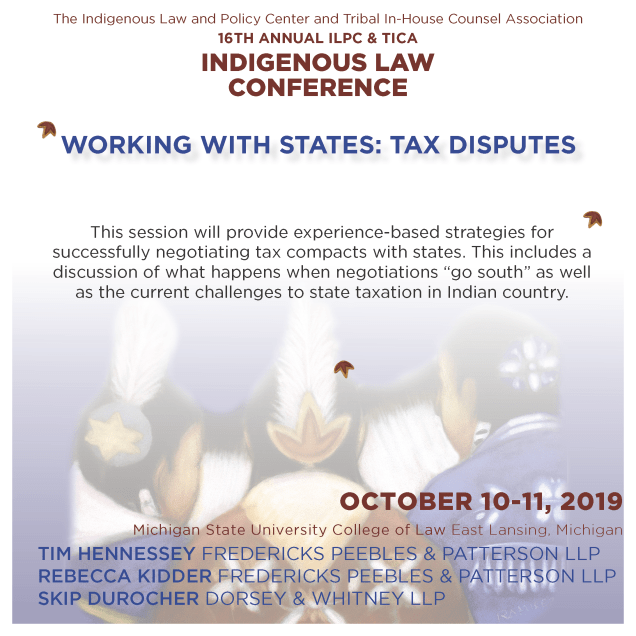
You can register to join us in person or via webcast for the ILPC/TICA 16th Annual Indigenous Law Conference at the MSU College of Law
For information about the agenda, sponsorships, and registration visit the event page.
The Working with States: Tax Disputes panel is sponsored by Sacks Tierney P.A.

New Study Explores How Indian Tribes Influence Federal Lawmaking
The BYU Law Review has published a new article, Lobbying as a Strategy for Tribal Resilience, that explores how Indian tribes and organizations have used legislative advocacy to influence federal Indian policy. It demonstrates how tribes have used lobbying as a way to build resilience over time by influencing the development of federal Indian policies that promote and protect tribal sovereignty. The article emphasizes the role of American Indian voices in the federal legislative process and shows how tribes have used advocacy to initiate new policies, to reverse court decisions, and to oversee the implementation of existing policies.
The article can be found here.
ILPC/TICA Panel – Evaluating Business Proposals

You can register to join us in person or via webcast for the ILPC/TICA 16th Annual Indigenous Law Conference at the MSU College of Law
For information about the agenda, sponsorships, and registration visit the event page.
The Evaluating Business Proposals panel is sponsored by Hobbs, Straus, Dean & Walker.

Opinion in Pueblo of Jemez v. United States
Here is the opinion:
An excerpt:
THIS MATTER comes before the Court on the bench trial held on October 29-November 20, 2018; November 29-November 30, 2018; December 3, 2018; December 5, 2018; and December 13, 2018. The primary issue is whether Plaintiff Pueblo of Jemez has the exclusive right to use, occupy, and possess the lands of the Valles Caldera National Preserve (“Valles Caldera”) pursuant to its allegedly unextinguished and continuing aboriginal title to those lands. The Court concludes that Jemez Pueblo has not established aboriginal title to the Valles Caldera. Although the evidence proves that Jemez Pueblo has actually and continuously used and occupied the Valles Caldera for a long time, the evidence also shows that many Pueblos and Tribes also used the Valles Caldera in ways that defeat Jemez Pueblo’s aboriginal title claim.
Earlier posts here.
 Turtle Talk
You must be logged in to post a comment.