Yesterday, we covered tribal constitutions. Today, the political and bureaucratic complexity of enrollment decisions in cartoon form (we will conclude tomorrow):
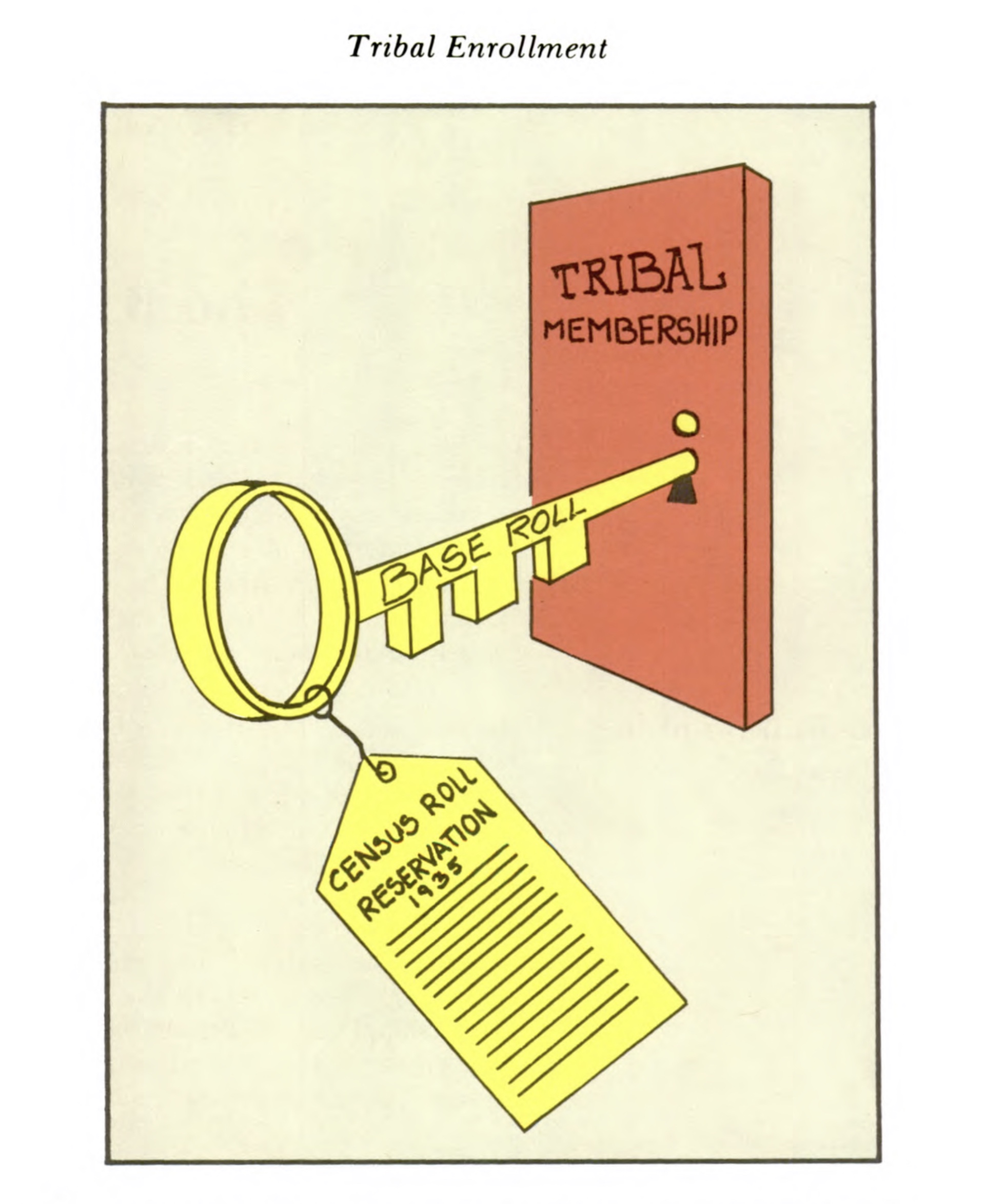

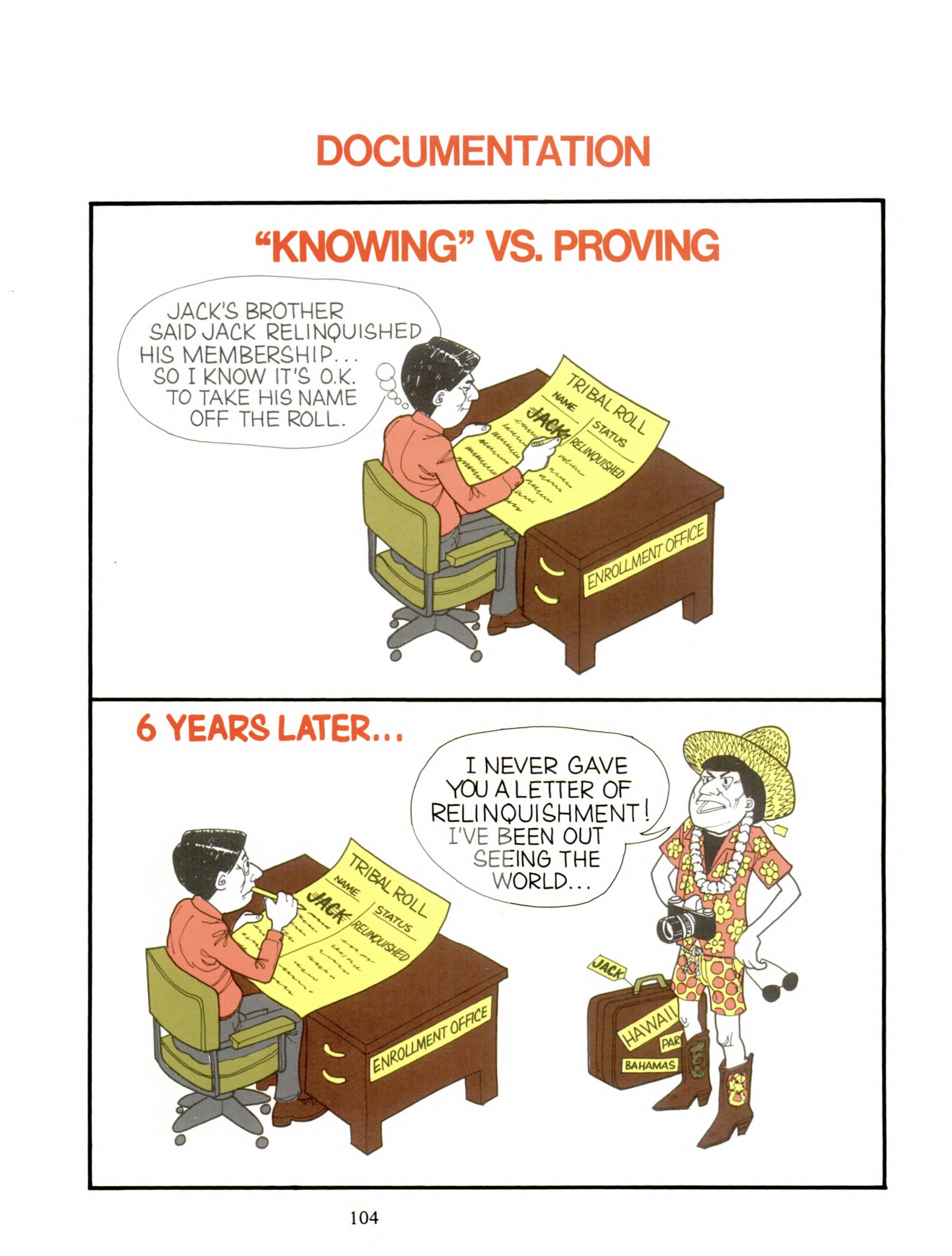
Yesterday, we covered tribal constitutions. Today, the political and bureaucratic complexity of enrollment decisions in cartoon form (we will conclude tomorrow):
Apparently, in 1977 or so, the Phoenix Area Office decided to write a lengthy manual for tribal governments, instructing them on how to make enrollment decisions that met tribal constitutional muster. Suffice it to say the text is TL:DR, but the illustrations are awesome — and by awesome, I mean crazy — and by crazy, I mean Indian country crazy.


Tomorrow, how tribal governments make membership decisions….
I posted a draft paper, “Indian Lives Matter: Pandemics and Inherent Tribal Powers,” on SSRN.
Here is the introduction to the paper:
America’s reaction to the COVID-19 pandemic of 2020 is a microcosm of how Americans see the nation. It is a story of rugged individualism versus community needs. Many Americans insist on freedom to do as they please, rigorously pushing back on government. But in an environment where small numbers of individuals can easily transmit a deadly infection to others, creating the exponential increase in infections, rugged individualism is a terrible threat. Pandemics, luckily for humans, do not seem to occur all that frequently, but when they do occur, they can dramatically alter human history.
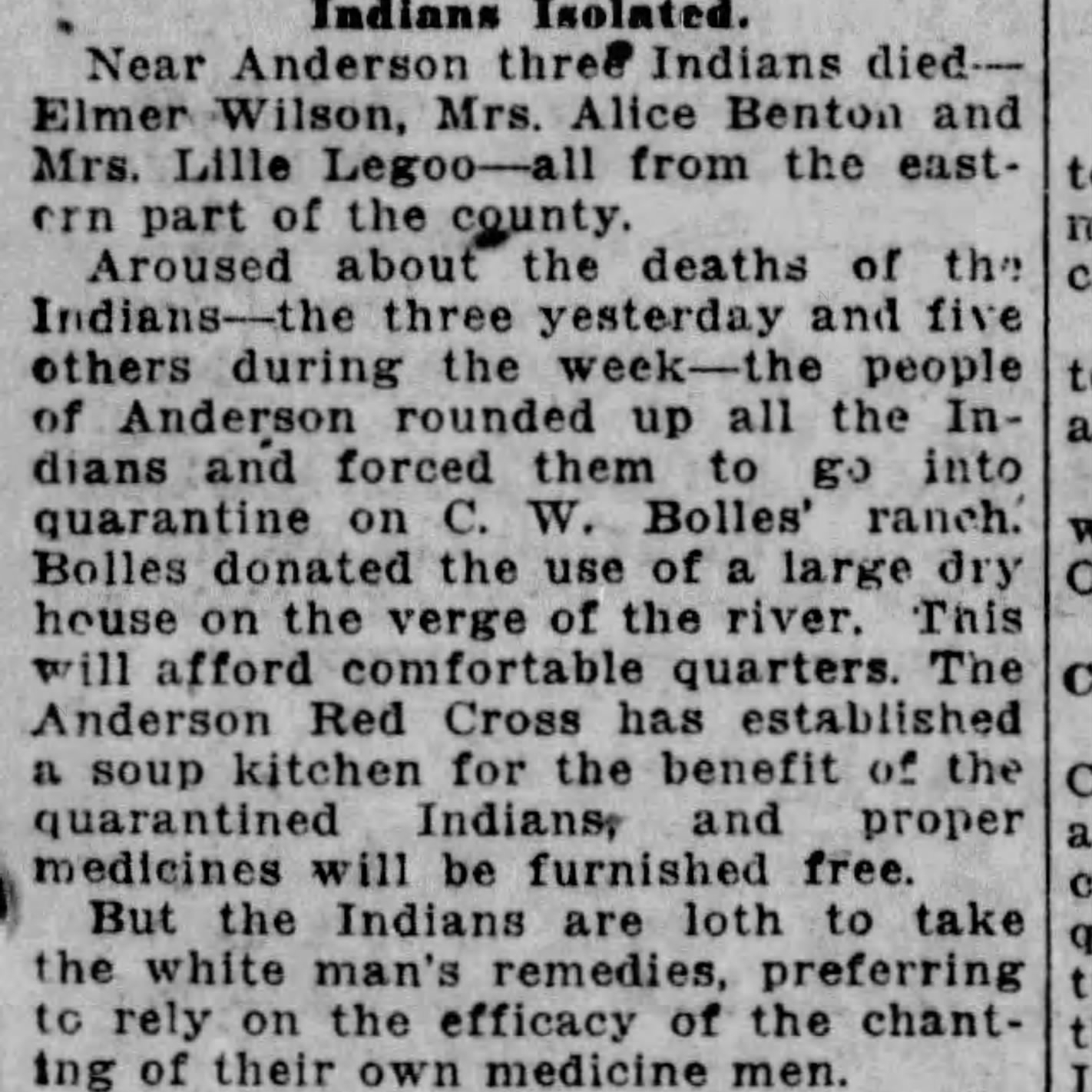
Indian people know all too well the impact of pandemics on human populations, having barely survived smallpox outbreaks and other diseases transmitted during the generations of early contact between themselves and Europeans. Indian people also suffered disproportionately from the last pandemic to hit the United States about a century ago. Some things have changed for the better for Indian people, namely tribal self-governance, but many things are not much better, including the public health situation of many Indian people.
Modern tribal governments navigate a tricky legal and political environment. While tribal governments have power to govern their own citizens, nonmembers are everywhere in Indian country, and the courts are skeptical of tribal authority over nonmembers. For example, after the Navajo Nation announced a 57-hour curfew for the weekend of April 10-13, 2020 (Easter weekend for many), the sheriff’s offices of Cibola and McKinley counties sent letters to the tribe insisting that the tribe refrain from citing nonmembers during the curfew, further insisting that nonmembers are governed more “fully” by the Governor of the State of New Mexico. Further, the fact that it is the county sheriff’s offices – and not counsel for the nonmembers – sending the letters is a deeply consequential signal to the tribal government. Of course, allowing nonmembers freedom to flout the tribe’s curfew defeats the purpose of the curfew. During a pandemic, the limitations on powers of tribal government could lead to tragedy.
This short essay is designed to lay down the argument favoring tribal regulatory powers over nonmembers in Indian country during a pandemic. It should be an easy argument, but federal Indian law makes it more complicated than it should be.
Here are some of the primary source documents noted in the paper:
McKinley County Sheriff Letter
Here are the materials in Leachman v. United States (D. Mont.):
Here are the briefs in Swiger v. Rosette:
Lower court materials in Swiger v. Rosette (E.D. Mich.):
Call for Presentations_NAICJA-NationalConf_02-28-20_final
CALL FOR PRESENTATION PROPOSALS 2020
National Tribal Judicial and Court Personnel Conference Deadline:
Friday, April 10, 2020, 5:00 pm MST
Submission form: https://naicja.wufoo.com/forms/m10hpejn06xrvqf/
The National American Indian Court Judges Association (NAICJA) invites presentation proposals for the 51st Annual National Tribal Judicial and Court Personnel Conference to be held October 20-23, 2020, at the Radisson Hotel and Conference Center in Green Bay, Wisconsin. NAICJA’s Annual Conference offers innovative and timely tribal justice information through high quality presentations by national experts. This is your opportunity to share your expertise and display your creativity by developing an original program for presentation. Proposals specifically tailored to meet the needs of the 300-person NAICJA audience are strongly preferred.
Here are the materials in State v. Nobles:
Lower court materials here.
Here are materials in Hengle v. Asner (E.D. Va.):
Please check out my new paper, “The Rise and Fall of the Ogemakaan,” now available on SSRN. Here is the abstract:
Anishinaabe (Odawa, Bodewadmi, and Ojibwe) legal and political philosophy is buried under the infrastructure of modern self-determination law and policy. Modern Anishinaabe tribes are rough copies of American governments. The Anishinaabeg (people) usually choose their ogemaag (leaders) through an at-large election process that infects tribal politics with individualized self-interest. Those elected leaders, what I call ogemaakaan (artificial leaders) preside over modern governments that encourage hierarchy, political opportunism, and tyranny of the majority. While modern tribal governments are extraordinary successes compared to the era of total federal control, a significant number of tribes face intractable political disputes that can traced to the philosophical disconnect from culture and tradition.
Anishinaabe philosophy prioritizes ogemaag who are deferential and serve as leaders only for limited purposes and times. Ogemaag are true representatives who act only when and how instructed to do so by their constituents. Their decisions are rooted in cultural and traditional philosophies, including for example Mino-Bimaadiziwin (the act of living a good life), Inawendewin (relational accountability), Niizhwaaswii Mishomis/Nokomis Kinoomaagewinawaan (the Seven Gifts the Grandfathers or Grandmothers), and the Dodemaag (clans). I offer suggestions on how modern tribal government structures can be lightly modified to restore much of this philosophy.
Here is “A woman took a stand against tribal disenrollment and paid for it” in High Country News.
Updates in pending litigation….
Doucette v. Bernhardt (W.D. Wash.):
Doucette v. Bernhardt 46-1. 1-29-20 Exhibit A
Doucette v. Bernhardt 46-2. 1-29-20 Exhibit B
Doucette v. Bernhardt 46-3. 1-29-20 Exhibit C
Doucette v. Bernhardt 46-4. 1-29-20 Exhibit D
Rabang v. Kelly (W.D. Wash.):
UPDATE:
 Turtle Talk
You must be logged in to post a comment.