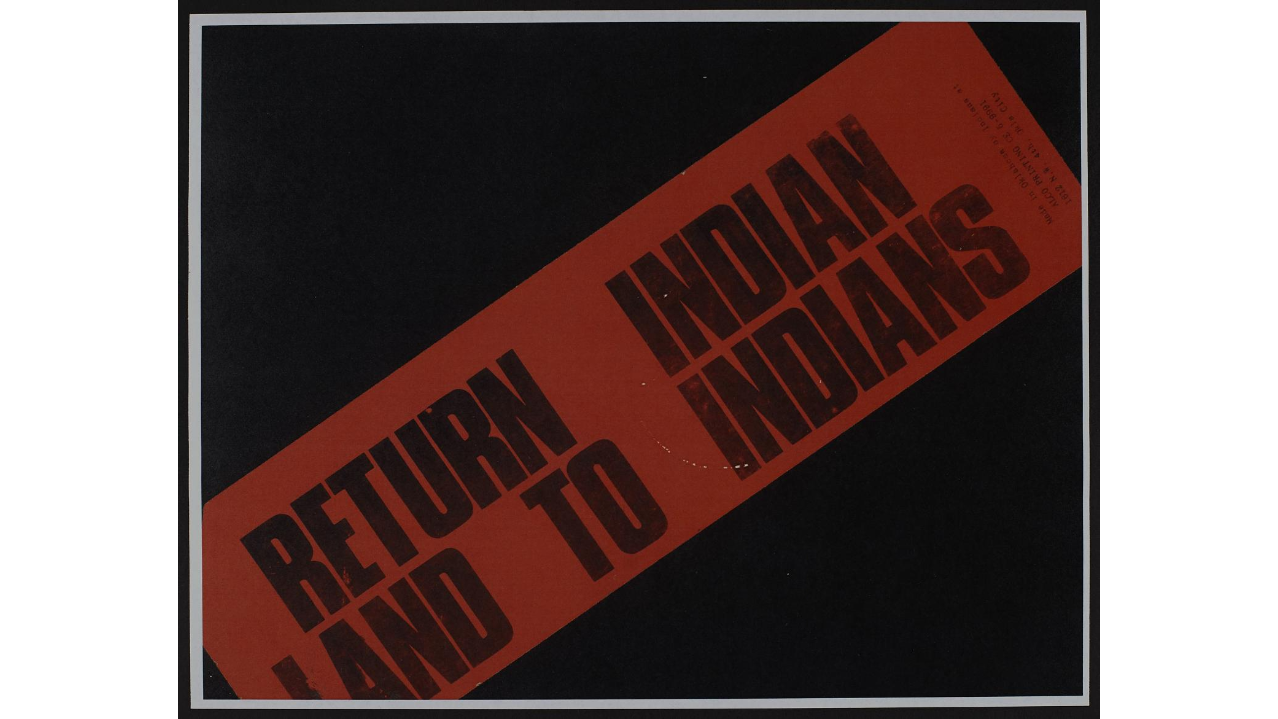
UNDRIP Tribal Implementation Project Talk on Oak Flat on Dec. 16, 2025

Register here.

The Implementation Project will be hosting the next TIP Quarterly Meeting on December 16, 2025 from 12:00-1:30 PM (Mountain Time).

“UN Declaration in Action: International and Domestic Strategies to Protect the Apache Sacred Site of Oak Flat” will feature Mr. Alex Ritchie, San Carlos Apache Tribe Attorney General. Join us to explore the ongoing efforts to defend Oak Flat and the role the UN Declaration on the Rights of Indigenous Peoplesplays in shaping these strategies. This webinar will offer valuable insights for anyone interested in Indigenous rights, cultural preservation, or Tribal advocacy. Moderated by TIP Co-Directors: Prof. Kristen Carpenter and Ms. Sue Noe.

Briefs in Opposition to Alaska’s Effort to Once Again Open Up the Alaska Native Subsistence Rights Litigation

Here are the new briefs in Alaska v. United States:

Federal BIO

Tribal BIO

Cert petition here.

OMG this is ridiculous.

Ninth Circuit Materials in UNITE HERE International v. Wilton Rancheria

Brief (only one is available?):

Opening Brief

Lower court materials here.

New York Federal Court Allows ERISA Suit against Oneida Casino, Citing LDF v. Coughlin

Here are the materials in Jones v. Turning Stone Enterprises LLC (N.D. N.Y.):

1 Complaint

21-1 Motion to Dismiss

29 Opposition

32 Reply

37 DCT Order

WaPo on Oak Flat: “A land fight pits a sacred Apache tradition against a copper mine”

Here.

An excerpt:

Oak Flat sits on one of North America’s largest undeveloped deposits of copper. The mineral is used in dozens of items, including smartphones, electric vehicles and solar panels. The company Resolution Copper believes there are 20 million tons of copper under Oak Flat that could supply up to one-quarter of the U.S. copper demand over 40 years. At today’s prices, experts say that much copper would be worth about $200 billion. The company asserts it will create more than a thousand jobs in an area with high unemployment.

Mining Oak Flat, however, would eventually transform the landscape, creating what geologists say would be a vast crater. To prevent this, the tribe and other opponents of the mine have filed multiple lawsuits and tried unsuccessfully to get one of the cases heard before the U.S. Supreme Court. A federal appeals court will hold a hearing for several of the suits in early January.

“If they take Oak Flat, they destroy our religion and who we are,” said Vanessa Nosie, an archaeology aide for the San Carlos Apache Tribe who also helps her father lead a nonprofit fighting the mine. Lozen, she added, is “dancing to carry the fight for all we’re trying to save.”

As the singers drummed in the downpour, Lozen pounded her ceremonial cane into the muddy ground. Thunder rumbled in the distance, and she faltered for a moment.

A woman in the crowd whooped. Another onlooker yelled, “Go, Lozen!” She pulled her shoulders back, lifted her head and looked straight ahead to the sprawling landscape of cacti and Emory oaks that give the region its name.

She kept dancing.

A Quick Overview of News Profiles and Government Documents Related to Tribal Contracting for ICE Detention Facilities and Related Activities

Prairie Band: “Prairie Band Potawatomi Nation has landed a $30 million contract to vet and design mega detention centers in the Trump administration’s push to stop illegal immigration.” [2025]

NANA Regional Corp.: “Through several presidential administrations, the company has turned itself into a large government contractor, with its biggest revenue generator run out of an office park in a suburb of Washington, DC. NANA’s largest contracts, worth hundreds of millions of dollars a year, are with the Department of Defense. But over the past decade, one of its fastest-growing lines of government business is with Immigration and Customs Enforcement. Schaeffer now says NANA is abandoning crucial values by taking an increasingly large role in President Donald Trump’s mass deportation drive.” [2025]

Other ANCs: “Alaska Native corporations and their subsidiaries do much of the work — and reap the profits — of detaining and guarding U.S. immigrants, patrolling the nation’s borders and maintaining detention centers.” [2021]

Other ANCs: “Well, I combed through the government contracts database to find out what kind of work they did. So I looked at recent contracts for ICE (U.S. Immigration and Customs Enforcement). I found a NANA subsidiary that got a $22 million contract for detention management at Krome, an ICE detention  facility near Miami. The same subsidiary got a contract of $8 million for detention support services in upstate New York. There was an AHTNA subsidiary that got a recent ICE contract for $35 million to provide guard services at a facility in Texas. And another Alaska Native corporation subsidiary runs an ICE detention center in San Pedro, California. Also, I saw one for armed ground transport — $700,000, one of the smaller ones — and it went to a Bering Straits Native corporation subsidiary.” [2018]

Bering Straits Native Corp. “Located just below the Arctic Circle, tribal communities in the Bering Straits region are well-acquainted with frozen conditions. Yet among the 8,000 Indigenous Alaskan shareholders who own the Bering Straits Native Corporation, some are unaware that their company staffs an ICE immigrant detention facility in El Paso, Texas.” [2021]

Same: “Native corporations and other Alaska-based companies have taken on at least a billion dollars in contracts with Immigration and Customs Enforcement in recent years, according to a review of available government contract data from 2012 through the present.” [2018]

Doyton Ltd and others: “Under current federal law and Department of Homeland Security regulations, Native American companies are favored recipients for immigrant detention contracts, and they reap large profits by assigning those contracts to non-Native American firms. One of the major Native-owned corporations that has received such contracts is Doyton Ltd., which holds the contract for operational, transportation and food services at the 800-bed El Paso Service Processing Center in El Paso, Texas.”

Same: “Doyon is one of several Native American corporations that are sealing major contracts with the Department of Homeland Security. Most are Alaska Native Corporations (ANCs), a collection of regional and village corporations created as part of the Alaska Claims Settlement Act of 1971. A few of these Native American corporations are contracting for various parts of ICE’s immigrant detention operations.” [2010]

Department of Homeland Security “Tribal Resources Guide

dhs-tribal-resource-guide

NANA [2025]

GAO Report : “Increased Use of Alaska Native Corporations’ Special 8(a) Provisions Calls for Tailored Oversight” [2006]

gao-06-399

More NANA/Akima: “As the Trump administration’s immigration crackdown has ramped up, officials are sending some migrants to a detention facility in Guantanamo Bay, Cuba that’s run by the subsidiary of an Alaska Native corporation.” More on same issue.

Yet more NANA/Akima: “A corporate conglomerate now running the US government’s immigration detention center at the Guantánamo Bay naval base on a lucrative contract has been the subject of critical audits and a civil rights complaint over conditions at three other migrant lockups it has run within the US, documents reviewed by the Guardian show.”

New Scholarship on the Morrill Act and Native Lands Dispossession

Teresa M. Miguel-Stearns, Samantha Ginsberg, and Kristen Cook have posted “More Than Morrill: The Intertwined History of Indian Land Dispossession, Arizona Statehood, and University Enrichment,” published by the Arizona Journal of Environmental Law and Policy, on SSRN.

Here is the abstract:

Through the federal government’s university land-grant programs, which began with the Morrill Act in 1862 and continue today, Congress has systematically allocated millions of acres of land in the western United States to states to create endowments to support the public higher education of its citizens. In Arizona, land was taken from Indigenous peoples, communities, tribes, and nations by treaty, act of congress, executive order, and force to accomplish this. As a result, by the time of statehood in 1912, the state of Arizona had accumulated approximately 850,000 acres of land around the state on behalf of higher education, including the University of Arizona, then the state’s only university and its designated land-grant institution. Today, the Arizona State Land Department still holds and manages 688,706 acres of land in trust for the benefit of public higher education. All three of Arizona’s public universities receive distributions from the revenue generated by these trust lands. The goal of this paper is to explore and analyze the University of Arizona’s historical and ongoing enrichment from land taken from Indigenous peoples by the federal government and transferred to the territory and, later, the state of Arizona in the nineteenth and early twentieth centuries for the benefit of institutions of higher education. A comprehensive understanding of Arizona’s history and the state’s current holdings and financial benefits is required to examine the policy implications and moral and legal obligations that Arizona and its universities have to Indigenous peoples in Arizona. 

Stroble v. Oklahoma Tax Commission — State Brief in Opposition to Cert

Here:

Oklahoma Brief in Opposition

Cert petition here. Amicus briefs in support of the petition here.

Sault Tribe v. Michigan — Briefs in Opposition to Cert

Here:

Federal Brief in Opposition

Tribal Brief in Opposition

Petition here.

Oklahoma Indian Bar Association CLE: “McGirt: The Promise Continues” — Dec. 8, 2025

Register here.