Here.
Here.
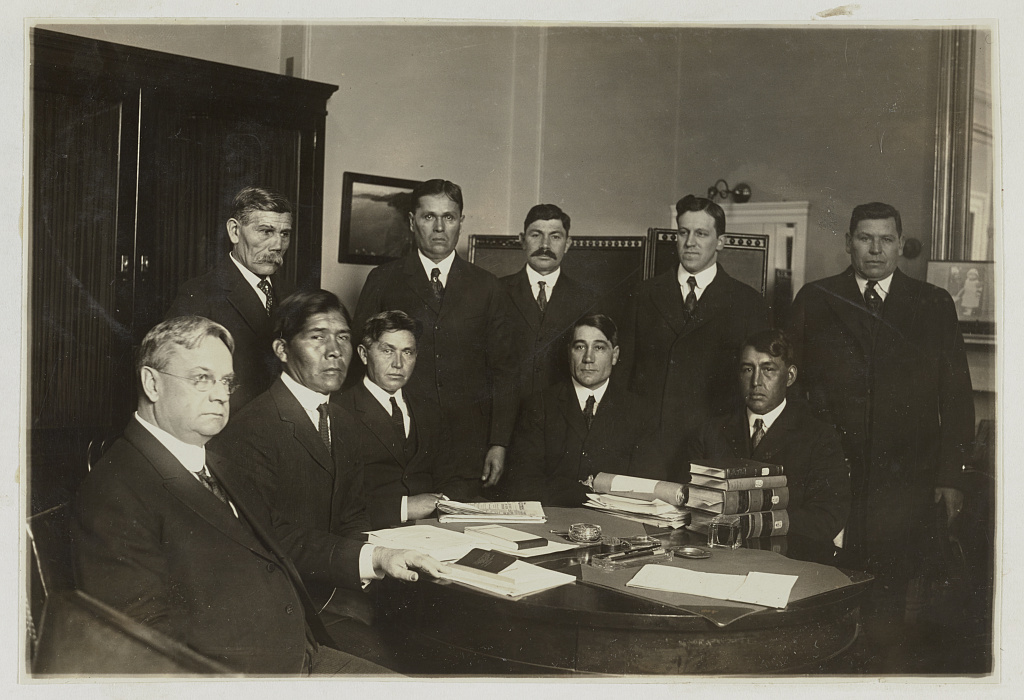
In 1969, after a meeting of the California Indian Legal Services board, a group “democratically-selected Indians,” CILS drafted a bill to transfer Bureau of Indian Affairs control over to “democratically-selected Indians.”
Here (zoom webinar link here):

Fletcher and Singel will discuss their forthcoming paper, “Lawyering the Indian Child Welfare Act.”
Here is the petition in Treppa v. Hengle:
Questions presented:
Lower court materials here.
Here is the petition in a related case, Asner v. Hengle:
Question presented:
Can a federal court refuse to enforce the delegation clause of an arbitration agreement on the ground that a choice-of-law provision applicable to the arbitration agreement as a whole prospectively waives federal rights?
John W. Ragsdale has posted “The Aboriginal Land and Water Rights of the Jemez Pueblo,” forthcoming in the Denver University Water Law Review, on SSRN.
Here is the abstract:
Since time immemorial, the indigenous people of what became the Southwest United States have maintained sustainable, vibrant communities in the harshest of environments; one with generally arid climate, inconsistent precipitation, heat, wind, thin soil and erosion. These communities, on the razor’s edge, survived for eons because resilience and community, within and with the land, were at the center of their life, economy and order. Balance was not always perfect, but it was the target. The possibility of economic surplus and growth is perhaps a latent human instinct, but it until the fluorescence of Chaco Canyon in the eleventh century it remained subordinate. With the fall of Chaco and eventual restoration of decentralizations and the traditional aboriginal practices, balance returned.
The European invasion and the infusion of competitive individualism and economic growth changed all this. The movement west on the wings of the doctrine of discovery and the ensuing extinguishment of both aboriginal title and the stable-state economies proceeded across the Mississippi and the prairies and slammed the capitalistic wrecking ball into the most resilient of the aboriginal survivors – The Pueblo Indians of the Southwest.
The Jemez Pueblo of Central New Mexico has been one of the fiercest defenders of the traditional aboriginal community. Through the intrusion of Spain, Mexico and ultimately the United States, the Pueblo clung to its central land, its claims to aboriginal surroundings and water, and its sustainable orientation, this article traces the prehistoric courses of the Pueblo, and it centuries-long efforts to maintain both the focus and the legal existence of its aboriginal community. It has not been a complete victory in the dominant sovereigns’ courts, but the aboriginal heart of the people and possibilities for collaboration with other Tribes and, perhaps, with a more generous and enlightened dominant sovereign, remain strong.
Here are materials in In re Diven (E.D. Cal. Bkrcy.):
111 Amended Opposition to Motion for Sanctions (FINAL)

Here are the en banc stage materials in Navajo Nation v. Dept. of the Interior:
Amended Order + Denial of En Banc Petition
Water District En Banc Petition
Panel stage materials here.
Here:
Questions presented:
Lower court materials here.

 Turtle Talk
You must be logged in to post a comment.