Gila River Indian Community Sues the VA over Health Care Costs Reimbursements

Here is the complaint in Gila River Indian Community v. Dept. of Veterans Affairs (D. Ariz.):

Complaint

An excerpt:

In 2010, the Patient Protection and Affordable Care Act (“ACA”) was enacted. One goal of the ACA was to improve health care access and delivery for Native Americans. A provision in the ACA allows Indian tribes to be reimbursed for health care provided to veterans and states:
The Service, Indian tribe, or tribal organization shall be reimbursed by the Department of Veterans Affairs or the Department of Defense (as the case may be) where services are provided through the Service, an Indian tribe, or a tribal organization to beneficiaries eligible for services from either such Department, notwithstanding any other provision of law.
25 U.S.C. § 1645(c). This law provides that, if an Indian tribe or tribal organization provides health care services to an individual who is otherwise eligible for care from the VA, the VA must reimburse the Indian tribe or tribal organization for the services provided. Despite this plain and mandatory language directing the Department of Veterans Affairs (“VA”) to reimburse Indian tribes and tribal organizations for health care services provided to veterans, the VA refuses to do so unless Indian tribes and tribal organizations agree to conditions well beyond the plain language of the law and which reduce the reimbursements that Indian tribes are entitled to under the law.
Materials in Osage Nation v. Leese (Updated 4/6/16)

Here are the materials, filed in the District Court for Osage County, Okla.:

Redcorn-MTD filed (FEB 11 2016)

Redcorn-Response to MTD (filed March 2016)

Redcorn-Reply brief 04 05 16 (Final w Signatures)

SCOTUS Denies Cert in Alaska v. Organized Village of Kake (Roadless Rule)

Here.

Cert petition here.

Jim Harrison Walks On

Here.

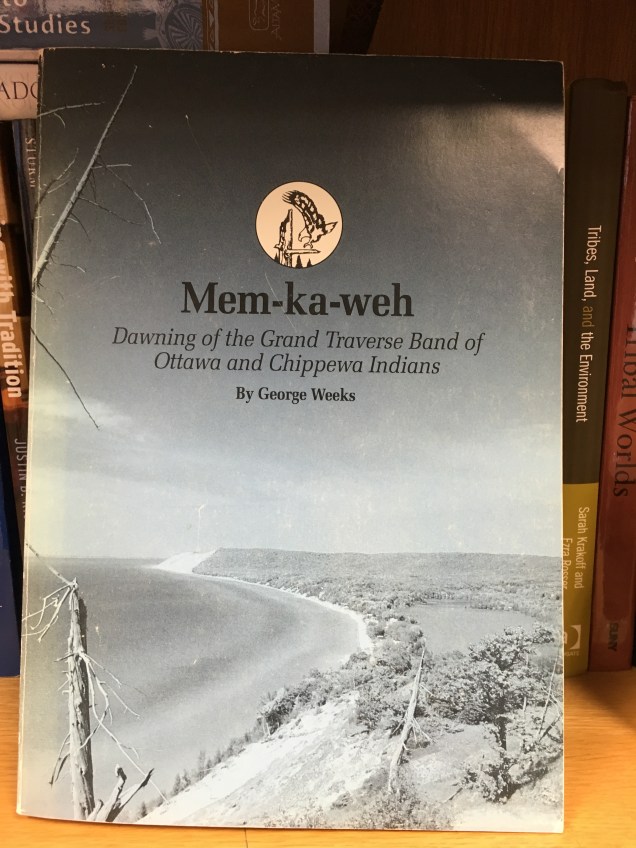
Harrison was a long time resident of Michigan, including Leelanau County, where he knew many Anishinaabe people. He wrote a compelling introduction to the history of the Grand Traverse Band of Ottawa and Chippewa Indians, Mem-ka-Weh: The Dawning of the Grand Traverse Band of Ottawa and Chippewa Indians.

Mem-ka-weh

He also wrote many Indian characters into his books. He wrote them as human beings, with all their flaws and strengths, and not as exotic others like so many writers do.

Patty Ferguson-Bohnee on Indian Voting Rights in Arizona

Patty Ferguson-Bohnee has posted “The History of Indian Voting Rights in Arizona: Overcoming Decades of Voter Suppression,” which she published in the Arizona State Law Journal. Here is the abstract:

Native Americans “have experienced a long history of disenfranchisement as a matter of law and of practice.” This comes from a complicated and contradictory history of laws and policy that has recognized tribes as separate sovereigns, reduced tribal status to that of domestic dependent nations, sought to remove, relocate, or assimilate tribal citizens, terminated numerous indigenous nations, and has now moved to a policy of tribal self-government. Unfortunately, the right to vote for Arizona’s first people has only recently been achieved, and there are continuing threats to the electoral franchise.

Voter suppression has been used to discourage or prevent Indian people from voting in Arizona. Voter qualifications such as literacy tests were used to prevent Indians from participating in elections for approximately fifty years. Once Native Americans started voting, redistricting and vote dilution were used to reduce the effectiveness of the Native vote.

This article will review the history of Indian voting rights in Arizona. The author begins by reviewing the history of Native American voting rights and the history of voting discrimination against Native Americans in Arizona. The Voting Rights Act turned the corner for Native people to participate in the state and federal election processes. The article then discusses the current challenges faced by Native American voters and specifically discuss the voter ID law passed in 2004. The voter ID law is a roadblock that impedes full participation by all Arizona Indians. The last part of the article focuses on strategies to protect Indian voting rights. Notwithstanding the Supreme Court’s invalidation of the Section 5 coverage formula in Shelby County, tribes should consider proactive measures to ensure that tribal citizens can participate in elections.

Highly recommended.

Galanda Broadman Lawyers Sue to Challenge Disbarment in Tribal Court

Here are the materials in Galanda v. Bernard (Nooksack Tribal Court):

Galanda v. Bernard Complaint

Galanda v. Bernard Motion for Injunction and Declaratory Relief

National Indian Law Library Bulletin 3/24/16

Here:

The National Indian Law Library added new content to the Indian Law Bulletins on 3/24/16.

U.S. Supreme Court Bulletin
http://www.narf.org/nill/bulletins/sct/2015-2016update.html
Petition was filed in California v. Pauma Band of Luiseno Mission Indians of the Pauma & Yuima Reservation (Gaming Compact – Waiver of Sovereign Immunity) on 3/17/16.

U.S. Federal Trial Courts Bulletin
http://www.narf.org/nill/bulletins/dct/2016dct.html
Maniilaq Association v. Burwell (Indian Self-Determination and Education Assistance Act; Health Services)
Tuttle v. Jewell (Indian Long-Term Leasing Act; Property Rights)
Pearson v. United Debt Holdings, LLC (Debt Collection; Tribal Exhaustion)

State Courts Bulletin
http://www.narf.org/nill/bulletins/state/2016state.html
State in Interest of M.D. (Indian Child Welfare Act – Active Efforts)

News Bulletin
http://www.narf.org/nill/bulletins/news/currentnews.html
In the Tribal Jurisdicti on section, we feature a couple of articles on the recent U.S. Supreme Court reservation diminishment opinion.

U.S. Legislation Bulletin
http://www.narf.org/nill/bulletins/legislation/114_uslegislation.html
Six bills we added:
S.2728: Alaska Native Access Card Act.
S.2711: Native American Education Opportunity Act.
S.2727: A bill to amend the Federal Water Pollution Control Act to allow preservation leasing as a form of compensatory mitigation for discharges of dredged or fill material affecting State or Indian land, and for other purposes.
S.2732: A bill to amend the Federal Water Pollution Control Act to exempt Indian tribes from compensatory mitigation requirements in connection with certain discharges of dredged or fill material, and for other purposes.
S.2739: Spokane Tribe of Indians of the Spokane Reservation Equitable Compensation Act.
S.2717: DRIFT Act of 2016.

U.S. Regulatory Bulletin
http://www.narf.org/nill/bulletins/regulatory/2016fr.html
We feature a notice of the Bureau of Indian Affairs on an extension of an effective date for the final rule on rights-of-way on Indian lands.

Law Review & Bar Journal Bulletin
http://www.narf.org/nill/bulletins/lawreviews/2016lr.html
We feature an article on Indian lands and jurisdictional challenges.

Eleventh Circuit Rejects Miccosukee Members’ Federal Tax Challenge

Here is the opinion in Cypress v. United States:

CA11 Unpublished Opinion

An excerpt:

This appeal arises out of a dispute between sixteen members of the Miccosukee Tribe of Florida (the “Tribe members”) and the United States, the U.S. Department of the Interior, the U.S. Department of the Treasury, and the Secretaries of the Treasury and of the Interior (collectively, “the Government”). The Tribe members seek declaratory relief to avoid paying federal income taxes on distributions, including gaming proceeds, paid out of the Tribe’s trust account. The district court dismissed the complaint for lack of subject matter jurisdiction, finding that the United States had not waived sovereign immunity for suits brought by individual Tribe members. The Tribe members now appeal the dismissal.

We agree with the district court that the Government did not waive sovereign immunity. Accordingly, we affirm the district court’s dismissal of this matter.

Briefs here.

Ninth Circuit Affirms Tribal Immunity from State Court Judgment & Award against Tribal Member Per Caps

Here are the materials in ABBA Bails Bonds v. Grubb (No. 13-56701) and Richard S. Held Retirement Trust v. Grubbe (No. 14-56701):

CA9 Unpublished opinion

ABBA Bail Bonds Opening Brief 13-56701

ABBA Bail Bonds Reply Brief 13-56701

Appellee Brief 13-56701

Appellee Brief 14-56760

Richard S. Held Retirement Trust Opening Brief 14-56760

Richard S. Held Retirement Trust Reply 14-56760

Tribal NLRB Background Materials

Here are the materials relevant to Little River Band of Ottawa Indians Tribal Government v. NLRB.

Supreme Court cert stage briefs

Little River Petition and Appendix COMBINED

USET Amicus Brief

Final CO-UMUT Amicus Cert Petition – Saginaw Chippewa and LRB

National Right to Work Legal Defense Foundation

CNIGA Amicus

NCAI Amicus

Michigan Amicus Brief

US Cert Opposition

Little River Reply

Sixth Circuit En Banc Stage Continue reading