Here is the complaint in Berry Creek Rancheria of Maidu Indians of California v. Lowry (E.D. Cal.):

Here is the complaint in Berry Creek Rancheria of Maidu Indians of California v. Lowry (E.D. Cal.):
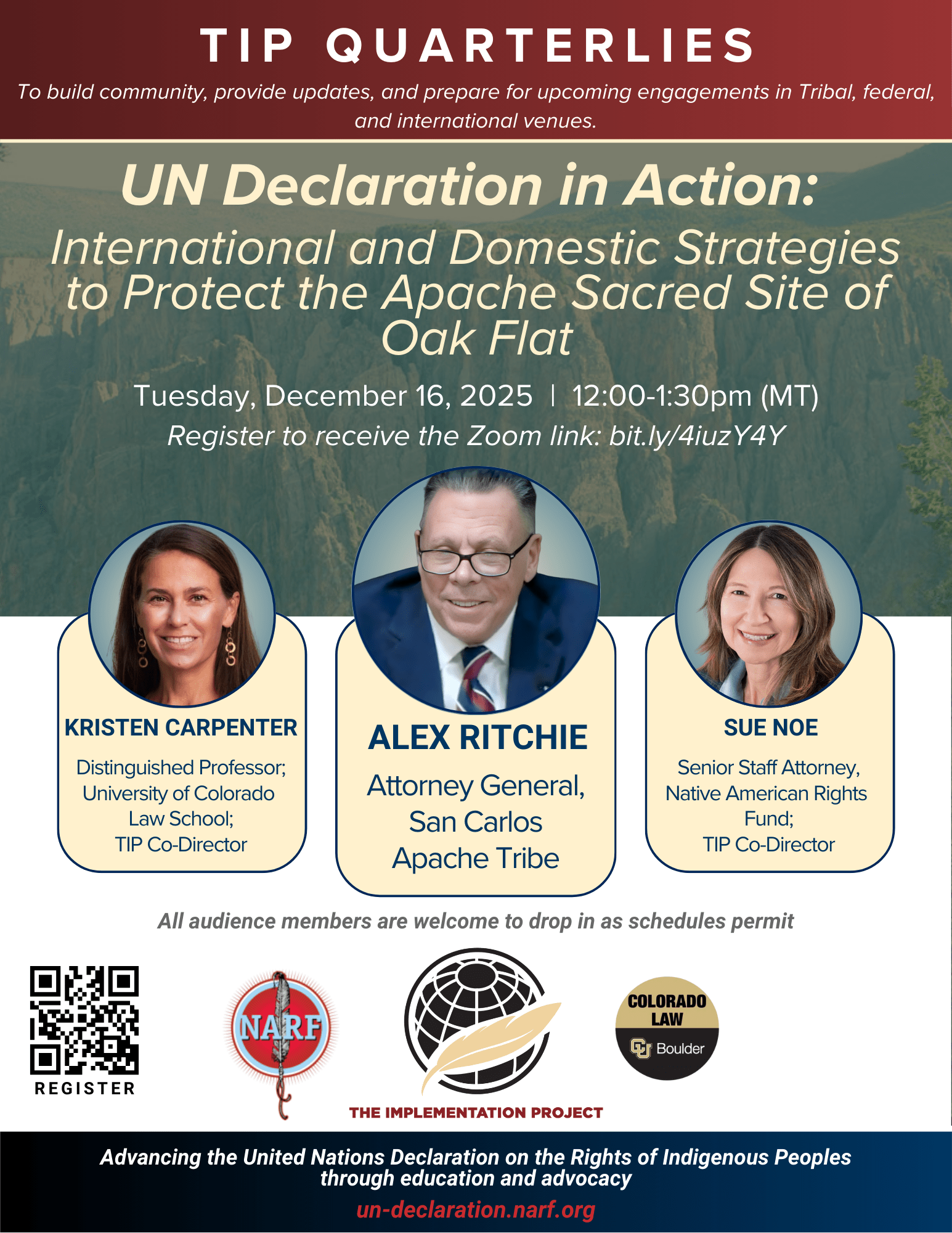
Register here.
The Implementation Project will be hosting the next TIP Quarterly Meeting on December 16, 2025 from 12:00-1:30 PM (Mountain Time).
“UN Declaration in Action: International and Domestic Strategies to Protect the Apache Sacred Site of Oak Flat” will feature Mr. Alex Ritchie, San Carlos Apache Tribe Attorney General. Join us to explore the ongoing efforts to defend Oak Flat and the role the UN Declaration on the Rights of Indigenous Peoplesplays in shaping these strategies. This webinar will offer valuable insights for anyone interested in Indigenous rights, cultural preservation, or Tribal advocacy. Moderated by TIP Co-Directors: Prof. Kristen Carpenter and Ms. Sue Noe.
Here.
An excerpt:
Oak Flat sits on one of North America’s largest undeveloped deposits of copper. The mineral is used in dozens of items, including smartphones, electric vehicles and solar panels. The company Resolution Copper believes there are 20 million tons of copper under Oak Flat that could supply up to one-quarter of the U.S. copper demand over 40 years. At today’s prices, experts say that much copper would be worth about $200 billion. The company asserts it will create more than a thousand jobs in an area with high unemployment.
Mining Oak Flat, however, would eventually transform the landscape, creating what geologists say would be a vast crater. To prevent this, the tribe and other opponents of the mine have filed multiple lawsuits and tried unsuccessfully to get one of the cases heard before the U.S. Supreme Court. A federal appeals court will hold a hearing for several of the suits in early January.
“If they take Oak Flat, they destroy our religion and who we are,” said Vanessa Nosie, an archaeology aide for the San Carlos Apache Tribe who also helps her father lead a nonprofit fighting the mine. Lozen, she added, is “dancing to carry the fight for all we’re trying to save.”
As the singers drummed in the downpour, Lozen pounded her ceremonial cane into the muddy ground. Thunder rumbled in the distance, and she faltered for a moment.
A woman in the crowd whooped. Another onlooker yelled, “Go, Lozen!” She pulled her shoulders back, lifted her head and looked straight ahead to the sprawling landscape of cacti and Emory oaks that give the region its name.
She kept dancing.

M. Alexander Pearl has published “Corporeal Property and the Limits of NAGPRA” in the Fordham Law Review.
Here is an excerpt:
The Native American Graves Protection and Repatriation Act represents a pivotal but incomplete legislative effort to confront the enduring legacy of colonialism in the United States. NAGPRA addresses a specific and deeply troubling consequence of colonialism: the unlawful appropriation of Native American ancestors and cultural items by federal and federally funded institutions. Although it lays a critical foundation for repatriation and a sense of cultural justice, NAGPRA’s effectiveness is constrained by its grounding in Western legal traditions—especially its emphasis on corporeal, material property. To redress a wider range of harms suffered by Native communities, we must look beyond the statute’s current framework and embrace an expanded understanding of property, one that includes intangible rights based
in cultural harms and rights.
Here are the materials in Native American Guardian’s Association v. New York State Board of Regents (E.D. N.Y.):

Michalyn Steele has posted “The Native American Graves Protection and Repatriation Act as a Model of Cultural Sovereignty for Protecting Indigenous Sacred Sites” on SSRN.
Here is the abstract:
This Essay argues that NAGPRA provides a model for reassessing how to measure sacred site protection against competing values. Part I briefly maps the scope and history of Indigenous dispossession of sacred sites that has resulted in the unique challenges Indigenous people face in gaining access to and protection of these sites. Part II illustrates the values that most frequently compete with (and defeat) sacred site access and protection claims. Finally, Part III argues that NAGPRA offers a case study for reordering these values to recognize and prioritize the human rights and religious interests of Indigenous peoples in their sacred sites.
David C. Scott has published Making Space for Sacred Lands: From the Harsh Glare of Lyng to Apache Stronghold in the Stanford Journal of Civil Rights & Civil Liberties.
Here is the abstract:
Federal courts have routinely held—under the Free Exercise Clause and Religious Freedom Restoration Act (RFRA)—that government actors operating on government-owned land may desecrate, destroy, modify, or restrict access to landmarks that are sacred to Native American tribes, even if doing so would “virtually destroy” the tribes’ ability to practice their religion. Beginning with Lyng v. Northwest Indian Cemetery Protective Association in 1988, courts have justified these results on the grounds that tribal litigants are asserting a positive right that would permit them to “exact something” from the government. The Free Exercise Clause and RFRA, however, only protect “substantial burdens” on religious practice, or rather, violations of negative rights (i.e., rights to be free from coercion). In its recent decision in Apache Stronghold, the Ninth Circuit’s 6-5 per curiam decision ostensibly expanded the scope of “substantial burdens” to include “preventing access to religious exercise.” A different 6-5 majority opinion in this case, however, retreated to Lyng’s analysis and denied the Western Apaches’ claims. The Supreme Court has declined to hear the case, over a vociferous dissent from Justice Gorsuch calling the decision to not review the Ninth Circuit’s “questionable reasoning” a “grievous mistake” with “consequences that threaten to reverberate for generations.” Indeed, the Ninth Circuit’s confused reasoning writes the Western Apache and other minority religions, especially those using public land, out of RFRA and the Free Exercise Clause. If federal courts do not revisit this analysis, land-based tribes are powerless to prevent the extinction of their religious and communal traditions.
This Article argues that the conceptual distinctions on which courts rely in sacred land cases—along with the policy arguments that support them—are simplistic and ahistorical. Holding onto the positive-negative rights distinction in these cases results in the mischaracterization of the harms that tribes have suffered and the attendant rights they seek to protect. In place of this binary distinction, this Article employs resources from social and political philosophy to argue for a more nuanced and historical context-sensitive inquiry, pursuant to which courts ask whether a religious litigant has access to a non-hostile religious atmosphere. After Part I presents a brief history of sacred land cases, Part II both makes a philosophical case for the right to a non-hostile atmosphere and argues this is what the Court intended in Wisconsin v. Yoder. Part III then presents additional resources from First Amendment doctrine and related areas of law, each of which suggest that this principle is already implicit in our doctrinal history.
Here are the briefs in several consolidated cases [Brown Lopez v. United States, 25-5197; Arizona Mining Reform Coalition v. Rollins, 25-5185; San Carlos Apache Tribe v. United States Forest Service, 25-5189]:
Arizona Reform Mining Coalition Opening Brief
San Carlos Apache Tribe Opening Brief
Religious Freedom Institute Amicus Brief
Additional briefs (that I feel like posting):
Hillary Hoffman has posted “Collaborative Management of Bears Ears National Monument: Perspectives from the Bears Ears Inter-Tribal Coalition” on SSRN.
Here is the abstract:
Tribal collaborative management of the Bears Ears National Monument is not new, but in its most recent iteration, it has only been recently recognized as a viable management framework. This article explores the meaning of that re-recognition to the five Tribal Nations of the Bears Ears Inter-Tribal Coalition, an organization that was formed to re-establish those ancestral connections and support the ongoing collaborative management of the Monument by the Bears Ears Commission and the two federal agencies charged with the legal mandate to protect this cultural landscape: the Bureau of Land Management and the U.S. Forest Service.




You must be logged in to post a comment.