Download materials in the matter of Klickitat County v. U.S. Department of Interior (E.D. Wash.):
Doc. 1 Complaint for Declaratory and Injunctive Relief
Link to previous coverage here.
Download materials in the matter of Klickitat County v. U.S. Department of Interior (E.D. Wash.):
Doc. 1 Complaint for Declaratory and Injunctive Relief
Link to previous coverage here.
Download decision here.
By using State v. Buchanon, 978 P.2d 1070 (Wash. 1999), the Oregon courts held that treaty hunting can only happen on traditional hunting grounds. The bighorn sheep were taken on land south of the Powder River, which state witnesses testified was the Nez Perce Tribe’s southern border due to historical conflicts with the Northern Paiutes.
Defendant was charged in November 2008 after bringing the sheep to the Oregon Department of Fish and Wildlife for tagging so they could be stuffed.
The case is State v. James Bronson, Jr., 586 P.3d 154 (Ore. Ct. of App. 2016).
Here are the materials in Turunen v. Creagh (W.D. Mich.):
56 DCT Order to Show Cause re Rule 19
66 Plaintiff’s Response to Tribes
67 DCT Order Dismissing Complaint
An excerpt:
Plaintiff, Brenda Turunen, is a member of the Keweenaw Bay Indian Community (KBIC), a federally recognized Indian tribe in Michigan’s Upper Peninsula that is the successor-in-interest to the L’Anse and Ontonagon bands of the Lake Superior Chippewa Indians. In 1842, the Lake Superior Chippewa Indians signed a treaty with the United States of America, 7 Stat. 591 (the 1842 Treaty), in which the Indian signatories ceded large portions of the western Upper Peninsula of Michigan, but reserved “the right of hunting on the ceded territory, with the other usual privileges of occupancy.” 7 Stat. 591.
Plaintiff owns property that is within the “ceded territory” at issue in the 1842 Treaty. Plaintiff asserts that the “the usual privileges of occupancy” reserved by the KBIC on the ceded territory included commercial farming and animal husbandry. Based on that interpretation of the 1842 Treaty, Plaintiff seeks a declaration that she may—as a member of the KBIC—raise animals free from state regulation on her property within the ceded territory.
Plaintiff’s claim rests on the twin propositions that the KBIC retained certain rights in the 1842 Treaty, and that she may exercise such rights based on her membership in the KBIC. Although the Court must determine the scope of the rights retained by the KBIC to resolve Plaintiff’s claim, the KBIC is not a party to this action. Thus, the Court previously sought briefing from the parties regarding whether the KBIC should be joined pursuant to Federal Rule of Civil Procedure 19, and whether the case should be dismissed if the KBIC could not be joined. After the parties responded, the Court—at Plaintiff’s urging—ordered Plaintiff to notify the KBIC of the pending action and the opportunity to intervene. The KBIC followed up to that notification with a letter to the Court stating that it would not intervene in the action, and further urging that the action be dismissed under Rule 19. For the following reasons, the Court concludes that the matter should be dismissed.
We have posted on this matter here, here, here, here, and here.
Here are the materials relevant to Little River Band of Ottawa Indians Tribal Government v. NLRB.
Supreme Court cert stage briefs
Little River Petition and Appendix COMBINED
Final CO-UMUT Amicus Cert Petition – Saginaw Chippewa and LRB
National Right to Work Legal Defense Foundation
Sixth Circuit En Banc Stage Continue reading
Here are the materials in United States v. Washington (subproceeding 11-02):
Port Gamble and Jamestown S’Klallam Tribes Brief
Oral argument video here.
MSU ILPC & Indian Law Clinic students presented at the Jackson Community Forum: Impact of Land Treaties.

As a side note–this event, hosted at the Jackson District Library and open to the public, was very well attended. The questions we received were all thoughtful, curious, and kind. Our students did well and felt welcomed. This event came out of a project volunteers in the city did around the 200 anniversary of 1815 survey of Michigan–which happened because of the Treaty of Detroit. Instead of ending there, the organizers decided they needed to know more about treaties and how they work today. Because the event went so well, the librarians are planning to have more events on other issues involving Native communities in Michigan.
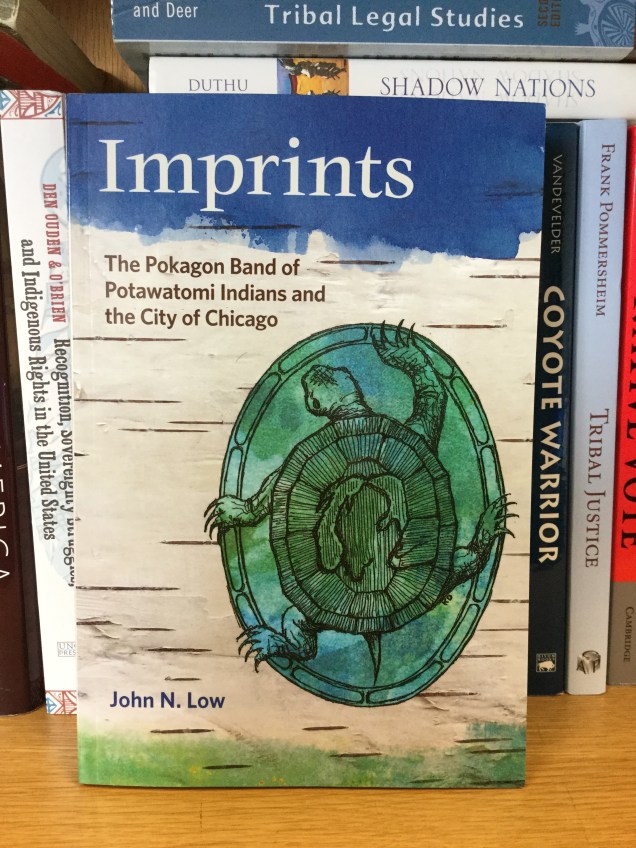
John Low has published “Imprints: The Pokagon Band of Potawatomi Indians and the City of Chicago” with Michigan State University Press (book page here).
From the website:
Imprints: The Pokagon Band of Potawatomi Indians and the City of Chicago
The Pokagon Band of Potawatomi Indians has been a part of Chicago since its founding. In very public expressions of indigeneity, they have refused to hide in plain sight or assimilate. Instead, throughout the city’s history, the Pokagon Potawatomi Indians have openly and aggressively expressed their refusal to be marginalized or forgotten—and in doing so, they have contributed to the fabric and history of the city.Imprints: The Pokagon Band of Potawatomi Indians and the City of Chicago examines the ways some Pokagon Potawatomi tribal members have maintained a distinct Native identity, their rejection of assimilation into the mainstream, and their desire for inclusion in the larger contemporary society without forfeiting their “Indianness.” Mindful that contact is never a one-way street, Low also examines the ways in which experiences in Chicago have influenced the Pokagon Potawatomi. Imprints continues the recent scholarship on the urban Indian experience before as well as after World War II.
Here are the materials in United States v. Washington (W.D. Wash.) (subproceeding 89-3-10):
20 Squaxin Petn for Order to Show Cause
Earlier proceedings in this matter are here.
Link to article here.
Here:
 Turtle Talk
You must be logged in to post a comment.