Yesterday, we covered tribal constitutions. Today, the political and bureaucratic complexity of enrollment decisions in cartoon form (we will conclude tomorrow):
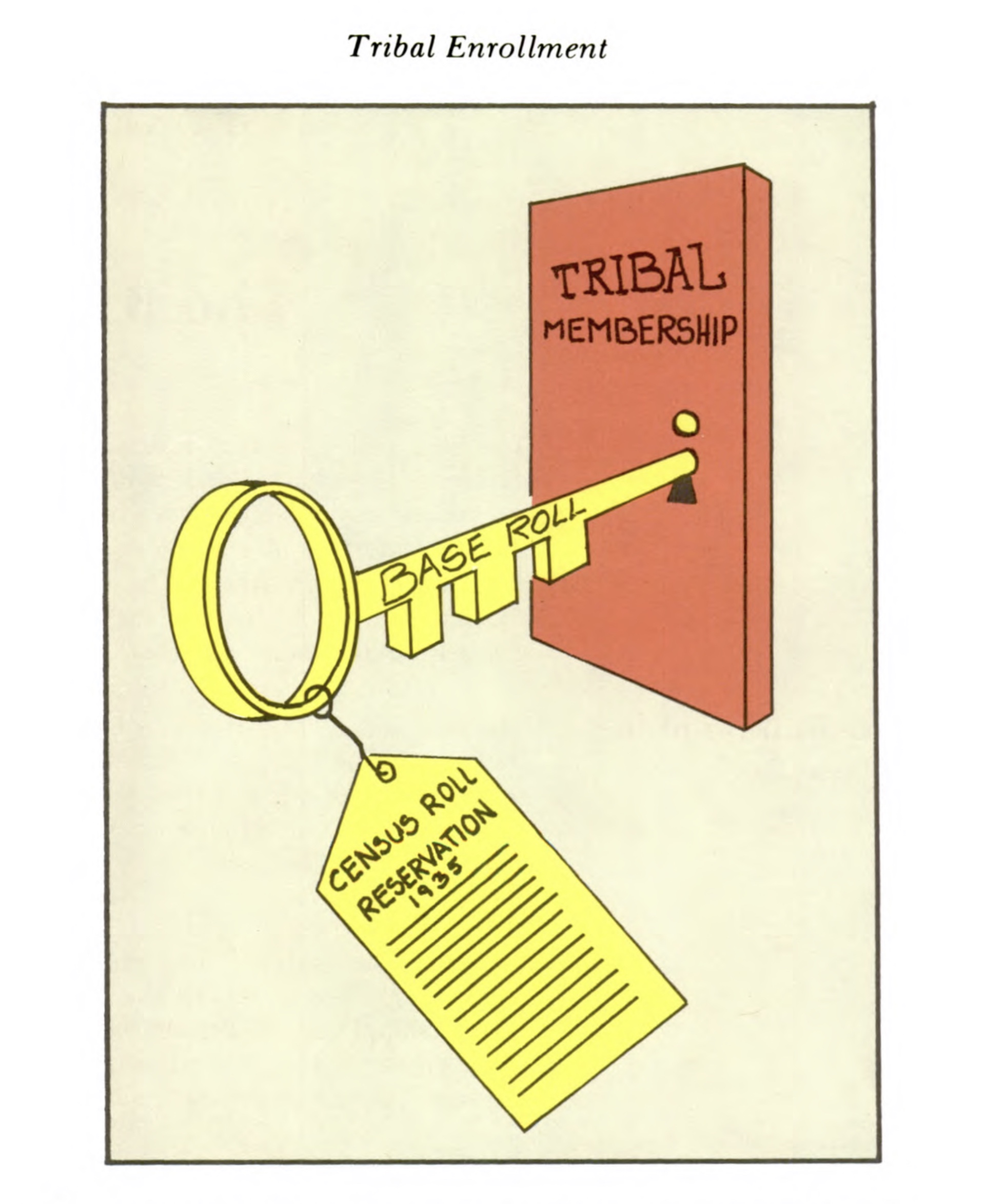

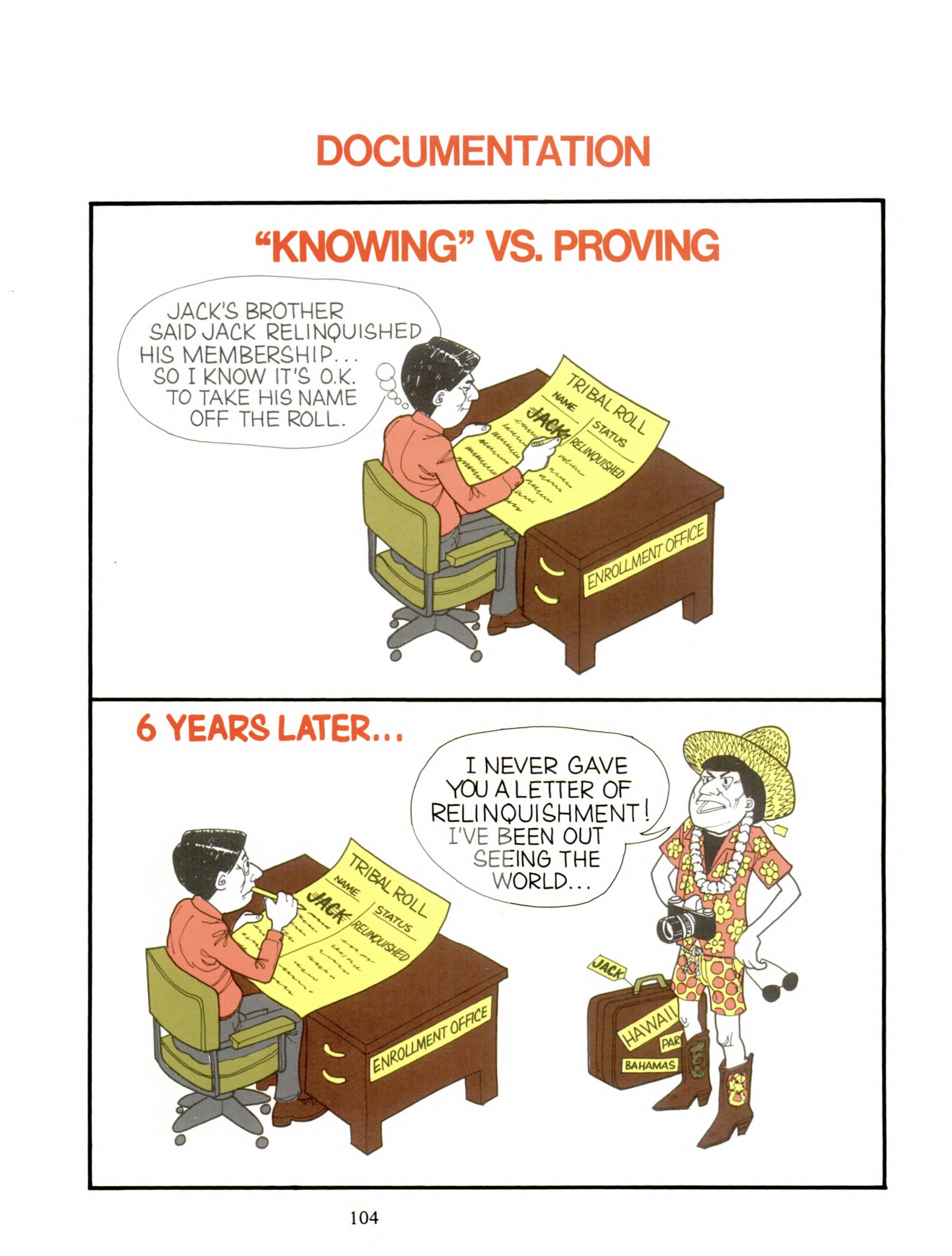
Yesterday, we covered tribal constitutions. Today, the political and bureaucratic complexity of enrollment decisions in cartoon form (we will conclude tomorrow):
Apparently, in 1977 or so, the Phoenix Area Office decided to write a lengthy manual for tribal governments, instructing them on how to make enrollment decisions that met tribal constitutional muster. Suffice it to say the text is TL:DR, but the illustrations are awesome — and by awesome, I mean crazy — and by crazy, I mean Indian country crazy.


Tomorrow, how tribal governments make membership decisions….
Here are the materials in Acres Bonusing Inc v. Marston (N.D. Cal.):
29-1 Boutin Jones Defendants MTD
30-1 Boutin Jones Anti-SLAPP Motion
31 Janssen Malloy Defendants Anti-SLAPP Motion
33 Janssen Malloy Defendants MTD
40 JM Defendants Response to 38
45 ABI Response to Marston MTD
46 ABI Reply in Support of Motion for Sanctions
50-1 Marston Anti-SLAPP Motion
52 Marston Response to ABI Motion to Strike
56 ABI Response to BJ Anti-SLAPP Motion
57 ABI Response to JM Anti-SLAPP Motion
58 ABI Response to Marston Anti-SLAPP Motion
59 JM Reply in Support of Anti-SLAPP Motion
60 BJ Reply in Support of Anti-SLAPP Motion
62 Marston Reply in Support of Anti-SLAPP Motion
Related cases here.
Here are the materials in United States v. Cline (W.D. Wash.):
Here are the materials in Zurich American Insurance Company v. McPaul (D. Ariz.):
1-2 Navajo Nation Complaint in Chinle D. Ct.
30 Zurich Motion for Summary J
I posted a draft paper, “Indian Lives Matter: Pandemics and Inherent Tribal Powers,” on SSRN.
Here is the introduction to the paper:
America’s reaction to the COVID-19 pandemic of 2020 is a microcosm of how Americans see the nation. It is a story of rugged individualism versus community needs. Many Americans insist on freedom to do as they please, rigorously pushing back on government. But in an environment where small numbers of individuals can easily transmit a deadly infection to others, creating the exponential increase in infections, rugged individualism is a terrible threat. Pandemics, luckily for humans, do not seem to occur all that frequently, but when they do occur, they can dramatically alter human history.
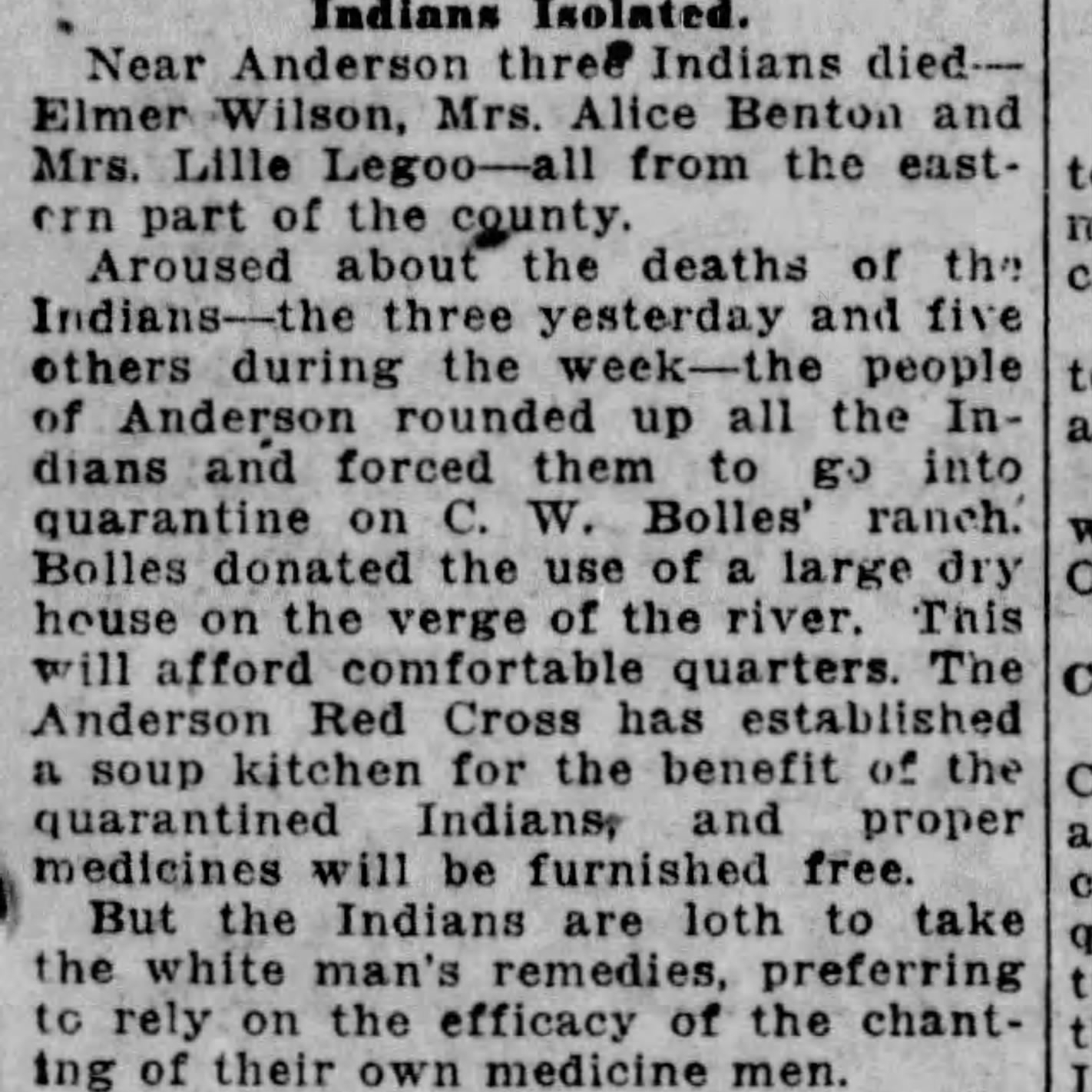
Indian people know all too well the impact of pandemics on human populations, having barely survived smallpox outbreaks and other diseases transmitted during the generations of early contact between themselves and Europeans. Indian people also suffered disproportionately from the last pandemic to hit the United States about a century ago. Some things have changed for the better for Indian people, namely tribal self-governance, but many things are not much better, including the public health situation of many Indian people.
Modern tribal governments navigate a tricky legal and political environment. While tribal governments have power to govern their own citizens, nonmembers are everywhere in Indian country, and the courts are skeptical of tribal authority over nonmembers. For example, after the Navajo Nation announced a 57-hour curfew for the weekend of April 10-13, 2020 (Easter weekend for many), the sheriff’s offices of Cibola and McKinley counties sent letters to the tribe insisting that the tribe refrain from citing nonmembers during the curfew, further insisting that nonmembers are governed more “fully” by the Governor of the State of New Mexico. Further, the fact that it is the county sheriff’s offices – and not counsel for the nonmembers – sending the letters is a deeply consequential signal to the tribal government. Of course, allowing nonmembers freedom to flout the tribe’s curfew defeats the purpose of the curfew. During a pandemic, the limitations on powers of tribal government could lead to tragedy.
This short essay is designed to lay down the argument favoring tribal regulatory powers over nonmembers in Indian country during a pandemic. It should be an easy argument, but federal Indian law makes it more complicated than it should be.
Here are some of the primary source documents noted in the paper:
McKinley County Sheriff Letter
Here are the complaints, each one captioned St. Croix Chippewa Indians v. [name]:
Related post here.
Here are the materials in Leachman v. United States (D. Mont.):
Here:
Questions presented:
1. Whether the Ninth Circuit correctly holds that tribal jurisdiction over nonmembers is established whenever a Montana exception is met, or whether, as the Seventh and Eighth Circuits have held, a court must also determine that the exercise of such jurisdiction stems from the tribe’s inherent authority to set conditions on entry, preserve tribal self-government, or control internal relations.
2. Whether the Ninth Circuit has construed the Montana exceptions to swallow the general rule that tribes lack jurisdiction over nonmembers.
Lower court materials here.
Update:
Here.
 Turtle Talk
You must be logged in to post a comment.