Here are the materials in United States v. Fisher (D. Minn.):
California COA Affirms Immunity of Miami Tribe Business
Here are the materials in In re Internet Lending Cases, AKA Rosas v. AMG Services, Inc.:
Yet Another Suit Arising from 2014 Wakpamni Lake Community Corp. Bond Issuance
Here is the complaint in Bonwick Capital Partners LLC v. U.S. Bank National Association (D.S.D.):
Update — the parties apparently reached settlement:
Federal Court Remands Insurance Dispute Involving Eastern Band Cherokee Gaming Entity to State Court
Here are the materials in Gemini Insurance Company v. Harrah’s NC Casino Company LLC (E.D. N.C.):
Elizabeth Reese on McGirt: “Welcome to the Maze: Race, Justice, and Jurisdiction in McGirt v. Oklahoma”
In the University of Chicago Law Review Online, here. An excerpt from this outstanding essay:
The morning of July 9th, American Indian tribal citizens and non-Indian residents of eastern Oklahoma woke up and experienced a similar shock. The United States Supreme Court, in an opinion authored by Justice Neil Gorsuch, announced that the Muscogee (Creek) Nation’s reservation boundaries had never been disestablished.
The Supreme Court’s 5–4 decision in McGirt v. Oklahoma implies, though does not explicitly hold, that eastern Oklahoma is, was, and always had been within the undiminished boundaries of the Muscogee (Creek), Cherokee, Chickasaw, Choctaw, and Seminole Nation’s reservations. The ruling was shocking and confusing for both groups of American citizens because they were experiencing a bit of what “justice” is like for the other group for the very first time.
That Thursday morning gave American Indian people a glimpse of what it must be like not to be “the Indians.” On that day, American Indians weren’t reduced to a metaphorical Red Sea, always parting to make way for White Americans’ interests. Instead, they were able to win despite those interests and without the indignities that have become the norm in the Supreme Court’s Indian law opinions.
That same morning gave the non-Indians of eastern Oklahoma a glimpse of part of the Indian experience: waking up to helpless confusion about what the United States government has just done to your lands and rights, followed by the even greater problem of trying to understand the confusing jurisdictional rules that have been the status quo in Indian Country for a long time.
At times like this I think that Lady Justice must have a sense of humor.
The Conversation: “Indigenous Mexicans turn inward to survive COVID-19, barricading villages and growing their own food”
Here.
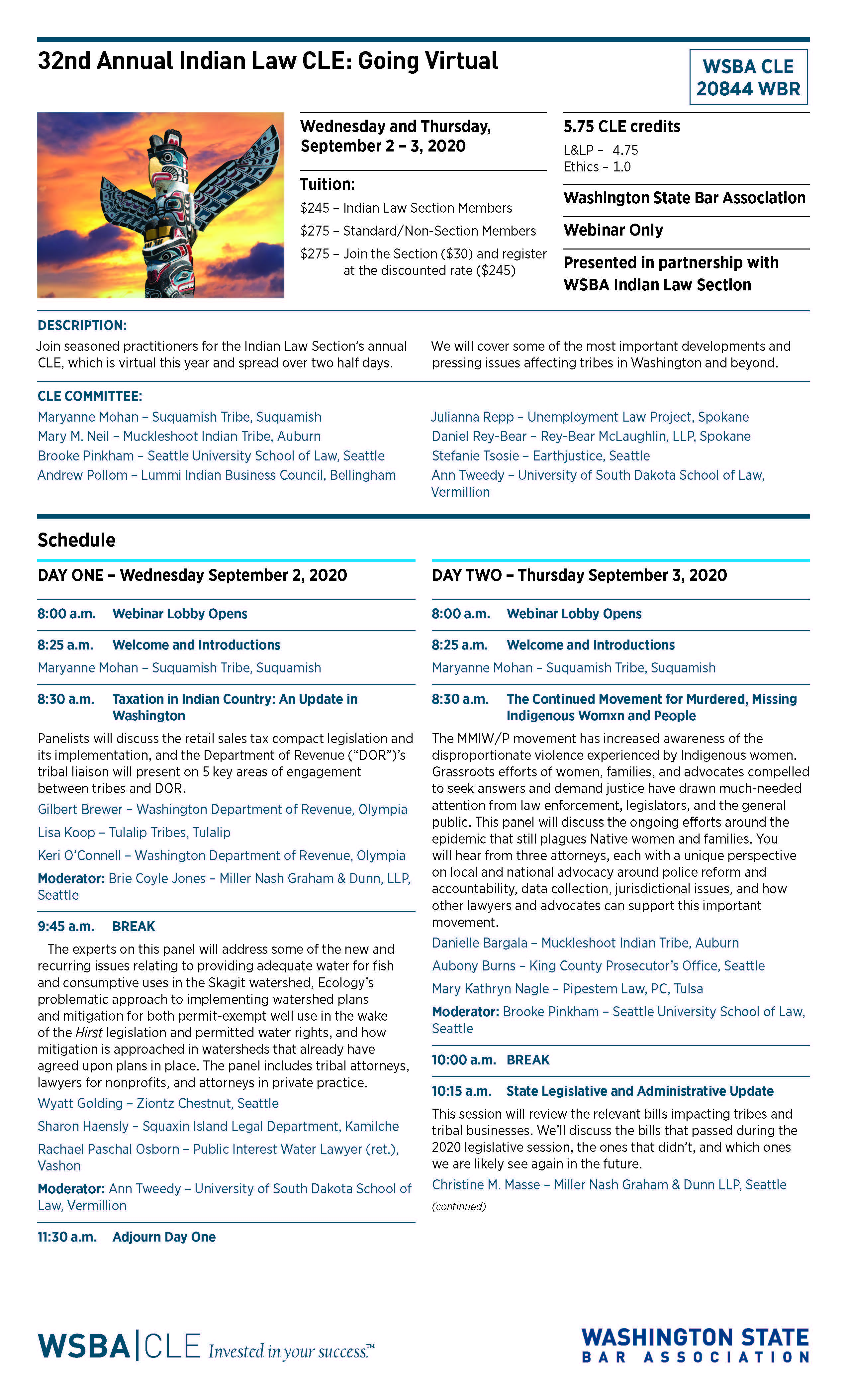
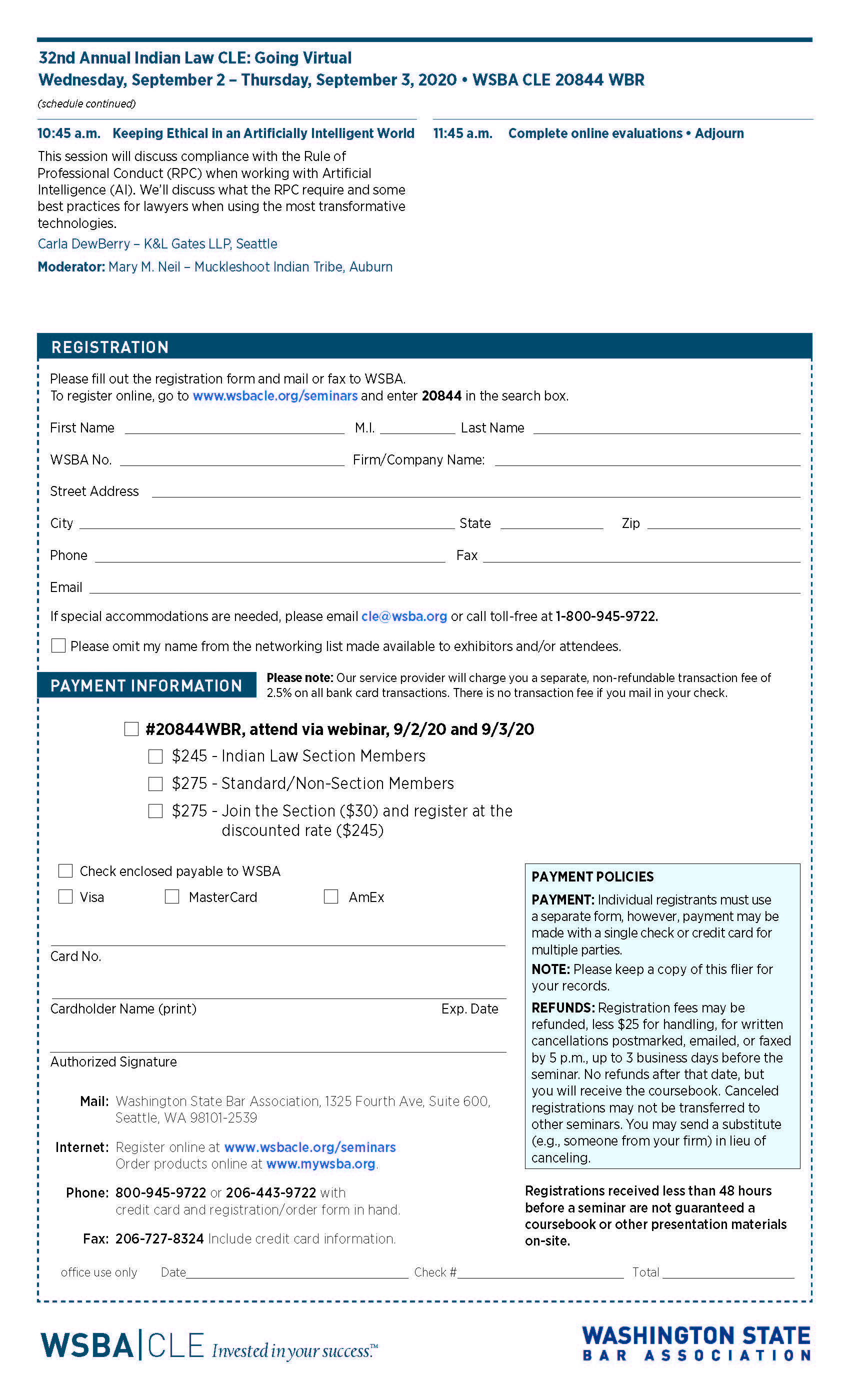
Washington State Bar Indian Law Section — 32nd Annual Indian Law CLE: Going Virtual
Here:
Friday Job Announcements
To post an open Indian law or leadership job to Turtle Talk, send the following information to indigenous@law.msu.edu:
- In the email body, a typed brief description of the position which includes
- position title,
- location (city, state),
- main duties,
- closing date,
- and any other pertinent details such as links to application;
- An attached PDF job announcement.
Shingle Springs Band of Miwok Indians Tribal Court
Chief Judge (part-time), Placerville, CA. Please see the link for a description of the main duties and application process. The position will be open until filled but we hope to have a Chief Judge selected and installed by October 1, 2020.
Saginaw Chippewa Indian Tribe
Senior Associate General Counsel, Isabella County, MI. Responsible for representing the Tribe in all judicial and administrative forums and in the Tribe’s governmental and business relations with all persons, organizations and entities, public and private, as directed by General Counsel. The Senior Associate General Counsel will supervise and coordinate the work of the all Associate General Counsel positions. Please visit the link for more information and to apply.
Native American Rights Fund
Summer 2021 Law Clerks. NARF is currently seeking candidates for its Summer 2021 Clerkships. Each year, NARF conducts a nation-wide search for law students to participate in its Law Clerk Program. Positions are available in all three of NARF’s offices: Anchorage, AK; Boulder, CO; and Washington, D.C. Please indicate your office preference in your cover letter. Application closes September 18, 2020. For more information and how to apply, please see the flyer.
Lummi Nation
Deputy Tribal Prosecutor I, Bellingham, WA.The Deputy Tribal Prosecutor works within the Office of the Reservation Attorney under the direction of the Legal Director, and represents the Lummi Nation in criminal and civil proceedings before tribal, federal, state, and local courts. The Legal Director evaluates the job performance of the Deputy Tribal Prosecutor. Application is open until filled. To obtain application click here or request by e-mail libchr@lummi-nsn.gov.
Earthjustice
Associate Attorney or Senior Associate Attorney, Mid-Pacific regional office, Honolulu, HI. Depending on the successful candidate’s years of experience, this position can either be an Associate Attorney or Senior Associate Attorney level. The term for this position is three years. For more information please see the job description.
Quinault Indian Nation
RFQ. The Quinault Indian Nation in Taholah, Washington is seeking a Chief Judge for the Quinault Tribal Court. Please see the detailed RFQ document for proposal qualifications and requirements. Proposals must be submitted by October 9, 2020. Anticipated start date will be early January, 2021. Proposals and/or questions about the RFQ should be submitted to lbruner@quinault.org.
Alaska Legal Services Corporation
Native Law Staff Attorney, Bethel, AK or Anchorage, AK. This position provides direct representation to Association of Village Council Presidents (“AVCP”) member Tribes. The attorney represents tribal clients in state court Child in Need of Aid proceedings related to the Indian Child Welfare Act (“ICWA”) in collaboration with AVCP advocates, and advocates on behalf of the Tribe for their youth and families. The attorney will have the opportunity to participate in impact litigation, and provide advice and support to tribes on issues related to child welfare. See attached job description, or visit https://www.alsc-law.org/job-opportunities/ for more information. Resume, writing sample, and references should be sent to ppickett@alsc-law.org, referencing “Native Law Staff Attorney” in the subject line. Posting remains open until position filled.
Michigan State University
Associate Director of Diversity, Equity and Inclusion, MSU College of Agriculture and Natural Resources, East Lansing, MI. The position is responsible for implementing, facilitating, and supporting diversity and inclusion training efforts in the ODEI. Will create and implement programming for faculty, staff, and student professional development, and structural and cultural diversity and equity initiatives in the college. Will also advise and support currently enrolled graduate students in CANR and represent graduate student concerns. For more information please visit the link. Application closes August 27, 2020 ET.
Echaga Corporation
CEO, Pine Ridge, SD. Echaga Corporation is a legal corporate entity wholly-owned by the Oglala Sioux Tribe and is the economic and business development arm of the Oglala Sioux Tribe. Echaga is accepting applications for a CEO until the position is filled. Please submit application materials to Jennifer Bear Eagle, Lead In-House Counsel for the Oglala Sioux Tribe, JenniferBE@ostlegal.org.
See posts from August 7, 2020.
Hoopa Valley Tribe Sues Bureau of Reclamation over Water
Here is the complaint in Hoopa Valley Tribe v. United States Bureau of Reclamation (N.D. Cal.):
Enbridge Line 5: Michigan Public Service Commission Litigation
See below for 1) Applicant Enbridge Energy, Limited Partnership’s Limited Objections to the Notice of Intervention of the Attorney General; (2) Applicant Enbridge Energy, Limited Partnership’s Limited Objections to the Petitions to Intervene Filed by The Bay Mills Indian Community, The Grand Traverse Band Of Ottawa And Chippewa Indians, Little Traverse Bay Bands Of Odawa Indians, and Notttawaseppi Huron Band Of The Pottawatomi; (3) Applicant Enbridge Energy, Limited Partnership’s Objections to the Petitions to Intervene Filed by The Michigan Environmental Council, Tip Of The Mitt Watershed Council, The National Wildlife Federation, For Love Of Water, The Environmental Law & Policy Center, And Michigan Climate Action Network and Certificate of Service.
A pre-hearing was scheduled Wednesday August 12, 2020 at 1:00PM. Petitions to intervene from Bay Mills Indian Community, Grand Traverse Band, Little Traverse Bay Bands, and Nottawaseppi Huron Band below. In addition, the Attorney General is now intervening in the proceedings and Enbridge has asked for a rehearing which is also below.
Other Line 5 posts here.
 Turtle Talk
You must be logged in to post a comment.